Emergency turned democracy into constitutional dictatorship: Jaitley
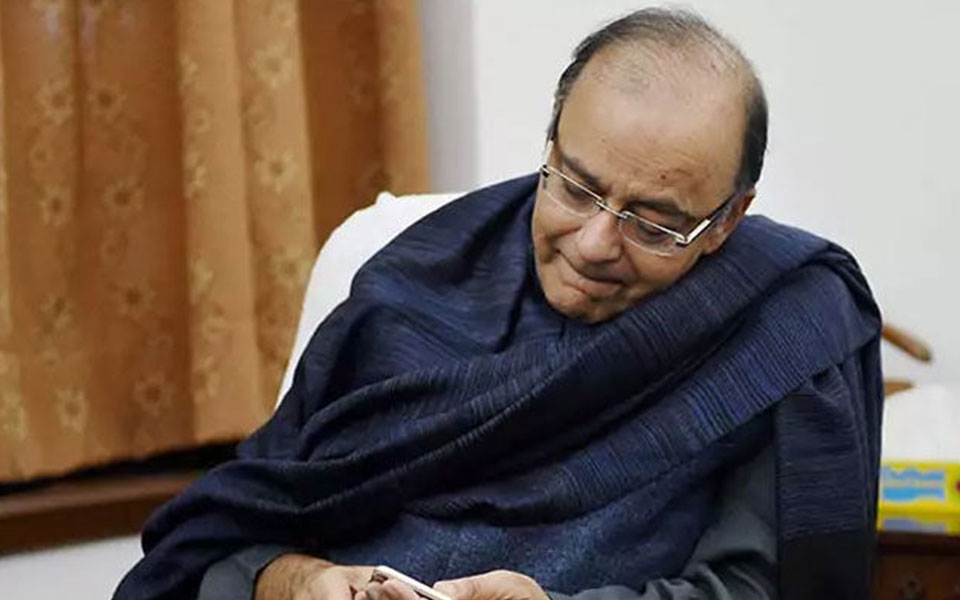
New Delhi, June 24: Union minister Arun Jaitley on Saturday recalled how the Indira Gandhi government had imposed a "phoney Emergency" and "turned democracy into a constitutional dictatorship" about more than 40 years back.
"It was a 'phoney emergency' on account of proclaimed policy that Indira Gandhi was indispensable to India and all contrarian voices had to be crushed," Jaitley wrote in a Facebook post titiled "The Emergency Revisited" - Part-I - the Circumstances Leading to the Imposition of Emergency.
"The constitutional provisions were used to turn democracy into a constitutional dictatorship," he added.
The Emergency was imposed on June 25, 1975 on account of internal disturbances leading to suspension of the fundamental rights.
Noting that on the midnight of June 25/26, a fresh proclamation was got signed by the President on a state of internal emergency, he said that "simultaneously with the proclamation under Article 352 ,another proclamation under Article 359 was issued suspending the fundamental rights under Articles 14, 19, 21 and 22 of the Constitution. Every Indian was now devoid of this fundamental right."
On his own role then, he said he was the first "Satyagrahi" against the Emergency.
"I led a protest of Delhi University Students where we burnt effigy of the Emergency and I delivered a speech against what was happening.
"The police had arrived in large number. I got arrested only to be served a detention order under the Maintenance of Internal Security Act. I was taken to Delhi's Tihar Jail...
"I thus got the privilege for organising the only protest on the morning of June 26, 1975 and became the first Satyagrahi against the Emergency," he said, adding that "little did I realize that at a young age of 22 years, I was participating in events which were going to be a part of history. For me this event changed the future course of my life..."
Terming 1971 and 1972 high points in the political career of Indira Gandhi, he said that she had challenged the senior leaders of her own party and a grand alliance of opposition party to win the 1971 general elections to become "the key centre of political power for the next five years".
However, listing her mistakes, Jaitley said: "She botched up the nationalisation of wheat trade (subsequently reversed) to tackle the unmanageable inflation. It led to greater inflation. This led to social and trade union unrest where large number of man-days were lost."
Noting that while the first oil shock had already had an adverse impact, the US, "due to its tilt towards Pakistan", suspended a lot of aid to India and inflation in 1974 "touched a staggering 20.2 percent and reached 25.2 percent in 1975".
"Labour laws were made more stringent and these led to a near economic collapse. There was large scale unemployment and the unprecedented price rise," he said, adding that investment in the economy had taken a back seat, and then the Foreign Exchange Regulation Act was enacted.
Noting that the government with a huge electoral mandate at the Centre and the states, continued in the same unviable economic directions which she had experimented in the late 1960s, Jaitley said: "The tragedy of Mrs. Indira Gandhi's politics was she preferred the popular slogans over sound and sustainable policies."
Let the Truth be known. If you read VB and like VB, please be a VB Supporter and Help us deliver the Truth to one and all.
AIITA welcomes Karnataka’s ban on obscene songs in school events

Bhatkal: The Karnataka unit of the All India Ideal Teachers Association (AIITA) has welcomed the Karnataka government’s decision to strictly ban school children from dancing to obscene songs during educational and cultural programmes in government, aided, and private schools across the state.
AIITA Karnataka State President M. R. Manvi congratulated the government for taking what he termed an important step to preserve the sanctity of education.
“Such decisions to safeguard the dignity of school children and uphold the values of education are the need of the hour. This rule should not be limited to government schools alone but must be strictly implemented in all private educational institutions as well,” he said.
He further urged the government to address other concerns within school programmes.
“The government should not only prohibit obscene dances in the name of school anniversaries, but also ensure that plays and dialogues that incite religious hatred are avoided. Schools should be centres of harmony, not platforms for spreading hatred,” he added.
According to a recent circular issued by the Department of School Education and Literacy, obscene dances are adversely affecting the mental health and moral values of students.
In this regard, schools have been advised to use songs that promote nationalism, positive thinking, the greatness of Kannada culture, and value-based traditions instead of inappropriate content during programmes.
The circular also emphasises that students should be dressed in decent attire.
AIITA also backed the department’s warning that disciplinary action would be taken against head teachers if such guidelines are violated. The association has further demanded that district Deputy Directors of Public Instruction strictly monitor the implementation of these rules.