Emergency was a mistake, even my grandmother admitted it too: Rahul Gandhi
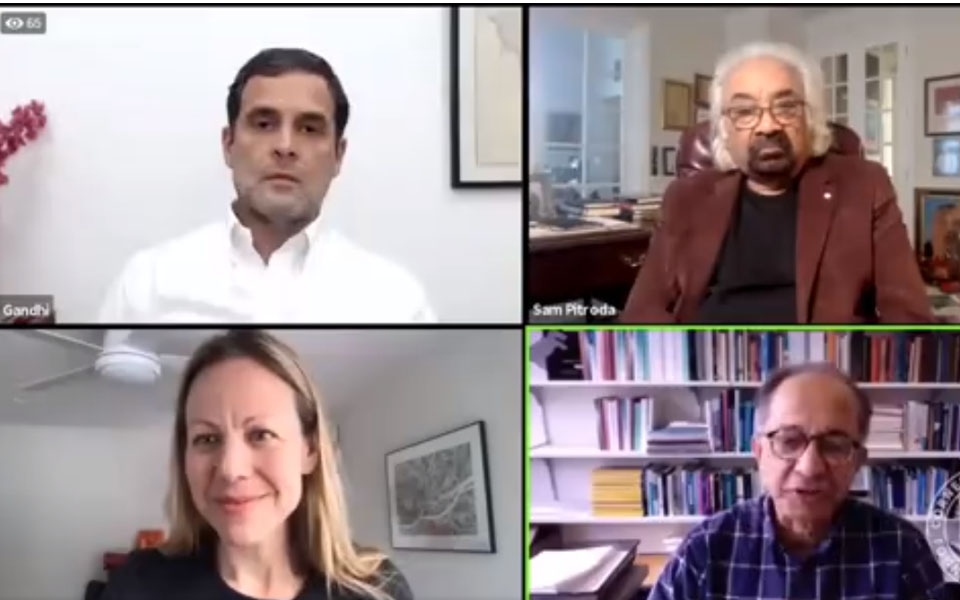
New Delhi, Mar 2: Terming the Emergency that was imposed by former prime minister Indira Gandhi a "mistake", Congress leader Rahul Gandhi on Tuesday said what happened during that period was "wrong", but it was fundamentally different from the current scenario as the Congress at no point attempted to capture the country's institutional framework.
In a conversation with Kaushik Basu, professor in the Cornell University in the US and India's former chief economic advisor, Gandhi said he is all for internal democracy in the Congress, which fought for India's independence, gave the country its Constitution and stood for equality.
Asked about his views on the Emergency, he said, "I think that was a mistake. Absolutely, that was a mistake. And my grandmother (Indira Gandhi) said as much."
Asked about Indira Gandhi announcing elections at the end of the Emergency and Pranab Mukherjee telling Basu later that she did so as she thought she might lose and wanted to put that to test, the former Congress chief said there is a fundamental difference between what happened during the Emergency, which "was wrong", and what is happening in the country now.
"The Congress party at no point attempted to capture India's institutional framework and frankly, the Congress party does not even have that capability. Our design does not allow us that and even if we want, we cannot do it," he said.
Gandhi alleged that the Rashtriya Swayamsevak Sangh (RSS) is doing something "fundamentally different" and filling up the institutions of the country with its people.
"So, even if we defeat the BJP in the election, we are not going to get rid of their people in the institutional structure," he said.
Gandhi recalled a conversation with former Congress chief minister of Madhya Pradesh Kamal Nath before his government was overthrown. Nath told him that senior bureaucrats in his government would not listen to him as they were RSS people and would not do something that they were asked to do.
"So, it is fundamentally different what is going on," he said.
The Emergency was imposed by Indira Gandhi for a 21-month period from 1975 to 1977, when curbs were imposed on the fundamental rights of citizens.
On internal democracy within the Congress, Gandhi said he is the one who pushed for elections in the party at the Youth Congress and NSUI levels, but was criticised and attacked by his own party leaders.
He wondered why nobody raises questions on why there is no internal democracy in the Bharatiya Janata Party (BJP), the Bahujan Samaj Party (BSP) and the Samajwadi Party (SP) and said such questions are asked about the Congress as it is an "ideological party" and has the ideology of the Constitution. "Therefore, it is more important for us to be democratic," he said.
Asked about how he felt about the death of his father, former prime minister Rajiv Gandhi, in May 1991, he said "it made me understand violence".
Gandhi said he saw his father's death coming as he was fighting many forces at the time.
LIVE: My interaction with Prof Kaushik Basu @Cornell University https://t.co/GfErZtSpW2
— Rahul Gandhi (@RahulGandhi) March 2, 2021
Let the Truth be known. If you read VB and like VB, please be a VB Supporter and Help us deliver the Truth to one and all.
Bengaluru airport introduces AI-based system to enhance safety at vehicle-aircraft intersections
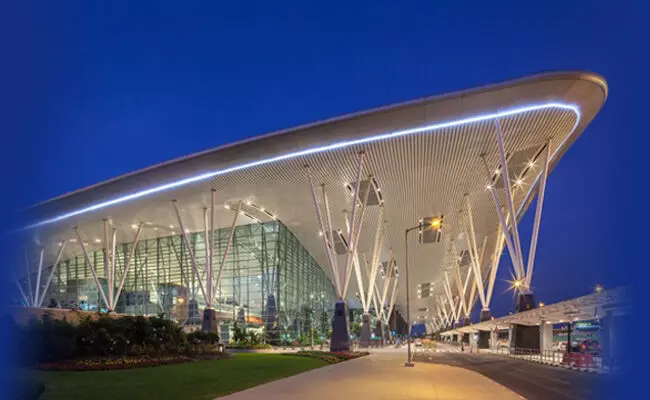
Bengaluru: Bangalore International Airport Limited (BIAL) has introduced an integrated smart airside safety system at Kempegowda International Airport to improve operational safety at key intersection zones.
According to The Hindu, the system has been designed to enhance safety at Cross Service Roads (CSRs), where aircraft and ground vehicle movements intersect.
According to BIAL, the system integrates AI-based computer vision, automation, and centralised monitoring to manage right-of-way movements and reduce the risk of human error.
“CRSs are among the most sensitive areas within airport operations, requiring precise and seamless coordination between aircraft and ground vehicles. Traditionally, right of way protection at these intersections relied on manual or semi-manual inset light activation, creating dependencies on human intervention, increasing the risk of delays and limiting operational visibility,” TH quoted BIAL as saying.
The new system uses real-time detection of vehicle movement, risk assessment, and automated signalling. AI-enabled cameras identify potential conflicts and trigger automated inset light signals to ensure aircraft priority. Normal operations resume once the area is confirmed clear.
“Based on these detections, the system triggers automated inset light activation to protect aircraft right‑of‑way and restores normal signalling once the intersection is confirmed clear. A centralised monitoring and analytics platform digitally logs all events, strengthening governance, compliance, and operational control,” BIAL said.
By embedding technology into operations, the system creates a data-driven separation layer between aircraft and ground vehicles, significantly reducing human error, especially during night and low-visibility conditions.
“Precision-led signal activation improves traffic flow, minimises unnecessary stoppage and enhances turnaround efficiency. It also establishes a scalable foundation for predictive safety analytics, enabling trend analysis, peak-hour optimisation, compliance mapping and risk forecasting to support continuous improvement and stronger airside governance,” BIAL said.