Employment falls first time by 9 million in 6 years: Study

A NEW academic paper — written by Santosh Mehrotra and Jajati K Parida and published by the Centre of Sustainable Employment at the Azim Premji University on Thursday — has formally concluded that the total employment in India declined between 2011-12 and 2017-18.
This is the first time such a decline has been recorded in independent India’s history. While this point has been made by the same authors as well as some others, such as Himanshu of Jawaharlal Nehru University, this is the first formal paper to this effect. According to Mehrotra and Parida, the “total employment during 2011-12 and 2017-18 declined by 9 million. This happened for the first time in India’s history”. Mehrotra is Professor of Economics at Jawaharlal Nehru University while Parida teaches at the Central University of Punjab.
This result is in stark contrast to the recent study by Laveesh Bhandari and Amaresh Dubey, which was commissioned by the Economic Advisory Council to the Prime Minister, that claimed that total employment grew from 433 million in 2011-12 to 457 million in 2017-18.
Mehrotra and Parida, however, claim that employment fell from 474 million in 2011-12 to 465 million in 2017-18. According to Himanshu’s opinion piece in Mint on August 1 — he has not yet written a formal paper on this issue — the total employment fell from 472.5 million in 2011-12 to an even more astounding 457 million — a fall of over 15 million over the six years. In other words, close to 2.6 million jobs were lost every year between 2011-12 and 2017-18.
On the face of it, these stark contrasts — there is a difference of 40 million in the estimates for 2011-12 given by Bhandari and Dubey on the one hand and Mehrotra and Parida and Himanshu on the other — are surprising because the underlying data for all these studies is the same — the National Sample Survey Organisation’s Employment-Unemployment Surveys for 2004-05 and 2011-12, and PLFS 2017-18. In other words, the ratios of employment and unemployment used by all academics are the same, but the absolute numbers differ.
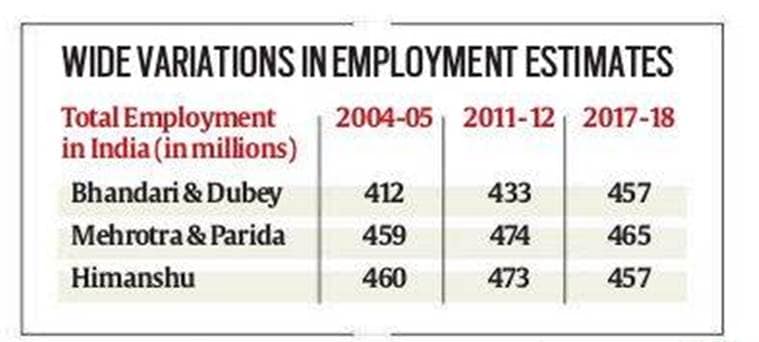
The ratios of employment and unemployment used by all academics are the same, but the absolute numbers differ.
While the academics figure out why they differ — neither side has read the other side’s paper as yet — there are two possible reasons.
One is the choice of the estimate for the total population of the country that is used to arrive at the total employment number. A higher population estimate used would yield a higher employment estimate. Bhandari and Dubey use 1.36 billion as India’s population for 2017-18. Mehrotra and Parida use 1.35 billion and say they do so to arrive at estimates that do not attract criticism for being unnecessarily low. The World Bank’s number for 2017-18 is lower at 1.33 billion. Himanshu, however, uses the number provided in the government’s official GDP data — and this is considerably lower at 1.31 billion.
This confusion about India’s population estimates has arisen because the government has not yet released the population projections based on Census 2011. They should have been released in 2016 as per the past norm.
The second reason for the difference between Bhandari and Dubey’s estimate and the rest is that the former have only used “principal status” of employment while leaving out the “subsidiary status”.
In essence, principal status checks if a person was employed for more than 182 days in the 365 days preceding the survey while subsidiary status checks if a person was employed for at least 30 days in the past year. Choosing only principal status would thus inadequately estimate both employment and unemployment. Since a fair amount of employment in India is seasonal — for example, brick-making doesn’t happen during monsoon and many women tend to work for short periods aligned to the demand in agriculture etc. — the norm is to map both principal and subsidiary status.
Courtesy: indianexpress.com
Let the Truth be known. If you read VB and like VB, please be a VB Supporter and Help us deliver the Truth to one and all.
Indian startup's 'Drishti' satellite launched aboard SpaceX rocket
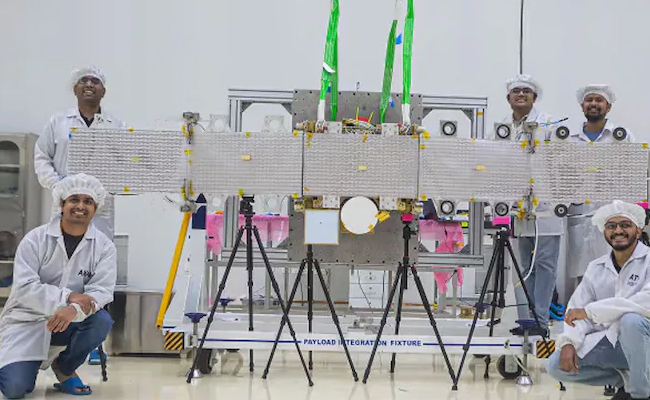
New Delhi (PTI): Bengaluru-based space start-up GalaxEye's Mission Drishti satellite was launched on Sunday aboard SpaceX's Falcon 9 rocket from California.
Mission Drishti is the world's first OptoSAR satellite, integrating electro-optical (EO) and synthetic aperture radar (SAR) sensors into a single operational platform, according to the company.
While EO sensors capture high-resolution images during sunlight and clear skies, SAR sensors provide all-weather and all-time images, using radar pulses.
In a statement, Suyash Singh, founder and CEO of GalaxEye, said, "With the satellite (Mission Drishti) now successfully in orbit, our immediate focus is on completing its commissioning. As we move through this phase, we are already witnessing strong global interest in the differentiated datasets enabled by our OptoSAR payload."
The satellite will help address long-standing limitations of conventional systems and enable more reliable and consistent data acquisition across diverse environmental conditions, the company said.
As a dual-use Earth observation satellite, the mission will support use cases across defence, agriculture, disaster management, maritime monitoring, and infrastructure planning.
The satellite is also expected to complement India's broader initiatives, including the 29 active Earth Observation satellites outlined in ISRO's recent annual report.
The launch came after five years of indigenous research and development, and extensive environmental testing and performance validation of the Mission Drishti.
In a statement, Lt Gen AK Bhatt (Retd), director general of Indian Space Association (ISpA), said, "GalaxEye has achieved what only a few global players have, which is seamlessly combining optical and SAR capabilities on a single platform to enable persistent, all-weather intelligence."
What stands out is not just the technology, but its broader impact on how downstream applications will increasingly define value in the space economy, particularly in Earth observation, where timely, decision-grade insights are critical," he added.
ISpA is the premier industry association of space and satellite companies in the country.
Union Minister Jitendra Singh also took note of the Mission Drishti launch, saying the development marked a significant milestone in India's space journey.
In a post on X, the minister said, "The successful launch of the world's first OptoSAR satellite, and the largest privately-built satellite in the country, reflects the immense potential of our young innovators driving nation-building."
GalaxEye aims to scale up Mission Drishti to a constellation of 10 satellites by 2030, developing a robust and sovereign Earth observation infrastructure for India.