EMPLOYMENT LEVEL COLLAPSED TO A NEW LOW
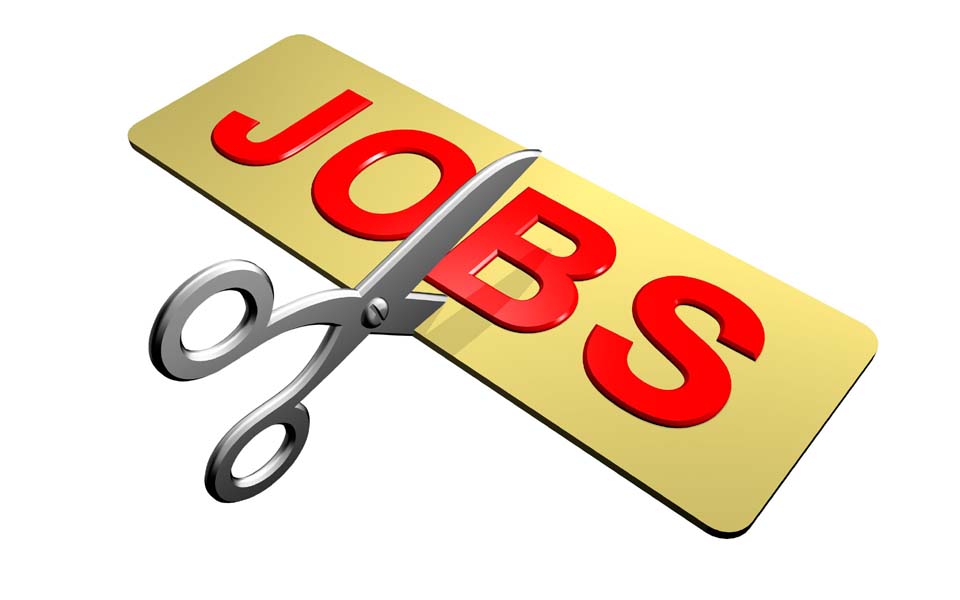
NEW DELHI: The National Family Health Survey (NFHS) has revealed that the number of women employees has been declined dramatically with a decline in employment levels in the past ten years in India.
Though women are employed in high numbers in some professional, technical, administrative and managerial positions than men, the overall decline in employment levels of women has been consistent with the survey.
The rate of women's employment which was 36% in the year 2005-06, has been reduced to 24% in 2015-16.The male workforce also saw a decrease of 10 percent over a decade. Interestingly, around 70% of women and 19% of men have felt that they did not find a job in the 12 months before the survey.
However, employment is rising in agricultural and manufacturing fields. About 48% of women and 32% of men have been employed in the agriculture field, whereas 21% of men and 32% of women have got a job in the manufacturing sector. In professional, technical, administrative and managerial careers and 10 and 8 percent of men and women respectively are employed.
Let the Truth be known. If you read VB and like VB, please be a VB Supporter and Help us deliver the Truth to one and all.
Jaishankar holds talks with Russia's Lavrov; trade, geopolitics top agenda
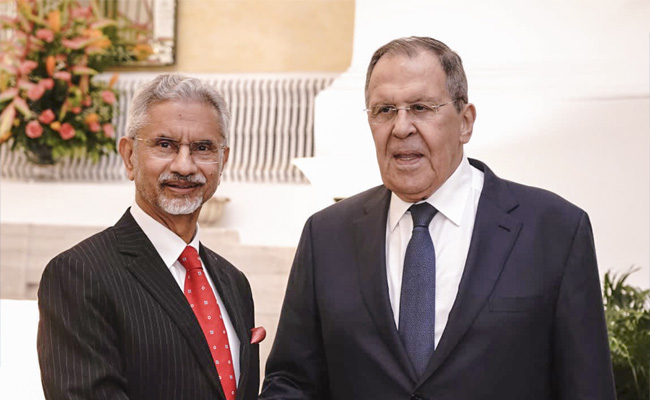
New Delhi (PTI): External Affairs Minister S Jaishankar and Russian Foreign Minister Sergey Lavrov held "productive" talks on Wednesday to advance bilateral cooperation in energy and trade amid shifting geopolitical tensions.
Jaishankar met Lavrov, shortly after the Russian foreign minister landed in New Delhi to attend a two-day conclave of the BRICS member states beginning Thursday.
Iranian Foreign Minister Abbas Araghchi, Brazil's Foreign Minister Mauro Vieira and South Africa's Minister for International Relations Ozzy Lamola are among those who already arrived in the national capital for the BRICS foreign ministerial meeting.
Jaishankar and Lavrov are learnt to have deliberated on the West Asia crisis as well as the Ukraine conflict.
In a social media post, the external affairs minister described his talks with his Russian counterpart as "productive exchange of views".
"Our conversation touched upon several aspects of the India-Russia Special and Privileged Strategic Partnership, including trade and investment, energy and connectivity, science and technology, as well as facilitating mobility of skills and talent," he said.
"Other global and multilateral issues of mutual interest were also discussed," he said.
It is not immediately known if India's procurement of Russian crude oil figured in the talks.
In his televised opening remarks at the meeting, Jaishankar said India and Russia have a shared interest in strengthening multipolarity and could benefit through greater "de-risking" .
"The last few years have seen a steady and sustained growth in our bilateral partnership. Its economic and energy dimensions have become pronounced. Our political cooperation is even more valuable in an uncertain and volatile global environment," Jaishankar said.
"We have expanded our collaboration in science and technology. The mobility of talents and skills has acquired greater salience and our interest in ensuring better connectivity is deeper," he said.
"The complicated international situation also merits an open exchange of views, especially between two trusted partners," he said.
The external affairs minister said India and Russia have a shared interest in strengthening multipolarity.
Jaishankar also held separate bilateral talks with Brazilian Foreign Minister Vieira South Africa's Ozzy Lamola.
The external affairs minister also met Maldivian Foreign Minister Iruthisham Adam.
"Underlined our Neighbourhood First policy and reviewed our bilateral cooperation. Reiterated India's commitment to Maldives' progress and development," he said on X.
India, as the chair of the BRICS, is hosting the conclave of the foreign ministers ahead of the annual summit of the grouping in September.
BRICS, originally comprising Brazil, Russia, India, China, and South Africa, expanded in 2024 to include Egypt, Ethiopia, Iran, and the United Arab Emirates, with Indonesia joining in 2025.
It has emerged as an influential grouping as it brings together 11 major emerging economies of the world, representing around 49.5 per cent of the global population, around 40 per cent of the global GDP and around 26 per cent of the global trade.
The BRICS meeting will be chaired by Jaishankar.