EPCA declares public health emergency in Delhi-NCR
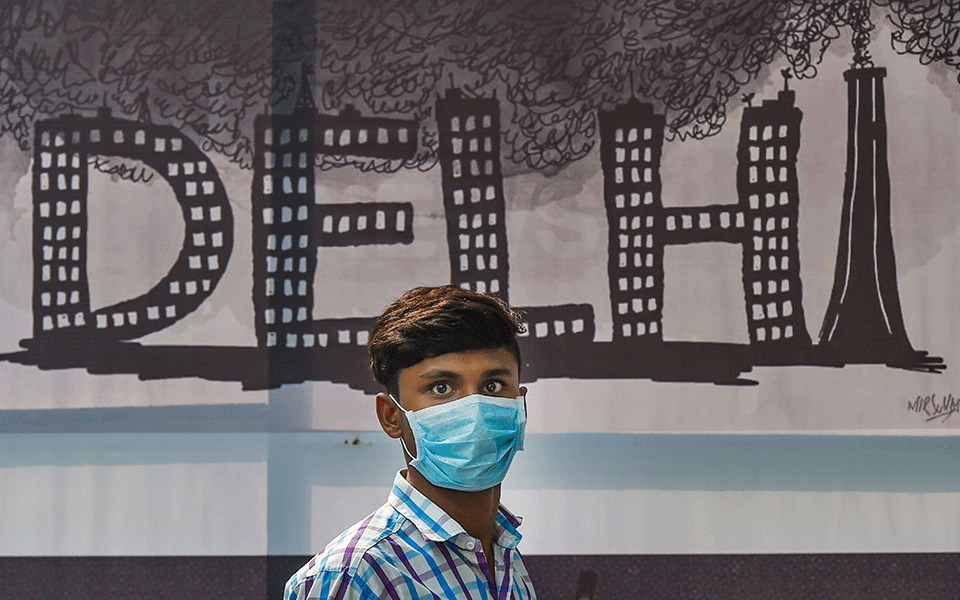
New Delhi: A Supreme Court mandated panel on Friday declared a public health emergency in the Delhi-NCR region and banned construction activity till November 5.
As the pollution levels in the region entered the "severe plus" category", the Environment Pollution (Prevention and Control) Authority also banned the bursting of crackers during the winter season.
In a letter to chief secretaries of Delhi, Haryana, Rajasthan and Uttar Pradesh, EPCA Chairman Bhure Lal said, "The air quality in Delhi and NCR deteriorated further last night and is now at the severe plus level. We have to take this as a public heath emergency as it will have adverse health impacts on all, particularly our children."
Under these circumstances, he said, construction activities, hot mix plants and stone crushers in Delhi, Faridabad, Gurugram, Ghaziabad, Noida and Greater Noida will remain closed till morning of November 5.
The blanket of haze over Delhi thickened on Friday morning with the national capital's pollution levels increasing overnight.
According to official data, the overall Air Quality Index (AQI) on Friday was 582 at 12.30 am for Delhi-NCR. It had shot up to 504 at 3.30 am.
An AQI between 0-50 is considered 'good', 51-100 'satisfactory', 101-200 'moderate', 201-300 'poor', 301-400 'very poor' and 401-500 'severe'. Above 500 falls in the 'severe-plus emergency' category.
Earlier, the EPCA had banned construction activities only for the period between 6 pm and 10 am till November 2. Now, no construction can take place even in daytime.
EPCA directed that all coal and other fuel-based industries, which have not shifted to natural gas or agro-residue, will remain shut in Faridabad, Gurugram, Ghaziabad, Noida, Bahadurgarh, Bhiwadi, Greater Noida, Sonepat, Panipat till the morning of November 5.
In Delhi, industries, which have not yet shifted to piped natural gas, will not operate during the period, it said.
"Cracker burning is completely banned for the entire winter period. We note that there are festivals coming and given the experience of Diwali, when in spite of all efforts, cracker burning was extremely high and led to accumulation of toxins in the air, this measure is needed," Bhure Lal said.
He also said that it is imperative that implementing agencies take urgent steps to stop local sources of pollution, as this will only add to the already polluted air.
"This requires stringent vigilance and punitive action against all cases of local pollution, from plastic and garbage burning to dust pollution. I am also constrained to say that in spite of all our efforts, there are still many instances of local pollution and therefore, enforcement needs to be stepped up further," he said.
Let the Truth be known. If you read VB and like VB, please be a VB Supporter and Help us deliver the Truth to one and all.
Indian startup's 'Drishti' satellite launched aboard SpaceX rocket
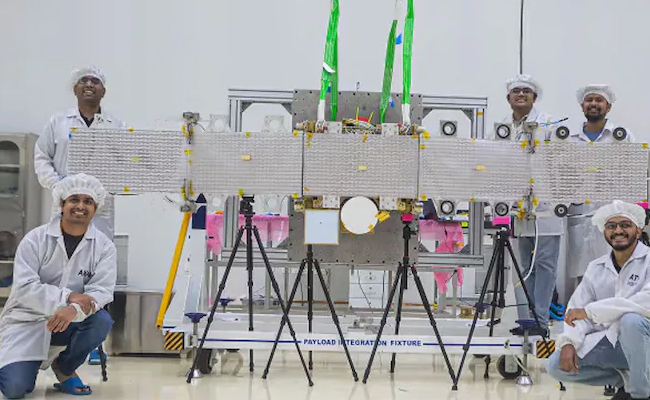
New Delhi (PTI): Bengaluru-based space start-up GalaxEye's Mission Drishti satellite was launched on Sunday aboard SpaceX's Falcon 9 rocket from California.
Mission Drishti is the world's first OptoSAR satellite, integrating electro-optical (EO) and synthetic aperture radar (SAR) sensors into a single operational platform, according to the company.
While EO sensors capture high-resolution images during sunlight and clear skies, SAR sensors provide all-weather and all-time images, using radar pulses.
In a statement, Suyash Singh, founder and CEO of GalaxEye, said, "With the satellite (Mission Drishti) now successfully in orbit, our immediate focus is on completing its commissioning. As we move through this phase, we are already witnessing strong global interest in the differentiated datasets enabled by our OptoSAR payload."
The satellite will help address long-standing limitations of conventional systems and enable more reliable and consistent data acquisition across diverse environmental conditions, the company said.
As a dual-use Earth observation satellite, the mission will support use cases across defence, agriculture, disaster management, maritime monitoring, and infrastructure planning.
The satellite is also expected to complement India's broader initiatives, including the 29 active Earth Observation satellites outlined in ISRO's recent annual report.
The launch came after five years of indigenous research and development, and extensive environmental testing and performance validation of the Mission Drishti.
In a statement, Lt Gen AK Bhatt (Retd), director general of Indian Space Association (ISpA), said, "GalaxEye has achieved what only a few global players have, which is seamlessly combining optical and SAR capabilities on a single platform to enable persistent, all-weather intelligence."
What stands out is not just the technology, but its broader impact on how downstream applications will increasingly define value in the space economy, particularly in Earth observation, where timely, decision-grade insights are critical," he added.
ISpA is the premier industry association of space and satellite companies in the country.
Union Minister Jitendra Singh also took note of the Mission Drishti launch, saying the development marked a significant milestone in India's space journey.
In a post on X, the minister said, "The successful launch of the world's first OptoSAR satellite, and the largest privately-built satellite in the country, reflects the immense potential of our young innovators driving nation-building."
GalaxEye aims to scale up Mission Drishti to a constellation of 10 satellites by 2030, developing a robust and sovereign Earth observation infrastructure for India.