Error of judgement, says team probing police delay in Alwar lynching case
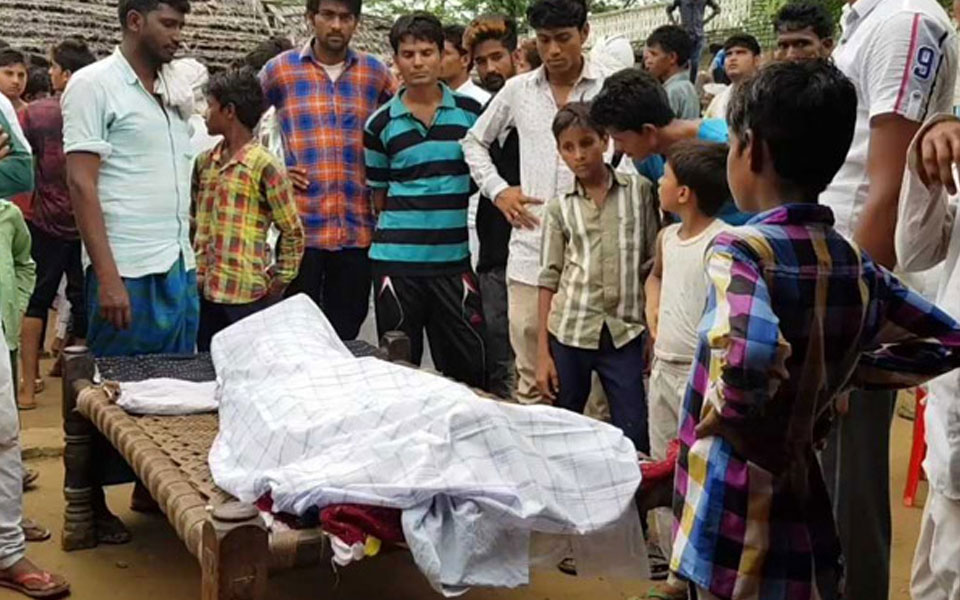
Jaipur, July 24 : A high level team, set up by the Rajasthan Police on Monday, to probe why policemen took three hours to reach a hospital only four kilometres away with a badly injured man accused of smuggling cows, admitted local personnel made an "error of judgement".
An Assistant Sub-Inspector was suspended for the undue delay and action taken against four constables.
The high level police team formed on Monday morning on directions of state Director General of Police O.P. Galhotra visited the location where Rakbar alias Akbar was brutally bashed by a mob in Alwar on Saturday night.
The team met his relatives, spoke to local residents and policemen to thoroughly investigate the matter.
Special Director General N.R.K. Reddy said police reached the location of the incident on time but failed to gauge the extent of injuries sustained by the victim. He also added that police first took the cows to a "gaushala" (cow shelter) and then took the victim to hospital where he was declared brought dead. "Rakbar alias Akbar died due to serious internal injuries and further investigations are on in the case," he said.
The panel was to also investigate whether the policemen callously stopped on the way to the hospital to have tea while Rakbar lay bleeding in their vehicle and was eventually declared dead.
Galhotra had said the team will find out why so much time was wasted in transporting Rakbar after he was beaten up in Alwar district on Saturday.
The team also includes senior officers P.K. Singh, Hemant Priyadarshi and Mahendra Singh Chaudhary.
Later on Monday, police sources said ASI Mohan Singh had been suspended for negligence and delay, while action has also been taken against four constables.
The policemen apparently reached the site of the attack at 1 a.m. but the victim reached the hospital only at 4 a.m., said a police official.
It has been alleged that the policemen stopped on the way to have tea.
Naval Sharma, the Vishwa Hindu Parishad's Gau Raksha cell chief in Ramgarh, quoted the FIR to say that the police reached the site at 12.41 a.m. and the victim was taken by them by 1 a.m.
However, surprisingly, police reached the hospital at 4 am. The post-mortem report says the victim died at 3.40 a.m.
A social worker in the region, Vijay Kumar, told IANS that Akbar and Aslam were taking bovines from the fields at midnight. When the animals cried out, some villagers came out and thrashed Akbar.
As it was raining heavily, Akbar fell on the muddy field and his companion Aslam escaped. By then, police reached the spot after being alerted about the attack.
However, as the victim was covered in mud, the police refused to take him in their vehicle and asked the villagers to clean him. The villagers poured water on him. Dharmendra, who was later taken as an accused by the police, brought clothes from his house.
Vijay Kumar says the policemen were drunk and they too might have beaten him as the victim had earlier records of cow smuggling. According to him, when Akbar died, police came to the village to arrest the witnesses to save their skin.
The cows, meanwhile, were shifted to a 'gaushala' at 3.26 a.m. in a three-wheeler -- just before the man died.
Alwar Superintendent of Police Rajendra Singh told the media: "We will investigate the matter thoroughly and take action against the accused."
Let the Truth be known. If you read VB and like VB, please be a VB Supporter and Help us deliver the Truth to one and all.
4 workers die after being buried under coal slurry in Jharkhand's Dhanbad
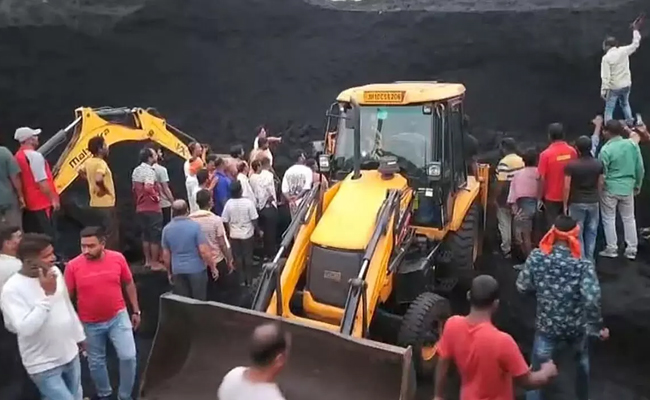
Dhanbad (Jharkhand) (PTI): At least four workers died after being buried under coal slurry in Jharkhand's Dhanbad district on Saturday, a police official said.
The incident took place at Moonidih coal washery in the command area of Bharat Coking Coal Limited (BCCL).
"Bodies of all four workers were dug out of debris during a rescue operation," Putki police station in-charge Waqar Hussain told PTI.
The incident took place when coal slurry was being loaded into trucks by workers, during which a large chunk of slurry fell and trapped several workers underneath, officials said.
The deceased have been identified as Manik Bauri, Dinesh Bauri, Deepak Bauri, and Hemlal Gope.
Meanwhile, the family members of the deceased and local villagers placed the bodies in front of the washery gate and began a protest.
They demanded compensation, jobs for dependents and action against those responsible for the incident.
Police and administration officials are trying to pacify the protesters, an official said.