Essential to make process of litigation citizen centric, technology must be augmented: CJI
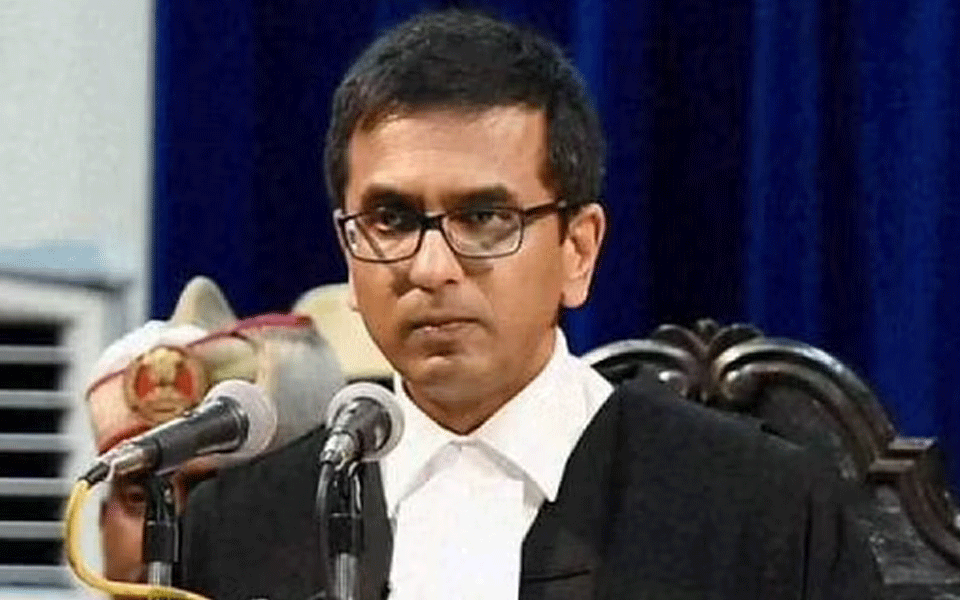
New Delhi(PTI): Chief Justice of India D Y Chandrachud on Saturday said technology must be augmented with institutional reforms to resolve issues of access to justice, and it is essential to simplify the litigation process and make it "citizen centric".
He also said the judiciary has been adopting technology to improve the working of courts and it is of "supreme importance" that courts are remodelled to reach out to citizens instead of them reaching out to courts in their quest for justice.
Speaking at the Constitution Day celebrations at the Supreme Court, the Chief Justice of India (CJI) said judges across the country must reflect upon the constitutional vision of securing justice, equality and liberty.
He said it is important that representation of marginalised communities and women in the legal profession and judiciary is increased.
Justice Chandrachud also spoke about the e-initiatives -- virtual justice clock, justIS mobile app 2.0, digital court and s3WaaS websites of district courts -- that were launched by Prime Minister Narendra Modi during the function.
In a nation as large and diverse as India, the "paramount challenge" the judiciary faces as an institution is to ensure that the justice delivery system is accessible to everyone, he said.
"We have been adopting technology to improve the working of courts. It is of supreme importance and necessity that courts are remodelled to reach out to people instead of people reaching out to courts in their quest for justice," the CJI said.
"To ensure that courts reach out to people, it is essential that the process of litigation is simplified and made citizen centric," he said.
Justice Chandrachud said though the judiciary's engagement with technology gained prevalence during the COVID-19 pandemic, "we must not dismantle the infrastructure but built upon it".
"I will earnestly request the chief justices of high courts to ensure that the technological infrastructure, on which public funds have been spent, is not dismantled but strengthened further," he said.
Justice Chandrachud said as the CJI, he is attempting to adopt technology based services in listing of cases and court hearings "so that institutional flaws such as delays in listing and hearing can be removed from our vocabulary".
"While technology has ably aided us in ensuring functionality of the judiciary during the pandemic, technology must be augmented with institutional reforms to resolve the chief issue of access to justice," he said.
The CJI said the first interface of people with the judicial system is the district judiciary and it is of paramount importance that it is strengthened and supported. "The district judiciary must be lifted from the mindset of being a subordinate judiciary," he said.
Giving details of the e-initiatives launched by the prime minister, Justice Chandrachud said these initiatives reflect upon the commitment of judiciary towards providing access to justice.
"Our endeavour is to enhance access to justice. This must not be understood in narrow terms of enriching the experience of those who are already in possession of access but by reaching out to those groups and communities, that are denied basic rights," he said.
The CJI said the Supreme Court now functions in a hybrid mode which enables lawyers and parties in person to appear from different parts of the country.
"Though the Supreme Court is located on Tilak Marg, the Supreme Court is a Supreme Court for the entire nation," he said. He said the colonial and pre-colonial courts followed an approach of reluctance, disinclination and inaction in protecting the rights of citizens.
"All judges across courts in India, ranging from district courts to the Supreme Court must reflect upon the constitutional vision of securing justice, equality and liberty," he said.
"There is a need for us to introspect on our actions and decisions and to question our own prejudices and preconceptions. For, until we open our minds to multiple views of persons with varied lived experiences, we would be lacking in our roles as judges," the CJI said.
He said an institution thrives with time only when it functions democratically and he believes that as the CJI, it is his responsibility to collaborate and consult judges at the apex court, judges of high courts, members of the district judiciary and stakeholders of the institution.
"It is crucial that we tap the experience of the diverse sections of people who are part of the judiciary," he said, adding, "That is why it is all the more important that the representation of marginalised communities and women in the legal profession and judiciary is enhanced."
On the e-initiatives, the CJI said the virtual justice clock is a platform where information available through the National Judicial Data Grid is made available to the public.
The justIS mobile app 2.0 is developed for judges of district courts and it is provided to judicial officers to monitor pendency and disposal of his or her court at the handset 24X7, he said.
Justice Chandrachud said digital court is a green initiative of the Indian judiciary to make courts paperless or digital. He said through the digital court and s3WaaS initiatives, the websites of district courts are being upgraded to a platform which is secure, scalable and accessible.
"I can assure everyone that the initiatives launched today are a part of a larger technological and institutional advancement of the Indian judiciary to ensure that even the most disadvantaged communities in the country do not stumble while reaching out to justice," he said.
The CJI appealed to youngsters to reflect on social realities of India and work towards achieving fraternity by dedicating themselves to the cause of justice in whatever way possible.
"Sometimes change happens by small acts of kindness. The heart and the soul of law, as it is administered in our courts, is our sense of compassion to our citizens," he said.
Let the Truth be known. If you read VB and like VB, please be a VB Supporter and Help us deliver the Truth to one and all.
Two injuries, one DNF, a DQ as India end messy World Relays campaign

Gaborone (Botswana) (PTI): Amoj Jacob and Ragul Kumar got injured during the men's 4x400m and 4x100 races respectively as India ended their World Athletics Relays campaign in disappointment on the second day of competitions here on Sunday.
The Indian camp had high hopes of making the 2027 World Championships in the men's 4x400m relay but the team did not finish (DNF) the race as Jacob suffered cramps and pulled out of the race after taking the baton from the first leg runner Dharamveer Choudhary. Rajesh Ramesh and Vishal TK were to run in the third and fourth legs.
Those teams which could not qualify for the 2027 Beijing World Championships by reaching the final round of each of the six relay events on Saturday were given another chance in the second qualification round on Sunday.
The top two teams in each of the two heats (in all six relay events) booked the Beijing ticket on Sunday.
India will now have to try and qualify for the World Championships through the Top Lists of the World Athletics, which is a long and tedious process.
In the men's 4x100m race, third leg runner Ragul Kumar fell down the track after failing to hand over the baton inside the exchange zone to fourth leg runner Gurindervir Singh, which clearly showed the lack of coordination among the runners.
Harsh Santosh Raut and Animesh Kujur ran the first two legs.
The Indian quartet was disqualified and Kumar was seen being taken away from the Field of Play with the help of the volunteers.
It was a comedy of errors in the case of the women's 4x100m race, which saw the baton being dropped during an exchange between first leg runner Tamanna and second runner Nithya Gandhe, though the Indians finished the race in 53.09 seconds.
Gandhe started running quite a distance, but after realising that the baton was not in her hand, she turned and ran back to pick it up.
The only silver-lining for the Indian contingent was the national record time in the mixed 4x100m relay race, though the quartet of Ragul Kumar, Nithya Gandhe, Animesh Kujur and Sneha SS finished sixth in heat number two with a time of 41.35 seconds, bettering the previous national mark of 42.30 seconds set in March in Chandigarh.
The mixed 4x400m relay quartet of Theerthesh P Shetty, Kumari Saloni, Nihal William and Rashdeep Kaur ended at fifth in heat number one with a time of 3 minutes and 19.40 seconds.
On Saturday, all the five Indian relay teams had failed to make it to the respective final rounds and thus missed out on the 2027 World Championships berths.