EVM is chor machine: Farooq Abdullah
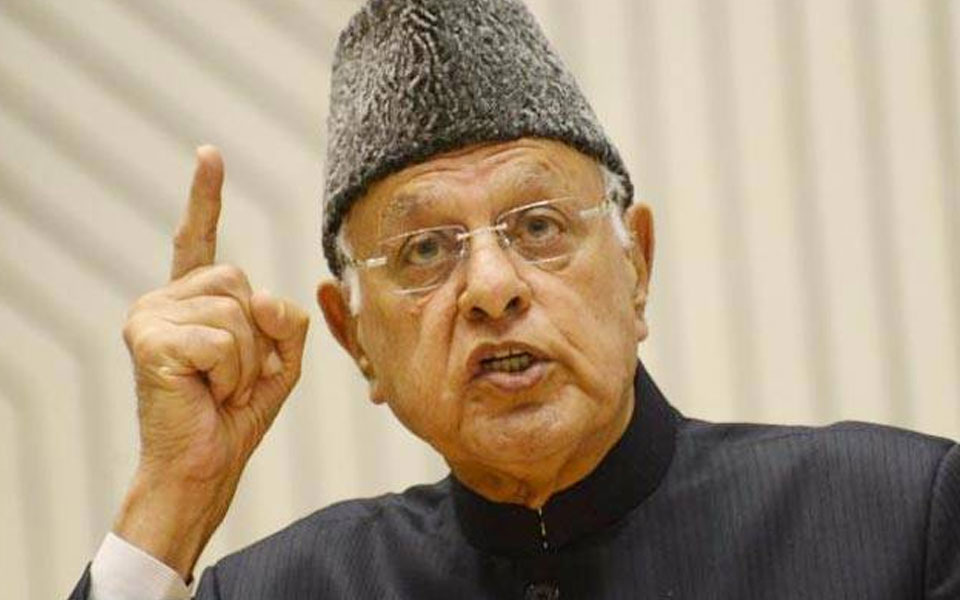
Kolkata, Jan 19 : National Conference leader Farooq Abdullah Saturday called the EVM the "chor machine" and demanded that the ballot paper system be brought back for the sake of transparency.
Speaking at the united opposition rally organised by TMC supremo Mamata Banerjee, he said, "It is not the question of ousting any single person (Prime Minister Narendra Modi) but of saving the country and honouring the sacrifices of those who fought for its freedom."
"The EVM is chor machine. Honestly speaking, it is so. Its use must be put to an end. Nowhere in the world is the machine used. The opposition parties should approach the Election Commission and the President of India to stop the use of the EVM and bring back the old ballot papers for the sake of transparency," he said.
He blamed the BJP for the situation in Jammu and Kashmir and said people are being divided on religious lines. "People are being branded as Pakistanis. But all people right from Ladakh to elsewhere want to continue in India.
"I am a Muslim and I love India, my country," he said.
Continuing his tirade against the BJP, he said it stood for the Triple Talaq Bill in Parliament but did not pass the Women's Reservation Bill.
Urging for a united fight by opposition parties in the coming Lok Sabha election, he said the prime minister can be decided after the poll results.
"We have to fight and oust BJP. We have to come together to put up a one-to-one fight against it. We should fight together to strengthen our country," he said and hoped the new government will take the country forward.
Let the Truth be known. If you read VB and like VB, please be a VB Supporter and Help us deliver the Truth to one and all.
Rickelton's ton in vain as SRH beat MI by 6 wickets
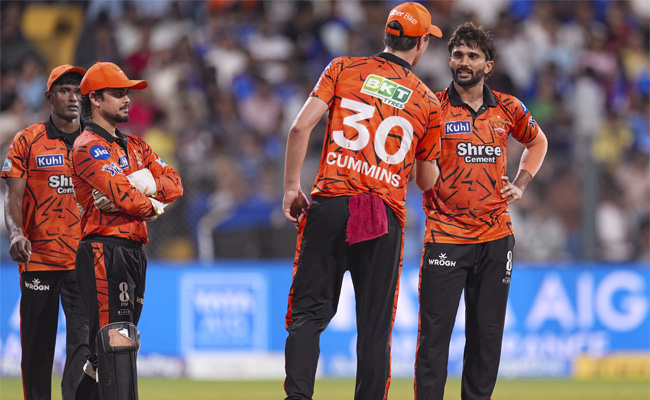
Mumbai (PTI): Ryan Rickelton's whirlwind unbeaten ton was overshadowed by Heinrich Klaasen's unbeaten 65 as Sunrisers Hyderabad defeated Mumbai Indians by six wickets in an IPL match here on Wednesday.
Chasing an imposing 244-run target, Travis Head (76 off 30) and Abhishek Sharma (45 off 24) shared 129 runs for the opening wicket to set the platform for SRH.
Klaasen (65 not out off 30 balls) then displayed his all-round hitting abilities to guide SRH home with the help of Nitish Kumar Reddy (21) and Salil Arora (30 not out off 10) in 18.4 overs.
Earlier, Rickelton's knock powered MI to 243 for five.
MI rode on a 93-run stand between Rickelton (123 not out off 55 balls) and Will Jacks (46 off 22) in 7.1 overs for the opening stand to power the side.
MI skipper Hardik Pandya scored a valuable 31 off 15 balls before being dismissed.
Praful Hinge (2/54), Eshan Malinga (1/29), Sakib Hasan (1/39) and Nitish Kumar Reddy (1/31) were the wicket-takers for SRH.
Brief Scores:
Mumbai Indian: 243 for 5 in 20 overs (Ryan Rickelton 123 not out; Praful Hinge 2/54).
Sunrisers Hyderabad: 249 for 4 in 18.4 overs (Travis Head 76, Heinrich Klaasen 65 not out; AM Ghazanfar 2/51).