Ex-bus conductor, nonagenarian musician among 45 awarded Padma Shri in ‘unsung heroes’ category

New Delhi (PTI): A former bus conductor who set up the world's largest free-access library, a paediatrician who formed Asia's first human milk bank, and a 90-year old rare musical instrument player were among 45 individuals from across India chosen for the Padma Shri award in the ‘unsung heroes’ category on the occasion of Republic Day, sources said on Sunday.
Anke Gowda, once a bus conductor, set up the world's largest free-access library, ‘Pustak Mane’, comprising more than two million books in 20 languages along with rare manuscripts.
The 75-year-old bibliophile from Haralahalli village near Mysuru in Karnataka has been chosen for the Padma Shri for his unique effort to empower learners across India.
Joining him will be Armida Fernandes, the Mumbai-based paediatrician who set up Asia'a first human milk bank, improving the survival prospects of infants, Bundeli war art trainer Bhagwandas Raikwar from Madhya Pradesh, Bhiklya Ladakya Dhinda, a 90-year old tribal Tarpa player – a musical instrument made of bottle gourd and bamboo – from Maharashtra, and distinguished social worker from Jammu and Kashmir, Brij Lal Bhat, among others.
Continuing with the principle of celebrating ordinary Indians making extraordinary contributions, this year’s Padma awards recognise a wide spectrum of unsung heroes from across the length and breadth of India, the sources said.
From preserving indigenous heritage and promoting national integration in the border states to promoting tribal languages and indigenous martial arts, dying arts and weaves to safeguarding the nation’s ecological wealth and championing ‘swachta’ – this set of awardees truly epitomises everyday Indians silently going about their everyday lives, in service of the country, they said.
The list also includes Budri Thati, who set up schools in the Naxal-affected areas of Chhattisgarh; Charan Hembram, a Santhali author-composer from Odisha; Chiranji Lal Yadav from Moradabad, an expert in intricate brass engraving work; Dharmiklal Chunilal Pandya, an exponent of ‘Maanbhatt’, a traditional Gujarati performing art form; and Hyderabad geneticist Kumarasamy Thangharaj, who traced human migration from Africa to India.
Each has overcome tremendous personal hardships and tragedies to not just excel in their chosen fields, but go further on to serve society at large, the sources said.
These include individuals from marginalised and Dalit communities, primitive tribes and those from remote and difficult terrains, they said.
These are people who have dedicated their entire lifetimes in service of the disabled, women, children, Dalits and tribals – working to promote healthcare, education, livelihood, sanitation, sustainability, etc.
Puducherry’s K Pajanivel has been awarded the Padma Shri for nurturing Silambam, an ancient Tamil weapon-based martial art, while senior journalist Kailash Chandra Pant, who has been working for over 60 years to propagate Hindi across India, has been awarded in the literature and education category.
Khem Raj Sundriyal from Haryana has been chosen for preserving and teaching the tapestry and Jamdani weaving technique to thousands of artisans from Haryana and Himachal Pradesh.
Sundriyal also revived the Panipat ‘khes’ with new designs and introduced polyester yarn in handlooms.
Let the Truth be known. If you read VB and like VB, please be a VB Supporter and Help us deliver the Truth to one and all.
Hemant Karkare dying at hands of Kasab ‘Karmic Justice’: Shefali Vaidya on Col. Purohit’s promotion
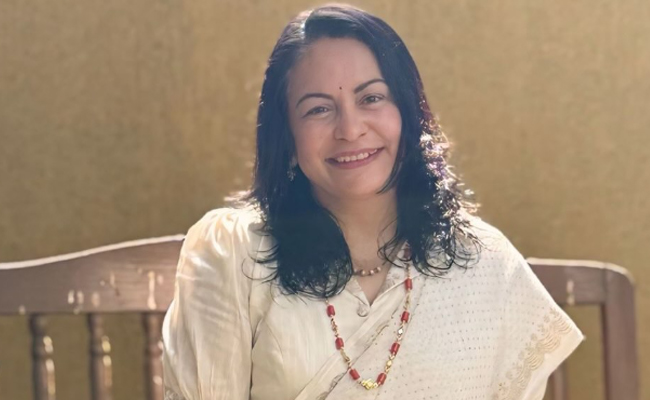
Shefali Vaidya’s ‘karmic justice’ remark on Hemant Karkare sparks controversy.
Columnist Shefali Vaidya said that the death of former ATS chief Hemant Karkare was “almost karmic justice,” while expressing support for the promotion of Shrikant Purohit.
In the post, she wrote, “Col Purohit to be made Brigadier! This is the least Indian Army could do to restore the honour of an officer who was wrongly accused, framed on false charges, tortured beyond imagination and lost many years of his life thanks to anti-national, evil Congress.”
She further stated, “the way Maharashtra ATS Hemant Karkare died at the hands of Kasab was almost karmic justice, for having tortured Col Purohit, Sadhvi Pragya and others in the fake Hindu terror case. Ditto for disgraced cop Parambir Singh!”
Her post came after reports that Colonel Purohit, who was acquitted in the 2008 Malegaon blast case last year, has been approved for promotion to Brigadier.
Defence sources cited by Indian Express had indicated that less than a month after his retirement was put on hold by the Armed Forces Tribunal (AFT), he has been approved for promotion to Brigadier.
According to the report, he will now continue in service for at least two more years, up to the age of 56, which is the retirement age for Brigadiers, compared to 54 for Colonels.
Purohit had reportedly approached the AFT, stating that the 17-year-long trial had affected his career progression and denied him the opportunity to be considered for promotions.
Though he was granted bail in 2017, he remained under a Discipline and Vigilance (DV) ban, which was lifted in July 2020. Due to this, his promotion to the rank of Colonel was reportedly withheld in 2021.
The controversy around remarks on Karkare is not new.
Earlier, YouTuber Dhruv Rathee had highlighted instances of social media users allegedly making derogatory comments about the slain officer.
Hemant Karkare, a 1982-batch IPS officer, served as the chief of the Mumbai ATS and led the investigation into the 2008 Malegaon blasts. He was killed in action on November 26, 2008, during the 2008 Mumbai attacks while responding to terrorist activity near Cama Hospital. He was posthumously awarded the Ashoka Chakra in 2009.
According to the Mumbai Police chargesheet, Karkare, along with Additional Commissioner of Police Ashok Kamte and Inspector Vijay Salaskar, was killed in an exchange of fire with Pakistani terrorists, including Ajmal Amir Kasab and Abu Ismail Khan.
The officers were ambushed near Rang Bhavan Lane while moving towards Cama Hospital.
According to a report by India Today, BJP leader Pragya Singh Thakur had earlier claimed that Karkare died as a result of a “curse,” while Maharashtra Leader of Opposition Vijay Wadettiwar had alleged that an “RSS-linked cop” was responsible for Karkare’s death, citing claims from a book by S.M. Mushrif.