Ex-DGP of Bihar meets Nitish Kumar; speculations of joining politics intensify
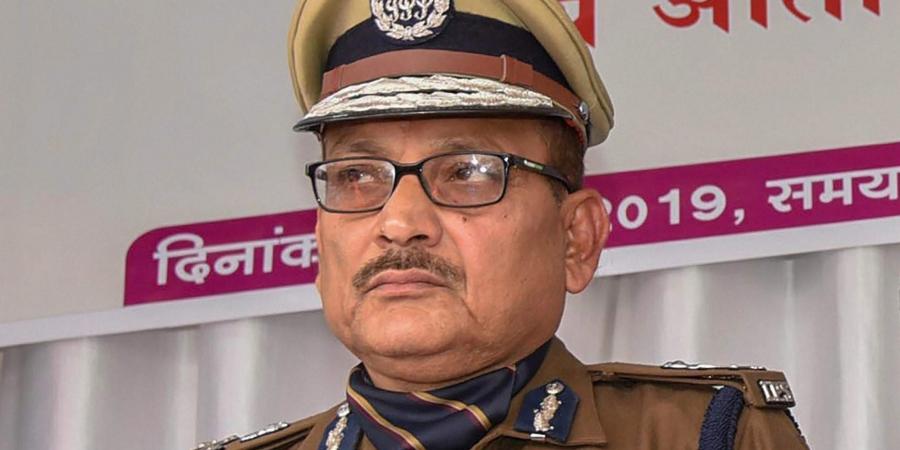
Patna: Former Bihar DGP Gupteshwar Pandey met Chief Minister Nitish Kumar here on Saturday, lending credence to speculations that the IPS officers sudden move of taking VRS was propelled by the intention to join politics.
Pandey, who stepped down as the state police chief less than a week ago, however, insisted that he had walked down to the state headquarters of the JD(U), headed by thw Chief Minister, to "thank" Kumar for the trust reposed in him by the latter.
"I discussed nothing political with the Chief Minister. I have worked with him for long and, after retirement, I just wanted to thank him for his support. If and when I decide to join any political party, I will make it known to all, Pandey told a posse of journalists waiting outside the JD(U) office at Birchand Patel Marg.
Although the IPS officer, who took VRS less than half a year before he was scheduled to superannuate, has chosen to keep his cards close to the rest, the grapevine has it that he is all set to join the JD(U) and get a ticket from one of the assembly segments in his native district of Buxar.
Reports in a section of the media also say that Pandey might be considered for the Valmiki Nagar Lok Sabha seat where a by-poll has been necessitated by the death of sitting JD(U) MP Baidyanath Mahto.
The JD(U) draws its support, largely, from among non-Yadav OBCs and Pasmanda Muslims. The party hopes that with the induction of Pandey it may be able to reach out to the Brahmins, traditionally supporters of the Congress who have gravitated towards the BJP of late.
Pandey had hit the headlines recently for his vocal condemnation of the non-cooperation meted out to the Bihar police team that had visited Mumbai to probe the death by suicide of Patna-born actor Sushant Singh Rajput.
With a candour that is usually not associated with bureaucrats, Pandey had lashed out at the municipal authourities in Mumbai when they had forcibly quarantined Vinay Tiwari, a young IPS officer from Patna who heading the investigating team until the probe was handed over to the CBI upon a request to the effect from the deceased actors father.
Pandeys comment, while he was still the DGP, that actress Rhea Chakraborty accused of abetment to suicide by Rajputs father did not have the aukaat (standing) to make any snide remarks against Nitish Kumar was also much talked about.
The Shiv Sena, which heads the ruling coalition in Maharashtra, had accused Pandey of acting as a political pawn of the ruling dispensation in Bihar ahead of the assembly elections.
Shiv Sena spokesman Sanjay Raut on the former DGP's VRS said, he was running a political agenda with his statements on the Mumbai case and now he is going to receive his award.
Maharashtra Home minister and NCP leader Anil Deshmukh Friday said that Pandey's quitting the job confirmed his doubts that in Rajput's death case he was making comments not as a DGP but as a BJP leader.
Pandey has earlier brushed aside criticism from the Shiv Sena, saying "they keep saying many things, I don't give much credence to it."
Pandey had resigned from service in 2009 to contest the Lok Sabha elections held that year. His resignation letter was, however, intriguingly not forwarded and he was reinstated into service a few months later.
Earlier, on Tuesday, decks seemed to have been cleared for Pandeys future move as his application for VRS received an expeditious approval from Governor Fagu Chauhan and an exception was made in his case with the waiver of a mandatory three-montlong cooling off period for government servants.
Let the Truth be known. If you read VB and like VB, please be a VB Supporter and Help us deliver the Truth to one and all.
Trump administration says its war in Iran has been 'terminated' before 60-day deadline
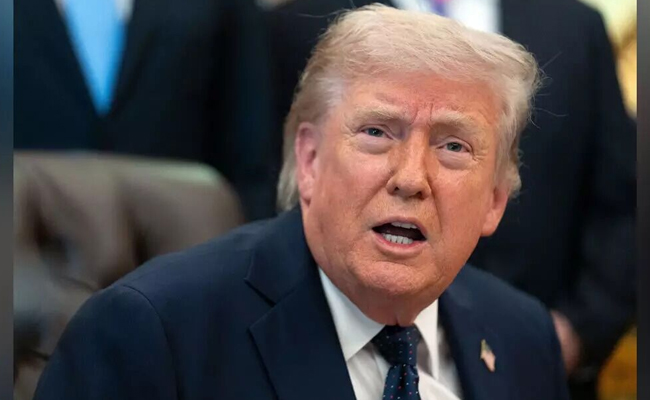
Washington (AP): The Trump administration is arguing that the war in Iran has already ended because of the ceasefire that began in early April, an interpretation that would allow the White House to avoid the need to seek congressional approval.
The statement furthers an argument laid out by Defense Secretary Pete Hegseth during testimony in the Senate earlier Thursday, when he said the ceasefire effectively paused the war. Under that rationale, the administration has not yet met the requirement mandated by a 1973 law to seek formal approval from Congress for military action that extends beyond 60 days.
A senior administration official, who spoke on condition of anonymity to discuss the administration's position, said for purposes of that law, “the hostilities that began on Saturday, Feb 28 have terminated.” The official said the US military and Iran have not exchanged fire since the two-week ceasefire that began April 7.
While the ceasefire has since been extended, Iran maintains its chokehold on the Strait of Hormuz, and the US Navy is maintaining a blockade to prevent Iran's oil tankers from getting out to sea.
Under the War Powers Resolution, the law that sought to constrain a president's military powers, President Donald Trump had until Friday to seek congressional authorisation or cease fighting. The law also allows an administration to extend that deadline by 30 days.
Democrats have pushed the administration for formal approval of the Iran war, and the 60-day mark would likely have been a turning point for a swath of Republican lawmakers who backed temporary action against Tehran but insisted on congressional input for something longer.
“That deadline is not a suggestion; it is a requirement,” said Sen Susan Collins, R-Maine, who voted Thursday in favour of a measure that would end military action in Iran since Congress hadn't given its approval. She added that “further military action against Iran must have a clear mission, achievable goals, and a defined strategy for bringing the conflict to a close."
Richard Goldberg, who served as director for countering Iranian weapons of mass destruction for the National Security Council during Trump's first term, said he has recommended to administration officials to simply transition to a new operation, which he suggested could be called “Epic Passage,” a sequel to Operation Epic Fury.
That new mission, he said, “would inherently be a mission of self-defence focused on reopening the strait while reserving the right to offensive action in support of restoring freedom of navigation.”
“That to me solves it all,” added Goldberg, who is now a senior adviser at the Foundation for Defense of Democracies, a hawkish Washington think tank.
During testimony before the Senate Armed Services Committee on Thursday, Hegseth said it was the administration's “understanding” that the 60-day clock was on pause while the two countries were in a ceasefire.
Katherine Yon Ebright, counsel at the Brennan Center's Liberty and National Security Program and an expert on war powers, said that interpretation would be a “sizeable extension of previous legal gamesmanship” related to the 1973 law.
“To be very, very clear and unambiguous, nothing in the text or design of the War Powers Resolution suggests that the 60-day clock can be paused or terminated,” she said.
Other presidents have argued that the military action they've taken was not intense enough or was too intermittent to qualify under the War Powers Resolution. But Trump's war in Iran would certainly not be such a case, Ebright said, adding that lawmakers need to push back against the administration on that kind of argument.