Ex-IPS officer moves Supreme Court for protection from WB cops after joining BJP
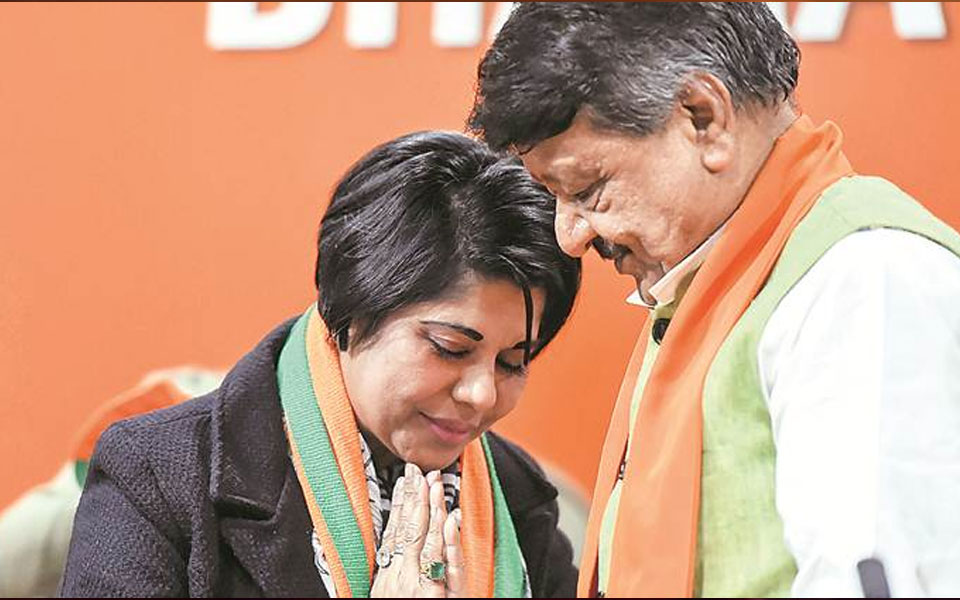
New Delhi : Former IPS Officer Bharati Ghosh, who joined BJP last week, has moved the Supreme Court seeking protection from any coercive action by the West Bengal police in new corruption cases registered against her.
Ghosh, once considered close to Mamata Banerjee, claimed police has registered seven FIRs against her including one lodged last week.
The apex court had on October 1, last year granted her protection from arrest in a case of alleged extortion and illegal exchange of banned notes for gold.
A bench of Justices A K Sikri and S Abdul Nazeer said that it will hear her application on February 19.
At the outset, senior advocate Ranjit Kumar, appearing for Ghosh said that seven FIRs have been lodged against her in an incident which dates back to 2016 in which allegedly gold was taken for currency.
He said police has been acting against her at different places and they should be restrained from taking any coercive action.
Kumar said that protection from arrest should be granted to her like it was given last year.
Senior advocate Kapil Sibal, appearing for West Bengal government opposed the plea and said she wants stay of arrest on a writ petition, which cannot be done.
He said Ghosh and her Personal Security Officer were involved in the gold extortion case and other cases and they both acted together.
Sibal said she was already granted protection from arrest in October, last year.
The bench said it will hear her plea on February 19 in detail on a non-miscellaneous day.
On February 4, Ghosh has joined BJP in the presence of Union Minister Ravi Shankar Prasad and senior party leader Kailash Vijayvargiya alleging that "thugocracy" has replaced democracy in the West Bengal.
Ghosh, who was the West Midnapore superintendent of police for more than six years, was transferred as commandant of the third battalion of the state armed police on December 26, 2017. She resigned from service two days later.
She was once considered close to West Bengal Chief Minister Mamata Banerjee and was also awarded a service medal on August 15, 2014.
Ghosh was transferred twice, once by the Election Commission before the 2014 Lok Sabha polls and the second time by the state itself before the 2016 Assembly elections.
She was, however, reinstated as West Midnapore SP as soon as the elections got over on both occasions.
An arrest warrant was issued against Ghosh in February, 2018 in connection with an extortion case registered at Daspur police station in West Midnapore district, following her resignation.
The CID, probing cases relating to alleged extortion and misconduct against Ghosh, had also conducted raids at various properties, including a house in Kolkata that belongs to her husband M A V Raju.
A few police officers of inspector and sub-inspector ranks have been arrested by the CID in connection with the probe.
Let the Truth be known. If you read VB and like VB, please be a VB Supporter and Help us deliver the Truth to one and all.
Man arrested with Rs 2.54-crore heroin in Mumbai

Mumbai (PTI): Police have arrested a man and seized over 500 grams of heroin worth Rs 2.54 crore in the illicit market from him in Mumbai, officials said on Friday.
The police's Anti-Narcotics Cell (ANC) made the drug seizure in Santacruz in the western suburbs. The operation was conducted by the Kandivali unit of the ANC on Thursday as part of a special crackdown against drug trafficking in the area, they said.
Acting on specific inputs, an ANC team conducted a raid in Santacruz (East) and intercepted a man. During a search, the team recovered 508 grams of high-grade heroin from his possession, an official said.
The seized contraband, a highly addictive, opioid drug derived from morphine, is estimated to be worth Rs 2.54 crore in the international market, he informed.
Following the seizure, a case was registered against the man under relevant sections of the Narcotic Drugs and Psychotropic Substances (NDPS) Act, 1985, and he was formally placed under arrest in the early hours of Friday.
The police are currently investigating the source of the drug and trying to identify the intended recipients of the consignment, he said.