Ex-RAW chief's revelations nothing new: Mehbooba on Abdullah's 'support' for Art 370 abrogation
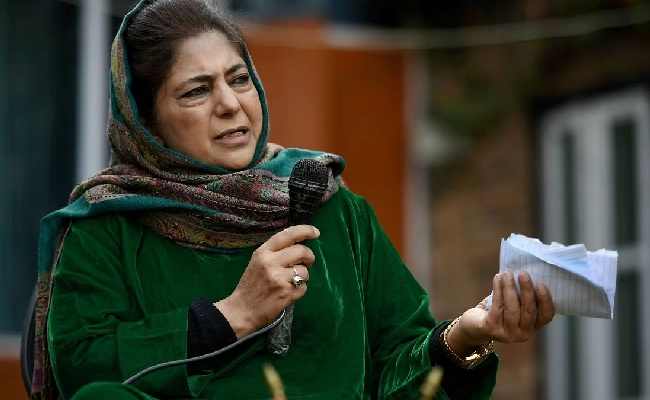
Srinagar (PTI): Peoples Democratic Party president Mehbooba Mufti on Thursday said she was not surprised by the revelations made by ex-RAW chief A S Dulat in his latest book about National Conference president Farooq Abdullah "privately' supporting the abrogation of Article 370.
"Dulat's revelations are nothing new for me. This father-son duo (Farooq Abdullah and Omar Abdullah) went to meet them (Prime Minister Narendra Modi) on August 3 (2019). Farooq Sahib did not even go to Parliament (on August 5, 2019). He stayed back. So there is nothing surprising for me," Mufti said while addressing a PDP workers' convention here.
Article 370 granting special status to the erstwhile state of Jammu and Kashmir was abrogated by the Centre on August 5, 2019.
Mufti also claimed that in 2014, Omar Abdullah met Amit Shah for government formation in Jammu and Kashmir.
"He told Shah not to form a government with the PDP but to go with the National Conference and that too unconditionally," she alleged.
Dulat's book, titled "The Chief Minister and the Spy", is slated to be released on April 18.
Mufti also claimed that one of the cornerstones of PDP's alliance with the BJP from 2015 to 2018 was that Article 370 will not be touched.
"In those two years and 10 months, Article 370 remained untouched," she said.
The PDP chief also spoke about the Waqf (Amendment) Act and "attacks" on mosques and shrines, saying graves were being dug up on the pretext that these were remnants of the Mughal empire.
"The signs of the Mughal empire are Taj Mahal, Red Fort, Qutub Minar and Fatehpur Sikri, which are flocked by millions of tourists every year.
"If you are looking for descendants of Mughals, they are not among us Muslims. They are somewhere around you... Because Mughals were kings and they did not marry into ordinary Muslim households but into princely states whose descendants are sitting around you," Mufti said.
Stating that the prime minister talks about the upliftment of Pasmanda Muslims, Mufti said, "I want to ask Modiji, is breaking down a madrassa in Madhya Pradesh or a 100-year-old mosque in Uttar Pradesh upliftment of Muslims?"
She also said that Muslims in the country should fight against the Waqf amendments peacefully.
"I request my fellow Muslims in India to fight against it (Waqf law) peacefully... What happened in Murshidabad was not good," she said.
On the perception that Muslims are being targeted in India, Mufti said they should not be treated in the same way as the terrorists treated Kashmiri Pandits in the Valley.
Let the Truth be known. If you read VB and like VB, please be a VB Supporter and Help us deliver the Truth to one and all.
CM Siddaramaiah alleges ‘criminal conspiracy’ in Sringeri recount, vows legal action
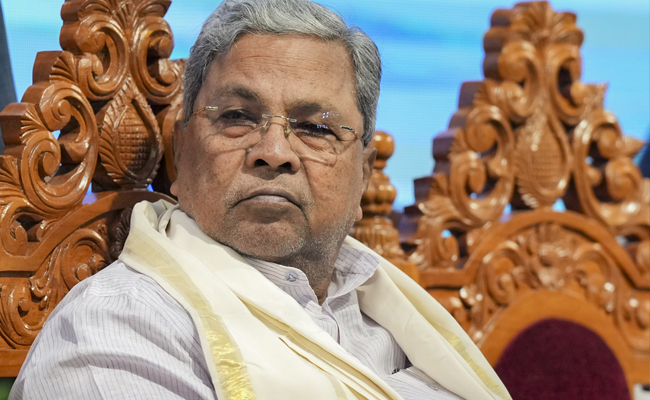
Bengaluru (PTI): Alleging a “criminal conspiracy” by BJP candidate D N Jeevaraj in the Sringeri Assembly poll recounting, Karnataka CM Siddaramaiah on Tuesday said the outcome was manipulated after valid postal ballot votes in favour of Congress leader T D Raje Gowda were tampered with during the recounting process.
Following a Karnataka High Court order on an election petition filed by Jeevaraj, challenging Raje Gowda’s election, the reverification and recounting were conducted on Saturday.
After the reverification and recount of postal ballots for the Sringeri Assembly constituency, votes polled in favour of Raje Gowda were reduced by 255, the returning officer said.
A report on the matter has been submitted to the Election Commission of India for further action, the officer added.
Congress leader Raje Gowda had won the 2023 Assembly polls from Sringeri by 201 votes, defeating his nearest rival Jeevaraj.
Addressing a press conference in Bengaluru, Siddaramaiah said the High Court had directed the recounting of postal ballots and that irregularities were noticed during the exercise conducted on May 2.
“This is a clear case of criminal conspiracy,” Siddaramaiah said, alleging that valid votes cast in favour of Raje Gowda were altered after being accepted by counting agents of all parties, including Congress, BJP, and JD(S).
He claimed that during the recounting of postal ballots, 255 votes were initially accepted as valid by all agents but were later tampered with by subordinate officials.
“There is a second mark on the votes polled in favour of Raje Gowda. They had accepted these as valid votes. Subsequently, another mark was made by officials. This is a clear case of criminal conspiracy,” he said.
When asked who was behind the alleged conspiracy, the CM replied, “It was hatched by Jeevaraj and others. It is planned.”
Siddaramaiah further alleged that the returning officer acted improperly by declaring the result despite the presence of an Election Commission observer during the recounting.
“Immediately after the counting, the returning officer announced the result. He should not have done so; this is against the law,” he said.
He pointed out that Raje Gowda had originally won by 201 votes, but after the recounting, the BJP candidate was declared the winner by 52 votes.
“The BJP has committed a criminal act of conspiracy. This is not vote chori but vote dacoity,” he alleged.
The CM said a police complaint had already been filed by Raje Gowda’s election agent, Sudhir Kumar, and emphasised the need for electoral integrity.
“We want transparency and free and fair elections. That is what our Constitution mandates,” he added.
Stating that the government would pursue legal remedies, Siddaramaiah said, “We are preparing an appeal challenging the returning officer’s announcement in a court of law.”
Responding to a separate query on elections in other states, the CM said there appeared to be an anti-incumbency factor in West Bengal, while results in Tamil Nadu were “surprising,” adding that Vijay’s party was emerging as the largest there.
Following the victory of party candidates in Bagalkote and Davanagere South, Siddaramaiah expressed confidence about future electoral prospects in Karnataka.
“Even in 2028, we will win the Assembly elections. We will come back,” the CM said.
Siddaramaiah added that he would order a forensic examination into the alleged tampering of postal ballots.