Excise policy case: ED opposes in Delhi HC plea by AAP leader Sanjay Singh against arrest
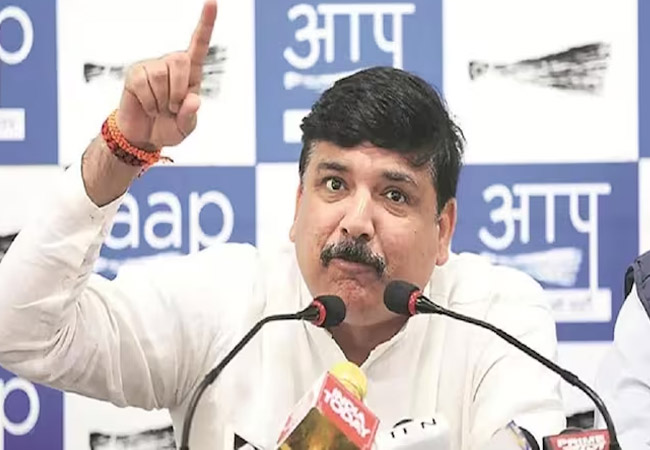
New Delhi, (PTI): The Enforcement Directorate Thursday opposed in the Delhi High Court a plea by AAP leader Sanjay Singh challenging his arrest in a money laundering case related to the now-scrapped Delhi excise policy, asserting a "clear cut" case was made out against him.
Additional Solicitor General S V Raju, appearing for the federal anti-money laundering agency, said the AAP Rajya Sabha member was apprehended observing due compliance with law, and his plea, which was a bail application in the "guise" of writ petition, was not maintainable.
Justice Swarana Kanta Sharma reserved the order on Singh's petition after hearing the rival parties. The order is likely to be pronounced on Friday.
Singh, who was arrested by the ED on October 4, had moved the high court last week challenging his arrest and remand in the money laundering case related to alleged irregularities in the scrapped Delhi excise policy for 2021-22.
The ED's money laundering case stems from the CBI FIR.
According to the CBI and the ED, irregularities were committed while modifying the Delhi Excise Policy 2021-22 and undue favours were extended to licence holders.
It alleged Singh played a key role in the formulation and implementation of the policy, which benefited certain liquor manufacturers, wholesalers and retailers, for monetary considerations.
Singh had earlier told the high court that his arrest was illegal, malicious and a "classic case of perversion of power", and he should therefore be released.
Raju Thursday vehemently objected to Singh's contention that his arrest was malafide, saying it was a "bogey" and "when offence (of money laundering) is made out, malafide is irrelevant".
"He (Singh) said because I sent (legal) notice to two officers, therefore I have been falsely involved...a clear cut case is made out that he is guilty (under PMLA). Grounds of arrest make out a case of money laundering and reason to arrest," the senior law officer said. He said the arrest was not made to teach him "a lesson" and was based on material in possession of the ED, including the statement of approver Dinesh Arora.
"Essentially, he is moving a bail application in the guise of petition under article 226 (of the Constitution). No constitutional right, fundamental right is violated. Petition is not maintainable. Trying to convert petition into bail cannot be permitted," Raju contended.
The ED said Singh was an influential person who was capable of tampering with evidence. It claimed it has recovered the photograph of a document, which was in ED's possession, from Singh.
Raju also said the remand order was passed by the trial court after "total application of mind" and considering case papers, and it cannot be interfered with unless there is an error apparent on the face of record.
The senior counsel also said that being an accused in the predicate offence being probed by the CBI was not necessary as money laundering was an independent offence.
After his arrest, the trial court had remanded Singh in the custody of the agency. On October 13, he was sent to judicial custody till October 27.
Earlier, Singh's counsel had argued the arrest of the "reputed leader" was a "knee-jerk reaction" as it was done without complying with due process of law and it deserved court's "condemnation" in order to not only protect his liberty but also set the right precedent.
Let the Truth be known. If you read VB and like VB, please be a VB Supporter and Help us deliver the Truth to one and all.
AIITA welcomes Karnataka’s ban on obscene songs in school events

Bhatkal: The Karnataka unit of the All India Ideal Teachers Association (AIITA) has welcomed the Karnataka government’s decision to strictly ban school children from dancing to obscene songs during educational and cultural programmes in government, aided, and private schools across the state.
AIITA Karnataka State President M. R. Manvi congratulated the government for taking what he termed an important step to preserve the sanctity of education.
“Such decisions to safeguard the dignity of school children and uphold the values of education are the need of the hour. This rule should not be limited to government schools alone but must be strictly implemented in all private educational institutions as well,” he said.
He further urged the government to address other concerns within school programmes.
“The government should not only prohibit obscene dances in the name of school anniversaries, but also ensure that plays and dialogues that incite religious hatred are avoided. Schools should be centres of harmony, not platforms for spreading hatred,” he added.
According to a recent circular issued by the Department of School Education and Literacy, obscene dances are adversely affecting the mental health and moral values of students.
In this regard, schools have been advised to use songs that promote nationalism, positive thinking, the greatness of Kannada culture, and value-based traditions instead of inappropriate content during programmes.
The circular also emphasises that students should be dressed in decent attire.
AIITA also backed the department’s warning that disciplinary action would be taken against head teachers if such guidelines are violated. The association has further demanded that district Deputy Directors of Public Instruction strictly monitor the implementation of these rules.