Exclusion of women from temples not essential to Hindu religion: Kerala govt on Sabarimala

New Delhi, Feb 6 : Exclusion of women from temples is not essential to the Hindu religion, the Kerala government said Wednesday vehemently opposing in the Supreme Court a batch of petitions seeking review of its verdict allowing the entry of women of all ages into the Sabarimala temple.
A five-judge Constitution bench headed by Chief Justice of India (CJI) Ranjan Gogoi was told by the counsel for the Kerala government that no ground was made out in any of the petitions seeking review of the apex court's September 28, 2018 verdict.
Senior advocate Jaideep Gupta appearing for the Kerala government told the bench, also comprising justices R F Nariman, A M Khanwilkar, D Y Chandrachud and Indu Malhotra, that there was a consensus among the four judges who delivered the majority judgment on three aspects -- Article 26, 25 (2) and rule 3 (b) of the Kerala Act.
Gupta said in none of the review petitions questions have been raised regarding these three points and therefore other aspects "raised in the review petition will make no difference".
He also said the exclusion of women from temples is not essential to the Hindu religion and women are allowed in many other Ayyappa temples.
The state government said there is a distinction between essential practice of a temple and the essential practice of the religion. If this essential practice test is applied temple wise then the purpose would be defeated.
The review petitions argued that certain submissions were not considered in the judgment or were not advanced is not a ground for re-examining the verdict, he said.
He said many of those who have sought a re-look of the judgment have not come out with valid legal points but have merely analysed the verdict by the way of a review petition and the court should not entertain them.
"It was argued that on account of the judgment, Social peace has been destroyed. This is not something which should concern a constitutional court. Peace will prevail ultimately. But a constitutional breach cannot be allowed till that time," Gupta said.
Another senior advocate Vijay Hansaria, also appearing for the Kerala government, said a case cannot be allowed to be reopened by way of review petition.
Gupta said nothing has been placed before the court that justifies a review in the matter.
"The overriding thing is that there was a consensus of Your Lordships in the majority judgment on three issues. Firstly, under Article 26, it is not a denominational temple. The devotees of Lord Ayyappa are not a denomination but a general body of Hindus. Anybody can go and visit the Temple.
"Secondly, excluding a person till the age of 50 is an exclusion for a major portion of the life of the person. Finally, Rule 3(b) [of the Kerala Hindu Places of Worship (Authorisation of Entry) Rules] is violative of section 4 of the 1965 Act itself, besides article 25(2)(b)," he said.
"A challenge on the ground that Articles 15 or 17 were not considered will not have an effect on the judgment so far as these three go. The mandamus will remain. Unless it is proved that a consideration of the same would affect the three points of consensus, there should be no review", Gupta said.
"Non-consideration of the arguments is not a ground of review at all. It is for the court to decide which arguments are essential to be for the disposal of a matter. It can't be a complaint and definitely not an error apparent on the face of the matter," he said.
Referring to a 1997 apex court judgement, the senior lawyer submitted that if a convoluted process of reasoning is required to challenge a finding, then it is not an error of law apparent on the face of it.
"There is a tendency to confuse essential practices of a religion with the essential practices of a temple. Essential Practice of a temple is not the essential practice of religion. The constitutional issue is that whether it is protected under Article 25 and a essential practice of the Hindu religion," Gupta said.
"The answer is no because there are any number of temples where the practice is not followed. In fact, We are only aware of one such temple.If Your Lordships are required to go into the essential practices of temples one by one, there is sufficient uniqueness in each of them.
"The doctrine would be demolished. The Jagannath temple is extremely unique, so is the Kashi Vishwanath temple. Nobody can underestimate the importance of the Tirupati temple. But none of these have been held to be denominational. On the hand, the Shirur Mutt, as a group that organises a temple and possesses identifying characteristics, is a denomination.", he elaborated.
The Kerala government referred to the submission of senior counsel Shekhar Naphade, who appeared for a party opposing the judgement saying that Sabarimala issue is a private law matter.
However, Gupta differed and said the Sabarimala issue concerns a public temple and there is a Kerala law that deals with it by envisaging that the shrine has to be laid open to all classes of Hindus without exception.
"Non-discrimination and non-exclusion are principles that override everything, " he said and refferred to a 1957 judgement of the apex court which dealt with the issue of harmonising Article 26 with Article 25(2)(b).
He said judgement makes its clear that "every practice of the temple will be protected under Article 25 except that which affects the right of entry. Entry has been regarded as higher than anything else.
Let the Truth be known. If you read VB and like VB, please be a VB Supporter and Help us deliver the Truth to one and all.
25 lakh properties in Bengaluru brought under e-Khata system: Shivakumar
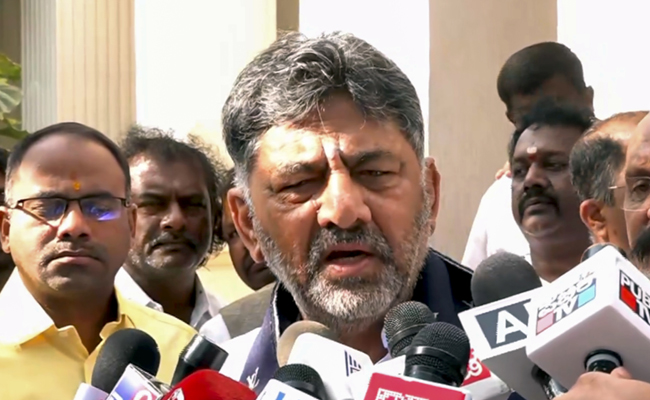
Bengaluru (PTI): Karnataka Deputy Chief Minister D K Shivakumar on Friday said that the state government has brought over 25 lakh properties under the e-Khata system in Bengaluru.
e-Khata is an electronic property certificate that maintains ownership information in an online database.
The e-Khata initiative aimed to ensure accuracy, transparency and universal coverage for property owners, he said.
Addressing a press conference here, Shivakumar, who is also the Bengaluru in-charge Minister, said over 25 lakh properties are being brought under the e-Khata system. Of them more than 7,000 applications have been processed, and additional outreach measures being planned for those yet to obtain their e-Khata.
"Twenty five lakh e-Khatas is a great number which has created history," he said.
The Deputy CM said the government is ensuring that every e-Khata will have its GPS, the shape of the property, and the measurement with every photo and document.
He explained that the government is integrating Aadhaar details, digital documentation, GPS mapping and property sketches to create a robust database.
"We want to see that every record is filled right. They (officials) are asking for documentation, stamp, digital documents. We wanted to connect every Aadhaar card and have it online," Shivakumar said.
To facilitate access, the Deputy CM announced the opening of more than 50 centres across Bengaluru, many of them in government schools, where citizens can apply for or rectify their e-Khata records.
"All of them will be working this Saturday. This 'Khata Mela' will be done. It is 'Nanna Khata, Nanna Swathu'," he said.
Applicants whose documents require verification will be given an acknowledgement and asked to return after 15 days, during which officials will conduct site inspections, he said.
Shivakumar said the government has also taken steps to identify and reclaim properties recorded as roads in revenue documents, asserting that such lands belong to the government.
"We have decided through the law that all the roads in the revenue records have been taken out. Those properties belong to the government itself," he said.
He noted that the initiative has received recognition from the Union government. "The Government of India has awarded us. It said that it is the model for the entire country," he said, while thanking officials involved in the project.
The Deputy CM said the government expects around 10 lakh additional households to benefit from the drive and assured that even those who have not downloaded their documents will receive printed copies free of cost at their residences.
"We will see that all the 25 lakh people will get their e-Khata to their home free of cost," Shivakumar said.
On apartment properties, he said all flats that have obtained occupancy certificates have been cleared.
"All the 37,460 flats (who have applied for e-Khata) have been issued an occupancy certificate. We have cleared all of them," the Deputy CM said.