Expect EC to rectify typographical errors, other mistakes in final Bihar electoral roll: SC
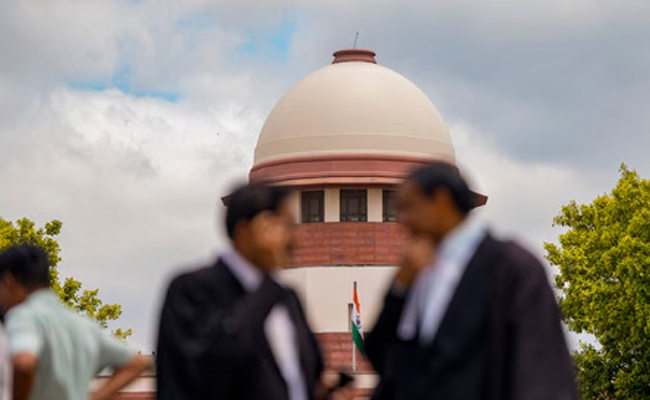
New Delhi (PTI): The Supreme Court on Thursday said it expects the Election Commission to look into typographical errors and other mistakes in the final Bihar electoral roll prepared after the Special Intensive Revision exercise as a responsible authority and come out with remedial measures.
A bench of Justices Surya Kant and Joymalya Bagchi said it will hear on November 4 the legal issues pertaining to the Bihar SIR exercise.
The poll panel said that since its publication of the final electoral roll on September 30, not a single appeal has been filed by any voter against name deletion.
Advocate Prashant Bhushan, appearing for the NGO 'Association of Democratic Reforms, said details of a voter claiming his name was not added in the final list, which was alleged by the EC as fake on the October 7 hearing in the matter, were true.
He said that EC should disclose how many voters were deleted and for what revision to ensure transparency in the exercise.
The bench noted that the electoral roll will be freezed on October 17 in some constituencies, which are going into poll in first phase and on October 20 for those going into poll in second phase.
On October 7, the top court asked the EC to provide details of 3.66 lakh voters who were part of the draft voter list but were excluded from the final electoral roll prepared after Bihar's SIR exercise, saying there is "confusion" over the matter.
On September 30, the EC, while publishing the final electoral list of the poll-bound Bihar, said the total number of electors has come down by nearly 47 lakh to 7.42 crore in the final electoral roll from 7.89 crore before the Special Intensive Revision (SIR) of the voter list carried out by the Election Commission.
The final figure has, however, increased by 17.87 lakh from 7.24 crore electors named in the draft list issued on August 1, which had removed 65 lakh voters from the original list on various accounts, including deaths, migration and duplication of voters.
While 21.53 lakh new electors have been added to the draft list, 3.66 lakh names have been removed, resulting in a net increase of 17.87 lakh.
The assembly elections in Bihar will be held in 121 seats of the 243-member Assembly on November 6, while the remaining 122 constituencies will go to polls on November 11. The counting of votes will be held on November 14.
Let the Truth be known. If you read VB and like VB, please be a VB Supporter and Help us deliver the Truth to one and all.
India achieves major milestone in wind energy; capacity now 56 gigawatts: PM Modi
New Delhi (PTI): India has achieved a major milestone in wind energy, with the country's wind energy generation capacity exceeding 56 gigawatts, Prime Minister Narendra Modi said on Sunday.
In his monthly radio address 'Mann Ki Baat', Modi also said the country must save electricity and adopt clean energy.
“India recently achieved a major milestone in wind energy. India's wind energy generation capacity has now exceeded 56 gigawatts. In just the past year, nearly 6 gigawatts of new capacity have been added,” he said.
Underlining that solar and wind energy are essential for India's development, Modi said, “It is not just about the environment; it is about securing our future, and we all have a role to play in it.”
On April 22, Union Minister for New and Renewable Energy, Pralhad Joshi, said that India has recorded its best-ever year in wind energy capacity addition, with a historic 6.1 GW added during 2025-26.
India currently ranks fourth globally in wind energy, with more than 56.1 GW installed capacity and an additional 28 GW under implementation.
Emphasising the vast untapped potential of the sector, Joshi highlighted that India's wind energy potential at 150 metres hub height is estimated at nearly 1,164 GW.
He expressed confidence that with sustained efforts, the country will achieve 100 GW wind capacity by 2030 and 156 GW by 2036, contributing significantly to the net-zero target by 2070.
Joshi also underlined that wind energy plays a critical role in stabilising India's energy system, particularly due to its peak generation during evening and night hours, which aligns with high demand periods.
He noted that nearly 45 per cent of wind power generation occurs during peak demand hours, making it a vital complement to solar energy.