Explainer: CBSE's three-language formula for Class 9; What does it mean, what changes?

New Delhi (PTI): Two months after beginning of the 2026-27 academic session, the Central Board of Secondary Education (CBSE) has notified implementation of the three-language formula for Class 9 from July 1, 2026.
Here is an explainer of what the formula is:
1. What is three-language formula?
The three-language formula in the National Education Policy (NEP) 2020 recommends that students learn three languages, at least two of which must be native to India. This formula applies to both government and private schools, giving states the flexibility to choose languages without any imposition.
2. What is the history of three-language formula?
The formula was first proposed by the Education Commission (1964-66), officially known as the Kothari Commission. It was formally adopted in the National Policy on Education (NPE) 1968 under then Prime Minister Indira Gandhi. The policy was reaffirmed in NPE 1986 under PM Rajiv Gandhi and revised in 1992 by Narasimha Rao’s Congress government to promote linguistic diversity and national unity.
The formula included three languages -- mother tongue or regional language, official language and a modern Indian or European language.
3. What does NEP 2020 say about the three-language formula?
The NEP proposes an “early implementation of the three-language formula to promote multilingualism" from the school level. The document states that the three-language formula will continue to be implemented "while keeping in mind the constitutional provisions, aspirations of the people, regions, and the Union, and the need to promote multilingualism as well as promote national unity”.
However, the NEP also states that there will be greater flexibility in the three-language formula, and no language will be imposed on any state.
The policy states that the three languages learned by children will be the choices of states, regions, and of course, the students themselves, so long as at least two of the three languages are native to India.
4. What about foreign languages?
According to NEP 2020, in addition to Indian languages and English, students at the secondary level can also learn Korean, Japanese, French, German and Spanish, among other foreign languages.
However, a key shift in the curriculum is the classification of English as a foreign language, with the Board allowing only one foreign language within the three-language framework. This could restrict students from choosing both English and another foreign language as their second and third languages.
5. Are books ready?
The board has said till the dedicated R3 textbooks are available, Class 9 students shall use the Class 6 R3 textbooks (2026-27 edition) of the chosen language.
The board has further said schools facing a shortage of adequately-qualified native Indian language teachers may, as an interim arrangement, engage existing teachers of other subjects who possess functional proficiency in the language concerned.
6. What is the controversy about three language formula?
The three-language formula has been at the centre of the political row between the former DMK-led Tamil Nadu government and the Centre.
The state has historically opposed the three-language formula. In 1937, the then Madras government, headed by C Rajagopalachari, introduced compulsory Hindi in schools. This move sparked widespread protests by the Justice Party and Dravidian leaders like Periyar. The policy was revoked in 1940, but anti-Hindi sentiments persisted.
When the three-language formula was introduced in 1968, Tamil Nadu opposed it, seeing it as an attempt to impose Hindi. Under Chief Minister C N Annadurai, the state adopted a two-language policy, teaching only Tamil and English.
Tamil Nadu remains the only state that has never implemented the three-language formula, choosing English over Indian languages, including Hindi and other regional languages.
Let the Truth be known. If you read VB and like VB, please be a VB Supporter and Help us deliver the Truth to one and all.
Protest against demolition drive turns violent in Kolkata, 3 cops injured
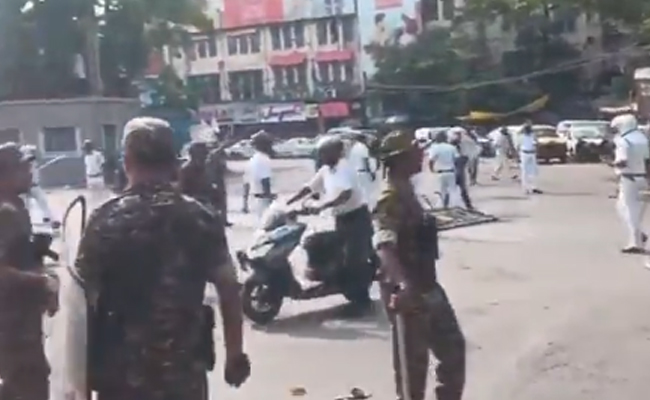
Kolkata (PTI): A protest against the recent bulldozer action in Kolkata's Tiljala turned violent on Sunday as demonstrators hurled stones at police personnel in the minority-dominated Park Circus area, injuring at least three officials and damaging several vehicles.
The flare-up came days after bulldozers rolled into Tiljala as part of the West Bengal government's demolition drive against alleged illegal constructions following the factory fire that killed two persons earlier this week.
On Sunday afternoon, a large number of people gathered near Park Circus Seven Point Crossing to protest against the anti-encroachment drive and attempted to block roads, police said.
As police tried to disperse, what they described as an "unlawful assembly", a section of protesters allegedly resorted to stone-pelting, triggering chaos in the area.
Several vehicles parked along the roadside, including those carrying central forces, were vandalised, officials said.
Heavy deployment of Kolkata Police and central forces was made in the area after the clashes. Route marches and intensified patrolling were undertaken in adjoining localities to prevent further escalation and restore normalcy.
Kolkata Police Additional Commissioner Ashesh Biswas said action has already been initiated against those involved in the violence.
"Some people tried to block the road. It was an illegal gathering. The police were trying to disperse them, and there was pelting of stones. Three of our colleagues were injured," Biswas told reporters.
"We have already arrested a few people," he said.
The officer said police followed standard operating procedures, and efforts were underway to identify all those involved in the violence.
"There was an attack on the police. We will see who is behind it and arrest everyone. Strict legal action will be taken," he added.
While the police maintained the agitation was linked to administrative action against illegal buildings, some locals claimed that grievances over alleged restrictions on the use of loudspeakers during religious prayers and curbs on offering prayers on roads had also contributed to the tensions.
The developments come close on the heels of tension in Kolkata's Rajabazar area on Friday, where a standoff broke out after a group of people allegedly attempted to offer prayers on a public road despite restrictions on blocking traffic.
According to police sources, a large contingent of personnel reached the area and asked people to vacate the road, after which the situation turned tense briefly.
Members of the local community argued that holding Friday prayers on roads had been a long-standing practice in the locality, while the administration maintained that keeping roads clear was necessary for traffic movement and maintenance of law and order.
Police, however, did not indicate any direct connection between the Rajabazar incident and Sunday's violence in Park Circus.
Authorities also did not immediately disclose the number of persons arrested in Sunday's clashes or whether any protesters sustained injuries during the confrontation.