Facebook counters Mukesh Ambani; says data is not new oil, shouldn't be hoarded within nations

New Delhi, Sep 12: Countering richest Indian Mukesh Ambani, Facebook Inc on Thursday said data is not the new oil, and countries like India should allow its free flow across borders instead of attempting to hoard it as a finite commodity within national boundaries.
Facebook Vice-President, Global Affairs and Communications, Nick Clegg said data sharing is crucial for national security as India right now finds itself "locked out" of major global data-sharing initiatives aimed to clamp down on serious crime and terrorism.
India should create a new template for the internet that "respects the rights of individuals to choose what happens to their data; one that encourages competition and innovation; and one that remains open and accessible for everyone," he said.
Chairman of Reliance Industries Mukesh Ambani had stated that "data is the new oil" as he propagated the protection of Indian users' data generated through use of internet as well as social media platforms, saying the country's data must be controlled and owned by Indian people and not by corporates, especially global corporations.
"There are many in India and around the world who think of data as the new oil and that, like oil having a great reserve of it held within your national boundaries, will lead to surefire prosperity. But this analogy is mistaken," Clegg said at an event here.
"Data isn't oil a finite commodity to be owned and traded, pumped from the ground and burned in cars and factories. Of course, no analogy is perfect, but a better liquid to liken it to is water, with the global internet like a great borderless ocean of currents and tides," he said.
The value of data, he said, comes not from "hoarding it" or trading it like a finite commodity, but from allowing it to flow freely and encouraging the innovation that comes from that free flow of data - the algorithms and the services and the intelligence that can be built on top of it.
"It is that innovation that has the potential to bring much greater wealth to India and it is that innovation that will place India, with its entrepreneurial society and its bedrock of engineering talent, at the forefront of the global internet for decades to come," he said.
Clegg said to contain data within geographical boundaries and restricting its flow outside the country would be to "turn this great ocean of innovation into a still lake."
"The global internet is built on this principle of cross-border data flows just as the global economy relies on capital, human resources and technological innovation to cross borders in order to flourish," he said.
Stating that it was not just the global economy that relies on data sharing across borders, he said data-sharing was crucial for national security too.
"Yet, right now India finds itself locked out of major global data-sharing initiatives aimed to clamp down on serious crime and terrorism, like the Clarifying Lawful Overseas Use of Data (CLOUD) Act and the Budapest Convention on Cyber Crime," he said.
The remarks came amid a raging debate in the country over whether data of Indians is safe with foreign companies, as the government is working on crafting data protection rules. The Reserve Bank of India last year imposed data localisation norms on foreign fintech companies to locally store the data of Indians.
Facebook, which is looking at launching payment services through its unit WhatsApp in India, and global firms such as Mastercard, Visa, PayPal, Google and Amazon had sought relaxation in the regulation on data localisation.
India is home to 400 million WhatsApp users and more than 328 million Facebook users.
The Facebook executive, however, said while national security is a major priority for the Indian government, inhibiting global data sharing is an issue of conflict of laws between the US and India.
"In our view, a major priority for the US and India should be to revive their bilateral relationship on cyber co-operation and for India to seek access to these existing mechanisms for data sharing. Now is not the time to drift further apart, now is the time to get around the table and agree on a data-sharing relationship that suits both sides," he said.
He went on to state that India finds itself at a crossroads as the internet matures. "The decisions it makes in the months and years ahead will likely do more to shape the global internet or end it than those made by any other country," he said.
Of course, India is not responsible for the actions of the rest of the world. But the eyes of the world are upon it and its decisions could have a domino effect as smaller countries wrestle with similar decisions, he added.
India, he said, could follow the Chinese model, further entrenching the fracturing of the global internet.
"Between these two great nations, China and India, a third of the world's population would be detached from the rest of the global internet and a great precedent would be set for other nations. And in a few short years there may not be such a thing as a global internet at all," he said.
"And some countries would use India as a precedent to justify even more restrictive laws, cutting their citizens off from the benefits of an open internet," he said.
"Or instead, India can choose to work with its natural allies in the open, democratic world to help shape an internet that respects rights of individuals; promotes competition and innovation; and remains open and accessible for all."
Let the Truth be known. If you read VB and like VB, please be a VB Supporter and Help us deliver the Truth to one and all.
Efforts of party cadres will be rewarded on May 4: DMK chief Stalin
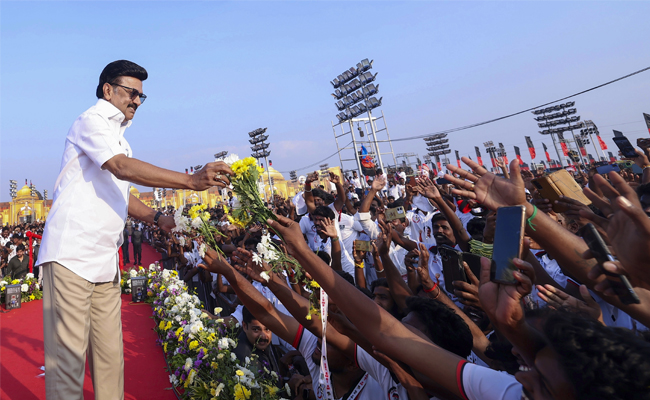
Chennai (PTI): Tamil Nadu Chief Minister M K Stalin on Friday said that the efforts made by his party cadres during the Assembly elections would be rewarded on May 4.
The counting of votes for the Assembly elections held on April 23 will be taken up on May 4.
"We are set to reap the rewards of the hard work put in by our party cadres on the coming fourth (May 4 counting day). There is absolutely no change in this and not even the slightest deviation," Stalin said at a May Day event here.
"There is no need for anyone to assume that I am speaking merely on the basis of exit polls," he added.
Stalin, who is also DMK chief, said that "good news" would come for those eagerly waiting for the election results.
Stating that the DMK governance is based on philosophy and principles, Stalin said, "This will continue."
He recalled the pivotal role of the then Chief Minister C N Annadurai, who first declared May Day as a government holiday, and subsequently, late CM M Karunanidhi, who was instrumental in extending it as a paid holiday across the nation.
"Responding to the request of Kalaingnar (Karunanidhi), the then Prime Minister V P Singh accepted the plea and declared it (May 1) a paid government holiday not merely for Tamil Nadu, but for the entire nation," Stalin said.