Fact Check: Trump did not insult Modi, he mocked at former US president Joe Biden's rule
telugupost,
Vartha Bharati | 19-02-2025 | 16:22:00 IST
Image Credit: telugupost.com
Claim: Indian Prime Minister Modi is seen smiling even after Trump insults him at a press conference
Fact: Trump is referring to former American President Joe Biden in his answer, not Indian PM Modi
Indian Prime Minister Modi arrived in the US from France on February 12, 2025. He was hosted by American President Trump for their first bilateral talks since assuming the US presidency. Modi met with Trump at the White House and discussed strategic India-US ties on various key issues. US President Donald Trump held a press conference, along with Prime Minister Narendra Modi, where several American and Indian Journalists asked questions about various topics. At this joint briefing, the two leaders addressed several key topics, including tariffs, the extradition of the 26/11 Mumbai attack accused Tahawwur Rana, illegal immigration and the Russia-Ukraine war. Trump also announced that the US is paving the way to provide India with F-35 fighter jets as part of increasing military supplies by "billions of dollars". During his two-day visit to the US, PM Modi also met US intel chief Tulsi Gabbard, National Security Advisor Michael Waltz, and tech billionaire Elon Musk. PM Modi is the fourth global leader to meet Trump at the White House since his inauguration on January 20.
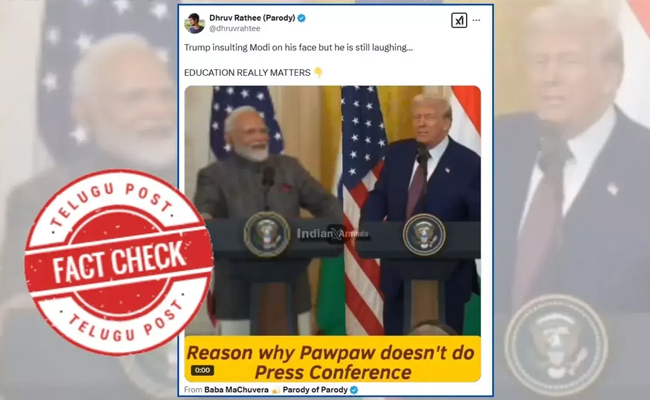
Amidst this, a short video of Trump and Modi's joint press conference is going viral with the caption “Trump openly insults Modi, yet he keeps laughing… This is why education truly matters." In the video, we can hear Trump saying: “That’s your question, but I’ll answer it. And yeah, I agree with you, gross incompetence”. After this statement, everyone in the press conference can be heard laughing, along with both the leaders. This video is in circulation with the claim that the comments made by Trump are about PM Modi and he is insulting him in the face. But unable to understand this, Modi is seen smiling at the joke.
— Baba MaChuvera 💫 Parody of Parody (@indian_armada) February 17, 2025
Here is the archive link of the claim.
Fact check:
The claim is False. American President Trump did not comment about Indian Prime Minister Modi. Those comments were made about the previous government formed by Joe Biden.
When we searched for the visuals of the joint press conference, we found a video published by Hindustan Times with the title “Trump Mocks Biden At Press Briefing With PM Modi: Watch Why | India | USA | White House”. In the video, when a reporter asks PM Modi about India’s relationship with USA after Trump became the President. His question was “Are you excited about this upcoming partnership, I was curious how much more confident are you with President Trump leading this country that there will be peace through strength and you will have a successful partnership with the United States versus with Biden's incompetence and weakness over the last four years.”
Before the Indian PM could respond to this question, President Trump cut in and answered the question. He says “That's your question but I'll answer it”, “I agree with your gross incompetence. we're going to have a fantastic relationship”
Here is another video of the same joint press conference, where we can see that the question and answer were about the administration of previous government in the USA and not about PM Modi.
According to a Times of India report, during a joint press conference between Prime Minister Narendra Modi and US President Donald Trump, an American journalist fired a pointed question at Modi, contrasting Trump’s leadership with what he called “Biden’s incompetence and weakness” over the last four years.
Before Modi could respond, Trump chuckled and took the question himself. “That’s your question, but I’ll answer it,” he said, agreeing with the journalist’s assessment and calling the previous administration’s handling of global affairs “gross incompetence.”
Trump claimed the world had suffered setbacks due to what he described as weak leadership from the US but assured that under his watch, the situation had already improved. “Even some of the media that we wouldn’t prefer has been writing that this is a much different country right now,” he said, adding that the world, including India, benefits from a strong and “good” America.
The US official website whitehouse.gov also shared the transcript of the conversation in the press conference. Here is the screenshot of the conversation which clearly shows that they were talking about the previous government's administration and not about the Indian PM.
Hence, the viral video does not show US President Donald Trump mocking Indian PM Modi and saying that he is incompetent. He was talking about Joe Biden’s administration in the USA. The claim is False.
Four booked for tying 18-year-old to tree, beating him up in UP's Pratapgarh
07-05-2026 ¦
07-05-2026 IST
Representational image (freepik)
Pratapgarh (UP) (PTI): Four people were booked here for the abduction and assault of a man who they allegedly tied to a tree and beat up, police said on Wednesday.
The incident, a video of which has gone viral, took place on Tuesday afternoon under the Kunda police station limits.
The FIR was registered on Wednesday evening based on a complaint from the victim's father.
According to Keshav Prasad Yadav, a resident of Mauli village, some people called his 18-year-old son Nikhil Yadav on the phone and asked him to come out of his house around 2.30 pm on Tuesday.
As he reached outside the village as instructed, the accused allegedly forced him into a car and took him towards the Tinpedwa forest area, where they tied him to a tree and assaulted, the complainant said.
The attackers also recorded a video of the incident and circulated it on social media. The purported video shows the men thrashing Nikhil one after another, while one of them is assumed to have recorded the act.
Kunda Station House Officer Manoj Pandey confirmed the incident and said efforts are underway to identify and arrest all the accused.
Meanwhile, Samajwadi Party president Akhilesh Yadav has shared the video on social media, describing the incident as reflective of a "dominant mindset" against the PDA (Pichda or Backward, Dalit, and Alpasankhyak or Minority), and demanded strict action against the accused.


_vb_80.png)