Falling rupee puts pressure on AI's cost structure; int'l flights provide hedge: Company official

New Delhi, Jan 12: Falling rupee puts pressure on Air India's cost structure and profitability but the airline has some natural hedge as it can charge more for international flights where tickets are priced in foreign currencies, according to a senior company official.
In recent weeks, Indian rupee has been on a decline and touched a record low of 86.04 against the US dollar on January 10. A weak rupee results in higher operational expenses for airlines as most of their costs are in dollars.
Air India's Chief Commercial Officer Nipun Aggarwal said the declining rupee definitely poses a challenge to the industry and to Air India, and the situation has to be dealt with by improving productivity and taking other initiatives.
"Falling rupee does put pressure on our cost structure because most of our cost is dollarised barring the manpower cost which is in local currency. The more the rupee falls, the more the pressure it puts on our cost structure, on our profitability," he said at a media briefing this week.
Air India Group operates 1,168 daily flights, including 313 services to international destinations. Of those overseas flights, 244 are short haul and 69 are long haul.
The group comprises Air India and low-cost carrier Air India Express.
Last year, Air India merged Vistara with itself and AIX Connect was integrated with Air India Express.
According to Aggarwal, the airline has some natural hedge as it flies international lot more than other airlines.
"So, we are able to charge in international currency for international flights and we are able to pass on some of that impact to our customers because we are pricing in dollars or whatever currency is there," he said.
At the same time, Aggarwal noted that not everything is priced in overseas currencies.
"Even on international flights, we do have some impact but some of those are mitigated with the hedge we have but it impacts our profitability and puts pressure on the fares in the market".
Increasing airfares is not easy as the industry is very competitive and the demand is sensitive to pricing, Aggarwal said, seeking to highlight the low profitability of the airline industry.
"We do have to fill the aircraft and if we had so much pricing power, the airline industry's profitability would not be what it is today. This makes it very challenging for us to operate... it (falling rupee) will put pressure on our cost structure, impact profitability and demand," he noted.
In December, the International Air Transport Association (IATA) projected global airline industry's net profit at USD 36.6 billion this year for a 3.6 per cent net profit margin.
"Average net profit per passenger is expected to be USD 7 (below the USD 7.9 high in 2023 but an improvement from USD 6.4 in 2024)," IATA said in its financial outlook for 2025.
Air India is an IATA member.
Taking a broader view, Aggarwal also pointed out that the rupee has been depreciating around 2-3 per cent every year for the last many years, and not just the airline industry but many other sectors have become used to the situation.
"We are also not unique in that respect. We will deal with it and are confident that it is not such a big issue," he added.
The loss-making Air India is implementing an ambitious transformation plan and is slowly expanding its fleet as well as network amid rising air traffic demand.
Let the Truth be known. If you read VB and like VB, please be a VB Supporter and Help us deliver the Truth to one and all.
Rajnath to top commanders: Outmaneuver adversaries with strategic surprise
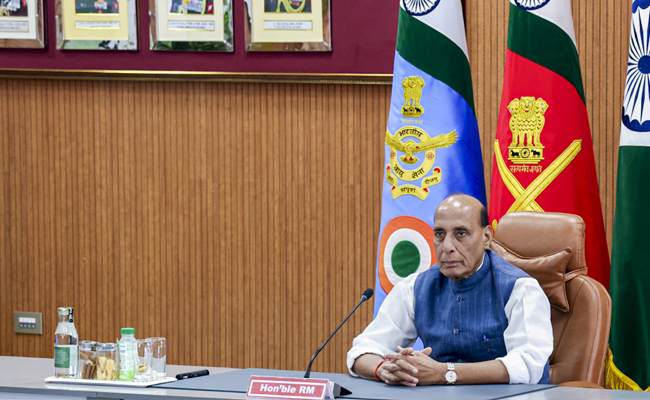
Jaipur/New Delhi (PTI): Defence Minister Rajnath Singh on Friday directed the top military commanders of the three services to integrate an "element of surprise" into modern warfare to outmaneuver India's adversaries and bolster strategic posture.
In his address at the joint commanders conference in Jaipur, Singh also described the Operation Sindoor as a testament to the "swift, precise, and joint response" of the Indian armed forces to safeguard national interests and called upon the military to remain ready to deal with any security challenges.
In their two-day deliberations, the commanders carried out a comprehensive review of the combat preparedness of the military in the wake of the evolving regional security situation.
Operation Sindoor was a demonstration of India's growing capabilities and a symbol of the nation's collective resolve and new military ethos, Singh said, a day after the first anniversary of Operation Sindoor.
He also unveiled a 'Joint Doctrine for Integrated Communication Architecture' that is aimed at strengthening doctrinal clarity, interoperability and integrated communications across the armed forces in future multidomain operations.
The joint commanders' conference, themed 'Military Capability in New Domains', brought together the top leadership of the defence ministry and the three services to deliberate on emerging security challenges and future readiness.
Comprehensive deliberations were held on future warfare, multidomain operations, technological transformation and joint capability development.
The conference witnessed extensive discussions on cognitive warfare, cyber resilience against evolving quantum and AI-enabled threats, military capability development in emerging domains, indigenous innovation and AI-enabled warfighting concepts.
It was attended by Chief of Defence Staff Gen Anil Chauhan, Chief of the Naval Staff Admiral Dinesh Kumar Tripathi, Chief of the Army Staff Gen Upendra Dwivedi, Chief of the Air Staff Air Chief Marshal AP Singh and Defence Secretary Rajesh Kumar Singh among others.
In his remarks, Singh asked the commanders to remain "future-ready" by learning from the operation as well as the current global security landscape.
He underscored the need to strengthen capabilities in artificial intelligence, autonomous systems, data analytics and secure communication networks to stay prepared in the rapidly evolving geopolitical security scenario. He emphasised that future conflicts will increasingly be shaped by hybrid threats, information dominance and operations conducted simultaneously across cyber, space, electromagnetic and cognitive domains, according to an official readout.
Highlighting the transformative impact of emerging technologies, Singh stressed on the importance of ensuring integrated national preparedness across all spectrums of conflict, it said.
Singh's remarks at the conference came a day after the first anniversary of Operation Sindoor.
The defence minister appreciated the progress achieved in enhancing jointness, integration and technological adoption across the three services, the readout noted.
Singh said that jointness constitutes a pivotal dimension within the transformative changes sweeping across the global defence sector.
"Future wars will not be won solely through weaponry, but through innovative thinking and enhanced synergy," he said.
The defence minister exhorted the commanders to cultivate the "element of surprise" to remain unpredictable to the nation's adversaries and secure a strategic edge in any given situation.
He, however, urged them to remain vigilant of the element of surprise of the enemy and always stay two steps ahead.
Singh also reiterated the Narendra Modi government's commitment to enhancing the capabilities of the defence forces through state-of-the-art weapons and platforms. He added that special focus is being laid on research in niche domains.
During the conference, he released a documentary film on Operation Sindoor.
The film reaffirms the nation's and defence forces' commitment to operational preparedness and decisive national response capabilities.
Demonstrations of advanced systems and platforms developed for intelligence fusion, operational planning and information management were also showcased during the conference reflecting growing integration of cutting-edge technologies into joint operational structures, according to the defence ministry.
The discussions will contribute significantly towards shaping India's future military transformation and integrated operational preparedness, it said.