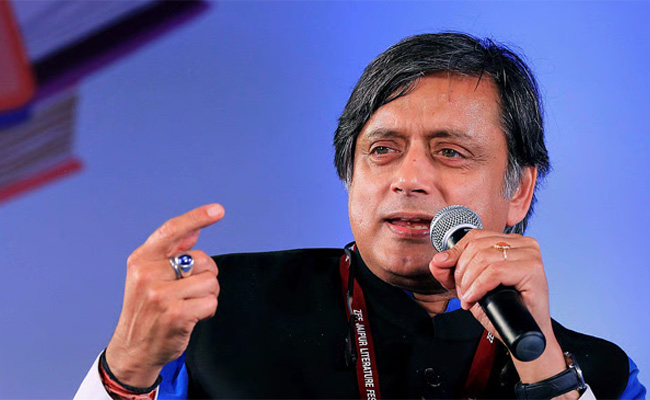
Farmers' associations can help fight poverty: Experts
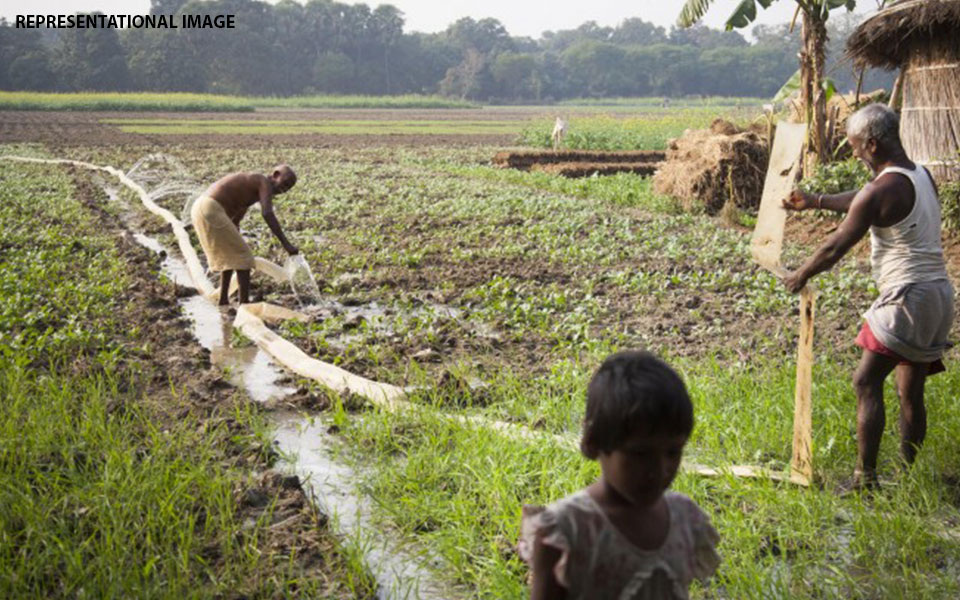
New Delhi, June 20: Setting up farmer-producer organisations can be the biggest weapon against poverty, said experts at a panel discussion on 'Making markets work for the poor' hosted by the Bill and Melinda Gates Foundation (BMGF) here.
"Farmer-producer organisations can help farmers increase their income and provide them better access to services. Dairy like cooperatives are coming up in the country," said International Food Policy Research Institute (IFPRI) Director for South Asia Pramod K. Joshi.
He said the current government has given a new lease of life to such organisations by promoting its formation and by offering the farmers incentives to become members. Poultry, 80 per cent in the organised sector, grew 12 per cent annually last decade, he said.
Self-Employed Women's Association's (SEWA) Social Security Team Director Mirai Chatterjee said: "Basic building block is organisation. It increases the collective strength, bargaining power and helps gain access to resources which no individual can alone do."
More than 270 million Indians still live on less than two dollars a day and millions more are in a state of near-poverty, one health emergency or crop failure away from destitution, BMGF said in a report, adding that systemic poverty presents the greatest barrier to equal opportunity.
"The foundation believes in 'All lives have equal value' and there is a continuous reduction in child mortality, infant mortality, tuberculosis, polio and the likes. But all lives do not have equal opportunity," said BMGF Executive Director Rodger Voorhies.
The BMGF's Global Growth and Opportunity division is a response to this, he said, adding that it is designed to redesign financial, technological, infrastructural and social systems so they provide equal opportunities to all. It works in four areas: agricultural development, financial services for the poor, water, sanitation and hygiene, and gender equality.
"No country has been able to come out of poverty without addressing problems and working on advancements in the agricultural sector," said Voorhies. Better collection of data, access to services and new technologies can increase farmers' productivity, he added.
KaliedoFin Co-Founder Sucharita Mukherjee said: "Procuring documents and letters from the poor to authenticate them was a cumbersome process. Aadhaar has made a big difference. Technology is making things possible but lot of businesses are still to adapt."
Praising Prime Minister Narendra Modi's Swachh Bharat campaign, Drinking Water and Sanitation Secretary Parameswaran Iyer said: "There is 90 per cent usage of toilets reflecting success in behavioural change. This is important for security and dignity of women, health impact and the huge savings each family does by way of reduction in doctor visits and medicines."
He said that while they have 10 months to completely make India open defecation free (ODF), the government is coordinating with states and districts to keep it sustainable, i.e. ODFS (ODF-Sustainable), and plans to take it beyond that with ODF+ (ODF-Plus), which would also look into solid and liquid waste management.
Let the Truth be known. If you read VB and like VB, please be a VB Supporter and Help us deliver the Truth to one and all.
Hospital wall collapse: CM orders suspension of executive engineer; kin of victims get solatium
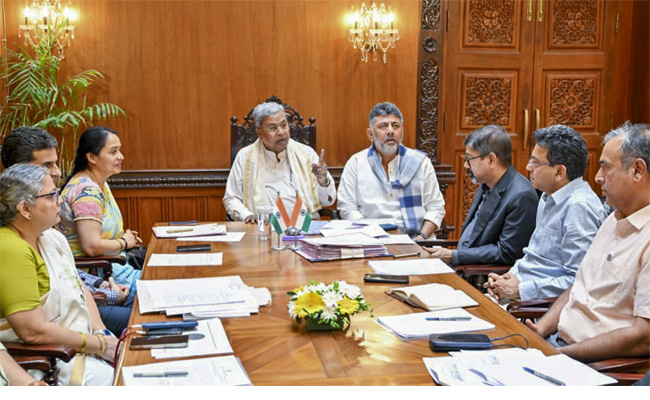
Bengaluru (PTI): Karnataka Chief Minister Siddaramaiah on Thursday ordered the immediate suspension of an executive engineer for the Bowring and Lady Curzon Hospital wall collapse that claimed the lives of seven people, during a high-level review meeting at Vidhana Soudha.
A compensation of Rs 5 lakh, as announced by the CM Siddaramaiah, was distributed to the families of seven victims who lost their lives in the tragedy on Wednesday evening, which occurred due to heavy downpour with gusty winds and hailstorm.
The meeting of municipal commissioners of the five corporations, chaired by the chief minister and attended by Deputy Chief Minister D K Shivakumar, focused on fixing accountability and examining lapses that led to the tragedy.
"Why was soil dumped in a way that damaged the wall? Why did you not monitor this?" Siddaramaiah asked, pulling up hospital authorities during the meeting.
A statement from the chief minister's office said that the CM ordered the immediate suspension of the executive engineer of the Karnataka Health Systems Development Project (KHSDP).
ALSO READ: Three arrested for running fake Aadhaar racket in UP's Badaun
He also questioned the hospital authorities, asking why they failed to monitor the dumping of soil that weakened the structure.
The chief minister directed that a notice be issued to the head of the Hospital.
During the meeting, Siddaramaiah said the rains had caused extensive damage in the city, with over 250 trees uprooted.
The Chief Minister instructed officials to take necessary measures before the onset of the monsoon to avoid untoward incidents.
Commissioners of all five municipal zones in Bengaluru have been asked to take precautionary steps, including trimming dry and dangerous tree branches, the CMO said.
Siddaramaiah also directed them to get the silt cleared from stormwater drains to prevent flooding, and that immediate action be taken to remove debris and fallen branches from roads.
Further, he instructed that barricades be placed at underpasses where water stagnates and restricts public movement.
The Greater Bengaluru Authority (GBA) Chief Commissioner M Maheshwar Rao said in a statement that Shivajinagar MLA Rizwan Arshad distributed compensation cheques of Rs 5 lakh each to the families of the deceased on Thursday.
Seven people, including a six-year-old girl, were killed and seven others injured when the compound wall collapsed amid heavy rain, strong winds and a hailstorm on Wednesday evening.
Police said the victims, comprising three from Bengaluru, two from Kerala on a study tour and one each from Uttar Pradesh and Assam, had taken shelter near the wall when it suddenly gave way, trapping them under the debris.
The chief minister questioned officials over the dumping of soil near the wall despite knowing it could weaken the structure, and directed that a notice be issued to the head of Bowring Hospital.
Siddaramaiah, who had visited the spot soon after the incident along with senior officials, reviewed the situation and ordered a detailed probe into the collapse.