Farmers, families end lives - Is this 'Achhe Din'? : Shiv Sena asks Modi
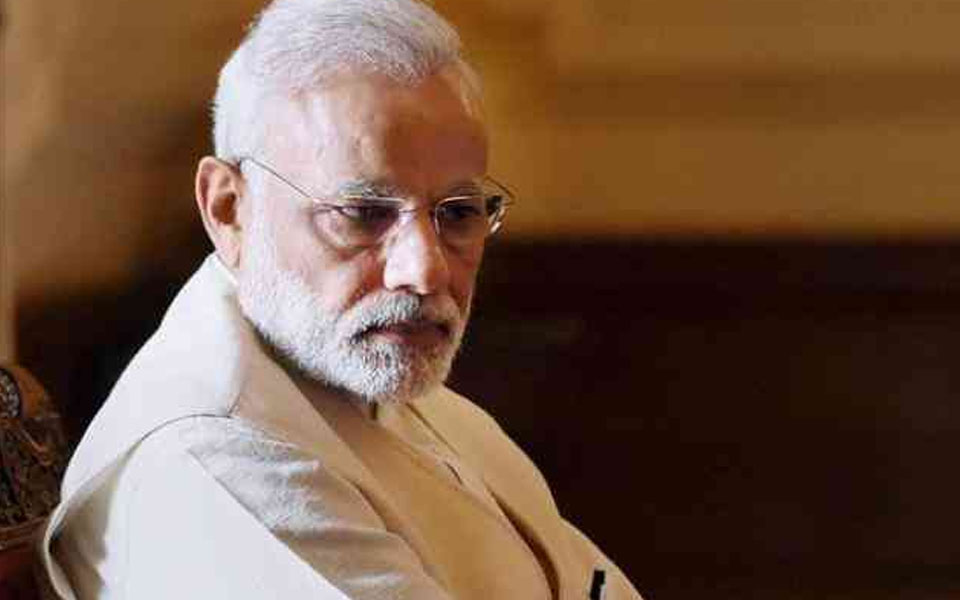
Mumbai, June 25 : Referring to suicides in Maharashtra by farmers and others, the Shiv Sena on Monday pointedly asked Prime Minister Narendra Modi: "Is this your promised 'Achhe Din'?"
Blaming the BJP-led governments at the centre and in Maharashtra, the Sena said that all these people took the extreme step of ending their lives due to poverty, lack of resources to survive and financial burdens resulting from the government's economic policies.
"The reality is that Maharashtra is in the grip of a severe crisis, people are going hungry, unable to make ends meet and entire families are resorting to suicides, not only in mofussil areas but even in Mumbai," the Sena said in editorials in the party mouthpieces 'Saamana' and 'Dopahar Ka Saamana'.
It cited the suicide of Mumbai couple Pravin Patel and Reena and their 11-year son. The family had taken huge loans for the cancer treatment of their 14-year old daughter who died recently and they could not afford to repay the loans, driving them to suicide.
The Sena said Mumbai was again stunned last week by the suicide of a government employee, Rajesh Bhingare, who ended his life along with his wife and two children as they couldn't afford their own home in Mumbai for years.
In Pandharpur in Solapur district, a 21-year-old engineering student, Alisha Navate, committed suicide as she was pained to see her parents struggling to pay for her education.
A poor farmer of Ahmednagar district's Pokhri-Baleshwar village, Santuji Fatangre throttled his two minor daughters and then committed suicide as he could no longer earn enough to feed the family.
"Until now, we heard only of debt-ridden farmers of Vidarbha killing themselves, but now suicide reports are coming from all over the state including Mumbai. People are despairing under poverty and hunger and choosing the last option - suicide," the Sena said.
Attacking the Prime Minister as well as Maharashtra Chief Minister Devendra Fadnavis, the Sena said both travel abroad frequently and upon return make tall claims of bringing huge development and prosperity which it said was visible nowhere.
"If there's any impression left that PM Modi will do something for the poor, we have to come out of it. There is only talk of all-round 'vikas', increase in GDP, but the poor continue to suffer, their lives have no value," it pointed out.
Referring to the recent 'Sampark to Samarthan' initiative launched by the BJP, the Sena said they are "in touch with Madhuri Dixit, Salman Khan, Tatas, Birla," but have lost their "contact with the poor in the country" and fail to understand the burning problems confronting the masses.
"The government is bringing forth expensive projects like Bullet Train, Metro Rail and Hyper Cities for the rich but if it cannot stop the poor people from committing suicides. Then burn these big ticket projects," the Sena demanded.
Let the Truth be known. If you read VB and like VB, please be a VB Supporter and Help us deliver the Truth to one and all.
AIITA welcomes Karnataka’s ban on obscene songs in school events
Bhatkal: The Karnataka unit of the All India Ideal Teachers Association (AIITA) has welcomed the Karnataka government’s decision to strictly ban school children from dancing to obscene songs during educational and cultural programmes in government, aided, and private schools across the state.
AIITA Karnataka State President M. R. Manvi congratulated the government for taking what he termed an important step to preserve the sanctity of education.
“Such decisions to safeguard the dignity of school children and uphold the values of education are the need of the hour. This rule should not be limited to government schools alone but must be strictly implemented in all private educational institutions as well,” he said.
He further urged the government to address other concerns within school programmes.
“The government should not only prohibit obscene dances in the name of school anniversaries, but also ensure that plays and dialogues that incite religious hatred are avoided. Schools should be centres of harmony, not platforms for spreading hatred,” he added.
According to a recent circular issued by the Department of School Education and Literacy, obscene dances are adversely affecting the mental health and moral values of students.
In this regard, schools have been advised to use songs that promote nationalism, positive thinking, the greatness of Kannada culture, and value-based traditions instead of inappropriate content during programmes.
The circular also emphasises that students should be dressed in decent attire.
AIITA also backed the department’s warning that disciplinary action would be taken against head teachers if such guidelines are violated. The association has further demanded that district Deputy Directors of Public Instruction strictly monitor the implementation of these rules.