Farmers force govt official who came to stop stubble burning to set paddy straw on fire in Bathinda
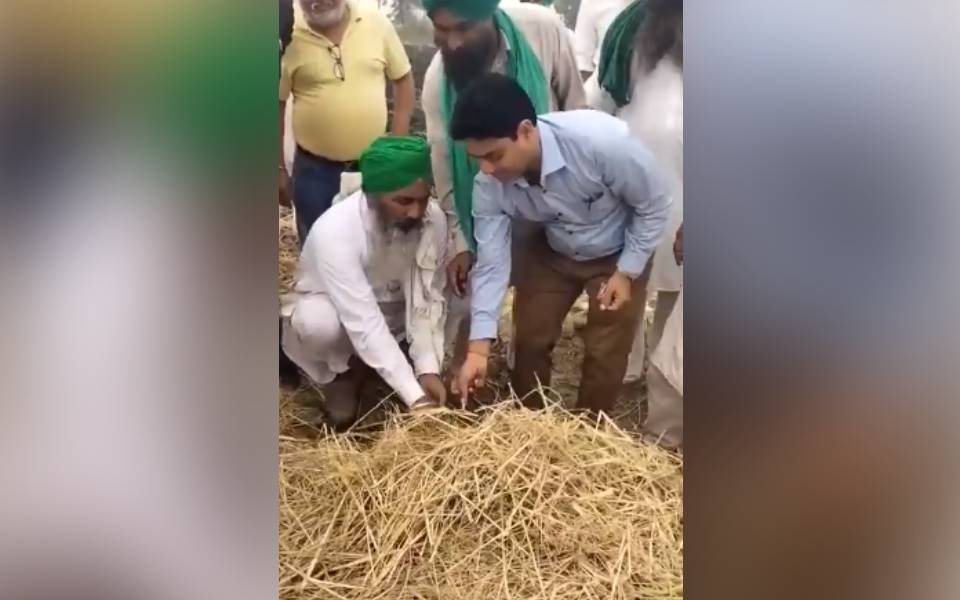
Chandigarh, Nov 4: A group of farmers allegedly forced a government official, who was part of a team to prevent farm fires, to set a heap of paddy stubble on fire in Punjab's Bathinda district an incident which drew condemnation from Chief Minister Bhagwant Mann.
A purported video of the entire incident also surfaced on social media. CM Mann said an FIR will be lodged in the matter.
Bathinda Deputy Commissioner Showkat Ahmad Parray on Saturday said he has written to the senior superintendent of police to register an FIR against the farmers for preventing the official from discharging his duty.
The incident took place in Mehma Sarja village on Friday when a team led by a special supervisor went there to check stubble burning incidents.
The DC said the official was surrounded by a group of 50-60 farmers with allegiance to a farmers' body, took him to a nearby field and forced him to put a heap of stubble on fire.
In the video, farmers could be heard saying that those who came to stop stubble burning were made to set the crop residue on fire.
The video also shows that the official's hand was held by two farmers, as they force him to set the stubble on fire with a matchstick.
The video was made by one of the farmers.
"when he (official) was mobbed, what option he could have. He had no choice," DC Parray said.
The DC said that an FIR will be lodged in the matter and those who were behind the incident will be put behind the bars.
"I am also visiting the village myself. We will not let it go way. Lawlessness is not something that we will tolerate," said the DC.
The DC said he has already written to the Bathinda SSP, and added that the FIR will be lodged on Saturday.
In a strongly worded post on X, CM Mann said "Dear Punjabis, which way are you are heading? The government employee went with a message of not burning paddy stubble but he was made to set it on fire Guru Sahib ji has given air the status of Guru to destroy this, we are ending oxygen meant for our children by taking matchsticks in our hands FIR is going to be lodged."
Paddy straw burning in Punjab and Haryana is considered as one of the major reasons behind the alarming spike in air pollution levels in the national capital in October and November.
As the window for wheat -- a key Rabi crop -- is very short after paddy harvest, some farmers set their fields on fire to quickly clear off the crop residue for sowing of the next crop.
Punjab has reported a total of 12,813 stubble burning incidents till Friday, according to Punjab Remote Sensing Centre data.
Farmers in Bathinda’s Burj Mehma forced government officials, who had come to stop them from burning stubble, to set fire to the stubble. The farmers also recorded a video of the incident and protested against the team. #Punjab #Bathinda #stubbleburning pic.twitter.com/o6z0KPk6HJ
— Gagandeep Singh (@Gagan4344) November 4, 2023
Let the Truth be known. If you read VB and like VB, please be a VB Supporter and Help us deliver the Truth to one and all.
Rickelton's ton in vain as SRH beat MI by 6 wickets
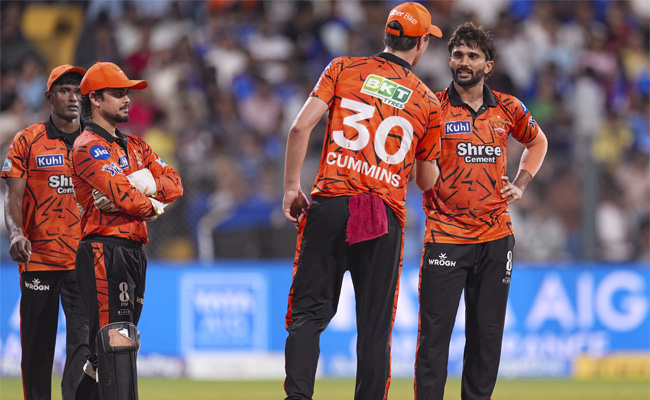
Mumbai (PTI): Ryan Rickelton's whirlwind unbeaten ton was overshadowed by Heinrich Klaasen's unbeaten 65 as Sunrisers Hyderabad defeated Mumbai Indians by six wickets in an IPL match here on Wednesday.
Chasing an imposing 244-run target, Travis Head (76 off 30) and Abhishek Sharma (45 off 24) shared 129 runs for the opening wicket to set the platform for SRH.
Klaasen (65 not out off 30 balls) then displayed his all-round hitting abilities to guide SRH home with the help of Nitish Kumar Reddy (21) and Salil Arora (30 not out off 10) in 18.4 overs.
Earlier, Rickelton's knock powered MI to 243 for five.
MI rode on a 93-run stand between Rickelton (123 not out off 55 balls) and Will Jacks (46 off 22) in 7.1 overs for the opening stand to power the side.
MI skipper Hardik Pandya scored a valuable 31 off 15 balls before being dismissed.
Praful Hinge (2/54), Eshan Malinga (1/29), Sakib Hasan (1/39) and Nitish Kumar Reddy (1/31) were the wicket-takers for SRH.
Brief Scores:
Mumbai Indian: 243 for 5 in 20 overs (Ryan Rickelton 123 not out; Praful Hinge 2/54).
Sunrisers Hyderabad: 249 for 4 in 18.4 overs (Travis Head 76, Heinrich Klaasen 65 not out; AM Ghazanfar 2/51).