Farmers' Punjab bandh cripples commuter traffic; rail, bus service suspended
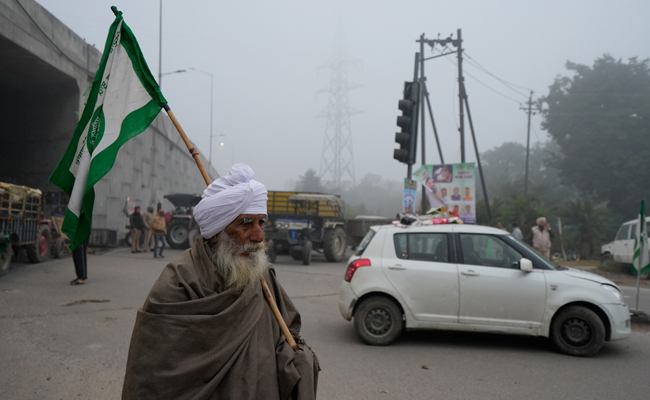
Chandigarh (PTI): Life was hit in several places of Punjab due to a 'bandh' imposed by farmers who have been agitating against the Centre for a legal guarantee of a minimum support price for their crops.
Rail and road traffic was crippled and commercial establishments remained shut in many places of the state. Farmers staged 'dharnas' on several roads as part of their bandh call, throwing commuter traffic out of gear. A call for a shutdown was given over a week ago by Samyukta Kisan Morcha (Non-political) and Kisan Mazdoor Morcha over the Centre not acting on the farmers' demand for a legal guarantee for the MSP. The bandh will be observed from 7 am to 4 pm.
Farmers observed a sit-in at Dhareri Jattan Toll Plaza which affected vehicular movement on the Patiala-Chandigarh National Highway. At Amritsar's Golden Gate, scores of farmers started to assemble near the city's entry point. Dharnas were staged in Bathinda's Rampura Phul.
Farmer leader Sarwan Singh Pandher told reporters in Amritsar that emergency and other essential services would be allowed to operate. He said anyone travelling to the airport to catch a flight anyone going to attend a job interview, or anyone needing to attend a wedding, will be allowed. "All establishments are closed. Punjabis have shown their unity today and they are extending full support," Pandher claimed. "We are seeing a successful bandh. Train services are also completely suspended and no train is entering Punjab," he said.
In Phagwara, farmers staged a dharna near the Sugarmill crossing on NH-44, blocking the roads leading from Phagwara towards Nakodar, Hoshiarpur and Nawanshahr. They also staged a dharna at Behram toll plaza on Phagwara-Banga road. Grain markets were shut in several places. Pandher claimed their strike has received strong support from transporters, employee unions, traders bodies, and religious bodies.
In the Mohali district, markets were deserted and hardly any traffic on the roads. Public transport remained off roads at several places, while most private bus operators suspended services abiding by the bandh call. Railways cancelled several trains passing through the state. The bandh's impact was also seen in some neighbouring areas of the state, including Ambala. Hundreds of daily commuters travelling from Ambala to Chandigarh, Mohali, Patiala and other nearby cities of Punjab were thrown off stride because of the shutdown.
Buses took alternate routes to go from Ambala to Chandigarh as they had to cross a stretch of the national highway that passes through Punjab. Sangeeta, who commutes every day from Ambala to Zirakpur for her work, was waiting for a bus at Ambala Cantt in Haryana. All buses going towards Chandigarh from Ambala were too crowded, she said.
Many outsiders studying in various coaching centres in Chandigarh faced a tough time reaching their destinations. Meanwhile, 70-year-old farmer leader Jagjit Singh Dallewal's hunger strike entered its 35th day on Monday. Dallewal has so far refused medical treatment.
Hundreds of farmers have been protesting at the Punjab-Haryana border demanding a legal guarantee of a minimum support price (MSP) for crops.
Dallewal had earlier said he would not break his fast until the government agreed to the farmers' demands.
The apex court has given the Punjab government time till December 31 to persuade Dallewal to shift to a hospital, granting the state the liberty to seek logistical support from the Centre, if necessary.
Farmers, under the banner of SKM (Non-Political) and Kisan Mazdoor Morcha, have been camping at the Shambhu and Khanauri border points between Punjab and Haryana since February 13, after their march to Delhi was stopped by security forces.
A "jatha" (group) of 101 farmers attempted to march to Delhi on foot three times between December 6 and 14 but were stopped by security personnel from Haryana.
Besides the MSP, farmers are also demanding a debt waiver, pension, no hike in electricity tariffs, withdrawal of police cases, and "justice" for the victims of the 2021 Lakhimpur Kheri violence.
Let the Truth be known. If you read VB and like VB, please be a VB Supporter and Help us deliver the Truth to one and all.
KMES Institutions shine in SSLC result, continue four-decade legacy of education in rural Karkala
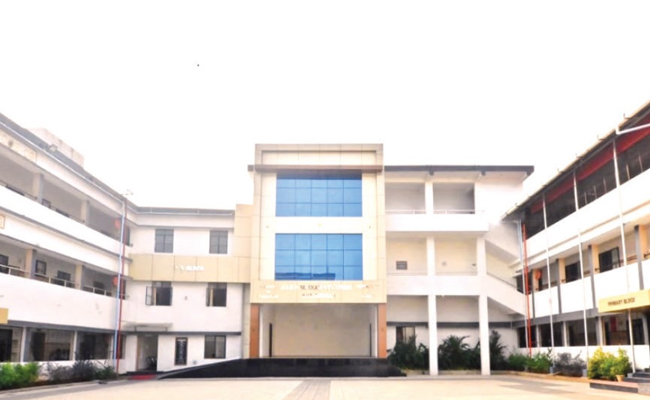
Karkala: KMES Institutions of Education at Kukkundooru in Karkala taluk has recorded outstanding results in the 2025-26 SSLC and PUC examinations, continuing a four-decade educational journey that began with just 22 kindergarten students and no building of its own.
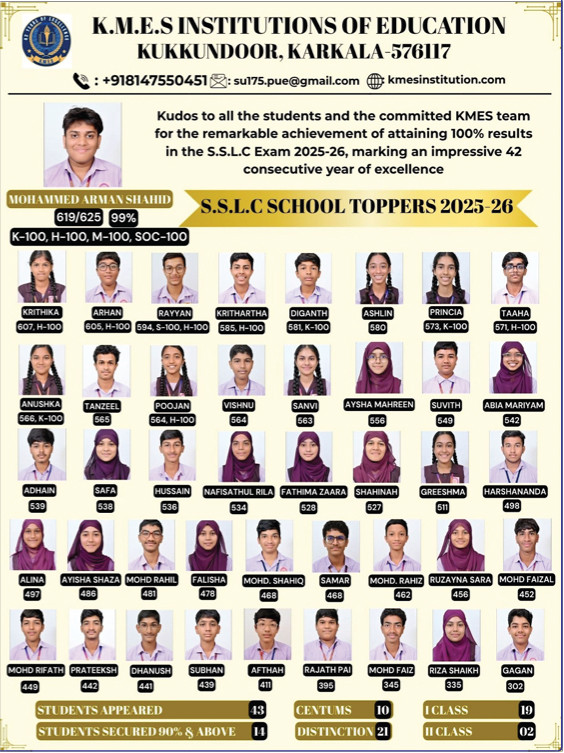
The institution secured a 100 per cent result in the SSLC examinations, with all 43 students passing the examination this year.
Muhammad Arman Shahid emerged as the school topper by scoring 619 marks out of 625, securing 99 per cent and also ranking sixth at the state level. He scored full marks in Kannada, Hindi, Mathematics and Social Science.
Krithika V. Nayak secured the second position in the school with 607 marks and 97.12 per cent, while Arhan stood third with 605 marks and 96.8 per cent.
Out of the 43 students, 21 passed with distinction, 19 secured first class, two students obtained second class and one student passed in third class. Fourteen students scored above 90 per cent.
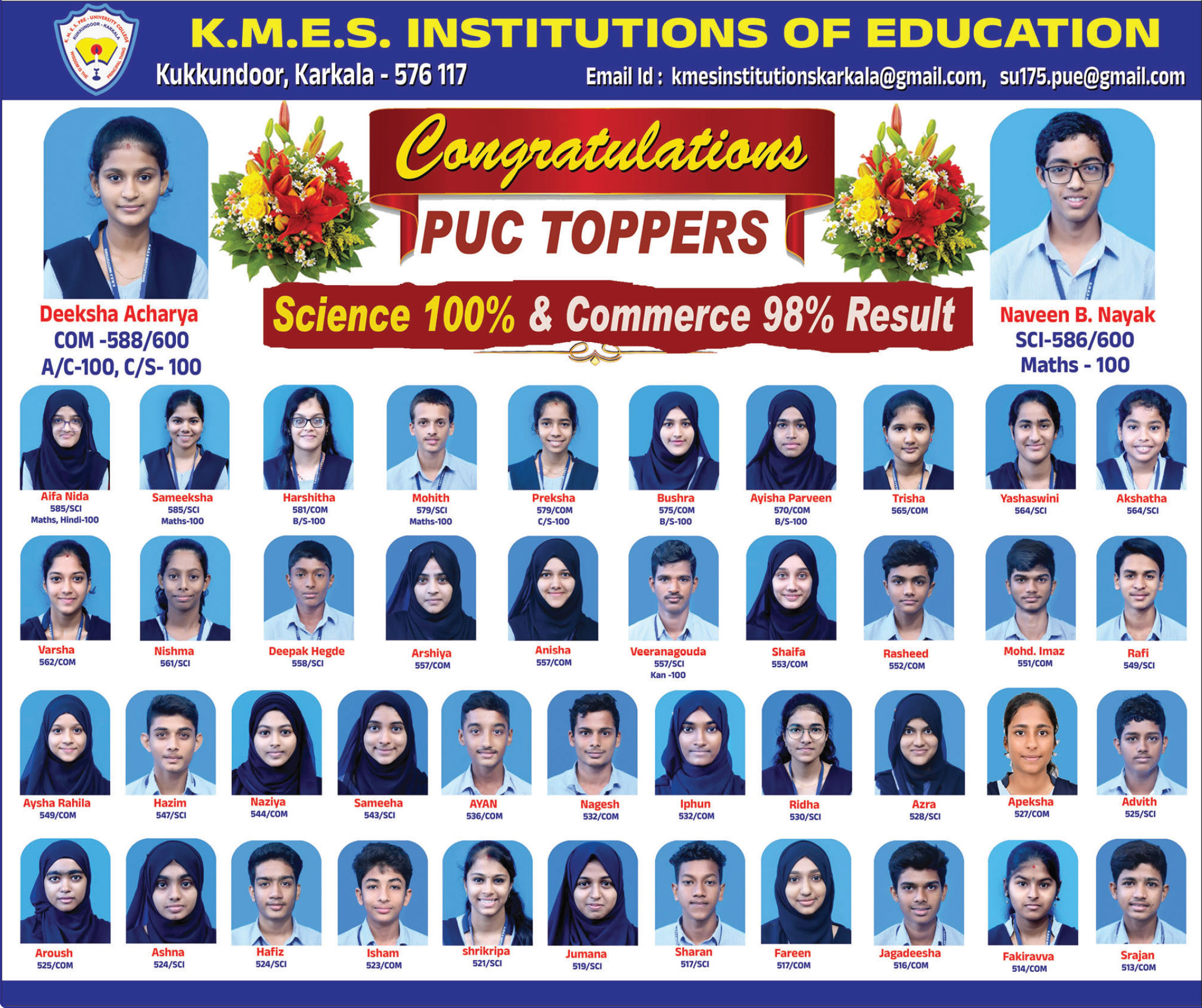
The institution also performed strongly in the PUC examinations. The Science stream recorded a 100 per cent result, with all 44 students passing, while Commerce secured a 98 per cent pass percentage.
Twelve students scored full marks in different subjects, including Mathematics.
In Commerce, Deeksha Acharya topped the college with 588 marks, while Harshitha H. Kini secured the second position with 581 marks.
In Science, Naveen B. Nayak emerged as topper with 586 marks, followed closely by Sameeksha Moily and Aifa Nidha, who both secured 585 marks.
Speaking about the achievement, High School head teacher Shrimati Patkar said the institution has always focused on supporting academically weak students through affordable education and free special classes.
“Our ambition is to provide quality education even to students who struggle in studies. The fees are very low, and free coaching classes are conducted. I have worked here for 28 years and have always found the atmosphere supportive of education,” she said.
Primary School head teacher Lolita Zeena D’Silva appreciated the dedication of the teaching staff and said the school encourages students not only to achieve high marks but also to become role models.
PU College Principal Balakrishna Rao said the institution focuses on value-based education and overall personality development.
“The aim is to help students succeed not only academically but also in cultural activities, sports and leadership. We encourage qualities such as patience, tolerance and discipline,” he said.
Rao also credited the institution’s growth to the support of founders K.S. Mohammed Masood and K.S. Nissar Ahmed, along with President K.S. Imtiaz Ahmed.
Speaking on the occasion, Imtiaz Ahmed said the institution was built on the dream of making quality education accessible to financially backward families in rural areas.
He said the guidance and encouragement of his elder brothers, Mohammed Masood and Nissar Ahmed, along with the contribution of teachers, students and parents, helped transform the institution into a model educational centre.
The KMES Institutions trace their roots back to 1984, when they were founded by senior social activists Haji P.M. Khan, K.S. Nazeer Ahmed and Haji A.S. Rashid Haider.
The institution initially functioned from the Government Urdu School premises as it did not have a building of its own. Classes began with only 22 students in lower kindergarten and two teachers.
Later, under the leadership of K.S. Mohammed Masood and with continuous financial and moral support from non-resident businessman K.S. Nissar Ahmed, the institution gradually expanded.
In 1993, the school shifted to its own building and began conducting classes from LKG to Class 5.
As student admissions increased, Nissar Ahmed personally funded the construction of three additional classrooms to address infrastructure shortages.
The institution’s new school building was completed in 1997, while the PU College building was constructed in 2001.
From humble beginnings in a borrowed building to producing state-level rank holders and consistent academic results, the KMES Institutions have grown into one of the prominent educational centres in the Karkala region.