Final analysis of Covaxin efficacy out; vaccine 65.2 percent effective against Delta variant
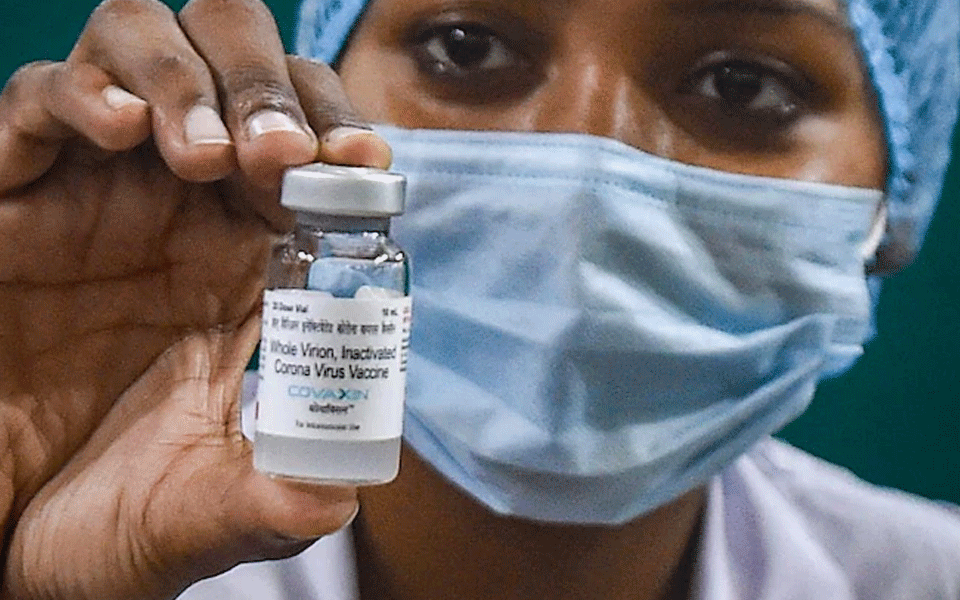
Hyderabad: Bharat Biotech's Covaxin has demonstrated 77.8 per cent effectiveness against symptomatic COVID-19 and65.2 per cent protection against the new Delta variant.
The company on Saturday said it concluded the final analysis of Covaxin efficacy from Phase3 trials.
The efficacy analysis demonstrates Covaxin to be 93.4 per cent effective against severe symptomatic COVID-19 cases while safety analysis shows adverse events reported were similar to placebo, with 12 per cent of subjects experiencing commonly known side effects and less than 0.5 per cent feeling serious adverse events.
The efficacy data demonstrates 63.6 per cent protection against asymptomatic COVID-19, a release from the city-based vaccine maker said.
Phase 3 clinical trials of the vaccine was an event driven analysis of 130 symptomatic COVID-19 cases, reported at least two weeks after the second dose, conducted at 25 sites across India.
The whole virion inactivated vaccine against SARS-CoV2, was developed in partnership with Indian Council of Medical Research and National Institute ofVirology in Pune.
Krishna Ella, Chairman and Managing Director of Bharat Biotech, said, "The successful safety and efficacy readouts of Covaxin as a result of conducting the largest ever COVID Vaccines trials in India establishes the ability of India and developing world countries to focus towards innovation and novel product development.
We are proud to state that Innovation from India will now be available to protect global populations."
Director General of ICMR, Balram Bhargava said, "I am delighted to note that Covaxin developed by ICMR and BBIL under an effective public private partnership, has demonstrated an overall efficacy of 77.8 per cent in India's largest COVID phase 3 clinical trial thus far.
Our scientists at ICMR and BBIL have worked tirelessly to deliver a truly effective vaccine of highest international standards."
He further said Covaxin will not only benefit the Indian citizens but would also immensely contribute to protect the global community against the deadly SARS-CoV-2 virus.
"I am also pleased to see that Covaxin works well against all variant strains of SARS-CoV-2.
The successful development of Covaxin has consolidated the position of Indian academia and Industry in the global arena," Bhargava said.
The Phase 3 trials were conducted between November 16, 2020 and January 7, 2021 with 25,798 participants who were randomised to BBV152 or placebo groups.
The preprint data of COVAXIN efficacy has not been certified by peer-review, according to Medrxiv in which thedata was published.
Let the Truth be known. If you read VB and like VB, please be a VB Supporter and Help us deliver the Truth to one and all.
UP man gets life term for electrocuting mentally challenged wife to death in Bareilly

Bareilly (UP) (PTI): A local court here has sentenced a man to life imprisonment for murdering his mentally challenged wife by repeatedly electrocuting her while she was tied to a cot, lawyers said on Thursday.
Additional district government counsel Harendra Singh Rathore said Additional Sessions Judge Avinash Kumar Singh on Wednesday convicted Vinod Kumar (45) for killing his wife, Satyavati, in Chaina village of Bareilly district and imposed a fine of Rs 15,000 on him.
According to the prosecution, he was allegedly frustrated with his wife Satyavati's mental illness and often assaulted her.
Rathore said the prosecution examined nine witnesses to establish the charges against him.
As per court records, on the night of May 1-2, 2022, when Satyavati was asleep, Vinod tied her hands and legs to a cot using ropes and then connected an aluminium cable to an electric board to repeatedly administer electric shocks to her.
"She writhed in pain, but the accused continued to electrocute her until she died," the prosecution said.
The court observed that the murder was carried out in an inhuman manner.
After committing the crime, the accused threw the rope and cable on the roof and left for work at a brick kiln around 2 am to create a false alibi.
He later tried to mislead the police and the victim's family by claiming that Satyavati, whose mental condition was unstable, had accidentally died by suicide after grabbing a live electric wire.
However, the victim's brother, Sanjeev, a resident of Shahjahanpur district, suspected foul play and lodged an FIR under sections 498A (husband subjecting wife to cruelty) and 302 (murder) of the Indian Penal Code at Nawabganj police station.
During the trial, the prosecution relied on the post-mortem report prepared by Dr Faraz Anwar, who stated that multiple electrocution marks found on different parts of the victim's body could not have been self-inflicted.
The police also recovered the rope and electric wire used in the crime on the accused's identification, officials said.