Finance Minister Nirmala Sitharaman asks corporates to clear dues to MSMEs in 45 days
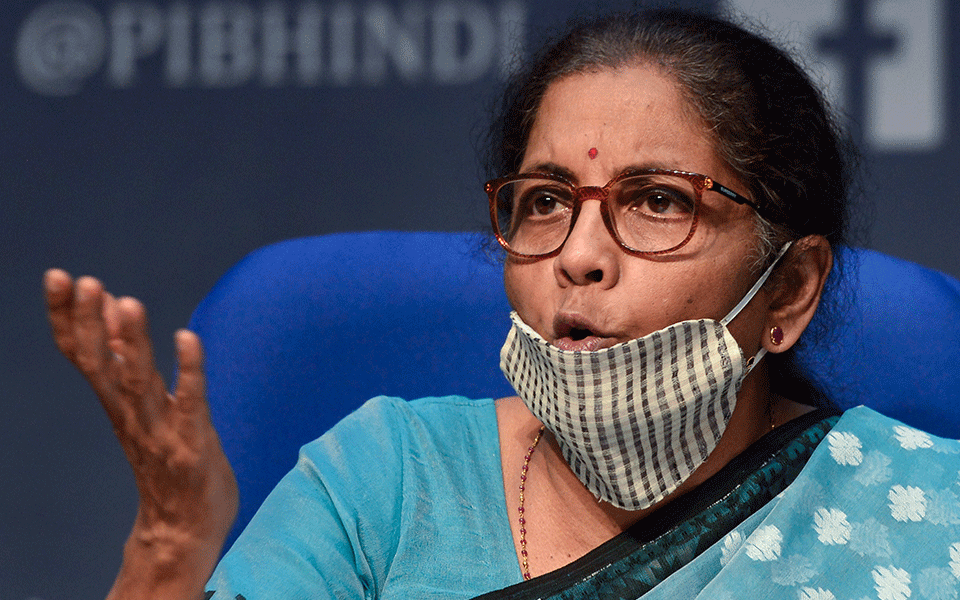
Mumbai(PTI): Finance Minister Nirmala Sitharaman on Friday asked private sector companies to clear dues to small businesses within 45 days and admitted that the central departments and enterprises are also not making payments to them on time.
She conceded that the Centre, states and state-owned enterprises too have outstanding dues to micro, small and medium enterprises (MSMEs).
The minister said that at a meeting with big businesses here two days ago, she had appealed to them to ensure that the dues of small businesses, who are the backbone of the economy, are cleared on time.
"Private sector industry should commit to make payments to MSMEs in 45 days along with the books of accounts filed with the Registrar of Companies which make a mention of outstanding dues, she said at an event organized by the Laghu Udyog Bharati, the RSS-affiliate devoted to small businesses, here this morning.
However, she admitted that the central departments and enterprises are also not making timely payments to MSMEs.
The minister, who has been in the financial capital since Wednesday, also said the Centre too will be taking adequate steps to resolve the issue of dues to MSMES by ensuring that the central departments and various enterprises make payments to them in 90 days and also appealed to states and their public sector enterprises to do so.
Stating that her ministerial colleagues also frequently bring up the issue of accumulating dues of MSMEs, Sitharaman highlighted various government schemes like the Treds (trade receivables discounting system) platform and also the Samadhan portal, which have helped small businesses to get timely payments.
Listing out the various initiatives rolled out to support the sector, she named the Rs 6,000-crore RAMP (racing and accelerating MSME performance) scheme for exporters and the Rs 500-crore digital transfers to 18,000 MSMEs under the self-reliance scheme, which has a total outlay of Rs 5,000 crore.
She urged MMSEs to embrace technology and provide skilling and upskilling training to bring efficiency in the production, and take advantage of Web 3.0 not to replace the workforce but to enhance productivity.
Artificial Intelligence, big data analysis and digitalisation will accelerate the pace of growth in the next 25 years and it will impact MSMEs in a positive way, she said.
Let the Truth be known. If you read VB and like VB, please be a VB Supporter and Help us deliver the Truth to one and all.
UP man gets life term for electrocuting mentally challenged wife to death in Bareilly
Bareilly (UP) (PTI): A local court here has sentenced a man to life imprisonment for murdering his mentally challenged wife by repeatedly electrocuting her while she was tied to a cot, lawyers said on Thursday.
Additional district government counsel Harendra Singh Rathore said Additional Sessions Judge Avinash Kumar Singh on Wednesday convicted Vinod Kumar (45) for killing his wife, Satyavati, in Chaina village of Bareilly district and imposed a fine of Rs 15,000 on him.
According to the prosecution, he was allegedly frustrated with his wife Satyavati's mental illness and often assaulted her.
Rathore said the prosecution examined nine witnesses to establish the charges against him.
As per court records, on the night of May 1-2, 2022, when Satyavati was asleep, Vinod tied her hands and legs to a cot using ropes and then connected an aluminium cable to an electric board to repeatedly administer electric shocks to her.
"She writhed in pain, but the accused continued to electrocute her until she died," the prosecution said.
The court observed that the murder was carried out in an inhuman manner.
After committing the crime, the accused threw the rope and cable on the roof and left for work at a brick kiln around 2 am to create a false alibi.
He later tried to mislead the police and the victim's family by claiming that Satyavati, whose mental condition was unstable, had accidentally died by suicide after grabbing a live electric wire.
However, the victim's brother, Sanjeev, a resident of Shahjahanpur district, suspected foul play and lodged an FIR under sections 498A (husband subjecting wife to cruelty) and 302 (murder) of the Indian Penal Code at Nawabganj police station.
During the trial, the prosecution relied on the post-mortem report prepared by Dr Faraz Anwar, who stated that multiple electrocution marks found on different parts of the victim's body could not have been self-inflicted.
The police also recovered the rope and electric wire used in the crime on the accused's identification, officials said.