First de-orbiting manoeuvre performed for Chandrayaan-2 spacecraft: ISRO
Bengaluru: A day after lander 'Vikram' was separated from Chandrayaan-2's orbiter, the ISRO said on Tuesday it has successfully performed the first de-orbiting manoeuvre for the spacecraft.
The city-headquartered space agency will perform one more de-orbit manoeuvre on Wednesday, before the powered descent on September 7 for its landing in the south polar region of the moon.
"The first de-orbiting manoeuvre for Chandrayaan-2 spacecraft was performed successfully today (September 03, 2019) beginning at 0850 hrs IST as planned, using the onboard propulsion system. The duration of the manoeuvre was 4 seconds," the ISRO said in an update.
"The orbit of Vikram Lander is 104 km x 128 km. Chandrayaan-2 Orbiter continues to orbit the Moon in the existing orbit and both the Orbiter and Lander are healthy," it said, adding that the next de-orbiting manoeuvre is scheduled on September 4, between 03:30 and 04:30 hrs IST.
In a key event of India's second moon mission Chandrayaan-2, lander 'Vikram' was separated from the orbiter on Monday.
Vikram (with rover 'Pragyan' housed inside) is expected to touch down on the surface of the moon on September 7, between 1:30 and 2:30 am.
Two de-orbit manoeuvres of Vikram Lander, to bring it further down, have been planned to prepare for its landing in the south polar region of the moon.
ISRO Chairman K Sivan has said the proposed soft-landing on the Moon is going to be a "terrifying" moment as it is something ISRO has not done before, where as LOI manoeuvre was successfully carried out during the Chandrayaan-1 mission.
Following the landing, the rover 'Pragyan' will roll out from lander 'Vikram' between 5:30 and 6:30 am on September 7, and carry out experiments on the lunar surface for a period of one lunar day, which is equal to 14 earth days.
The mission life of the lander is also one lunar day, while the orbiter will continue its mission for a year.
India's Geosynchronous Satellite Launch Vehicle, GSLV MkIII-M1 had successfully launched the 3,840-kg Chandrayaan-2 spacecraft into the earth's orbit on July 22.
Chandrayaan-2 satellite had began its journey towards the moon leaving the earth's orbit in the dark hours on August 14, after a crucial manoeuvre called Trans Lunar Insertion (TLI) that was carried out by ISRO to place the spacecraft on "Lunar Transfer Trajectory."
In a major milestone for India's second Moon mission, the Chandrayaan-2 spacecraft had successfully entered the lunar orbit on August 20 by performing Lunar Orbit Insertion (LOI) manoeuvre.
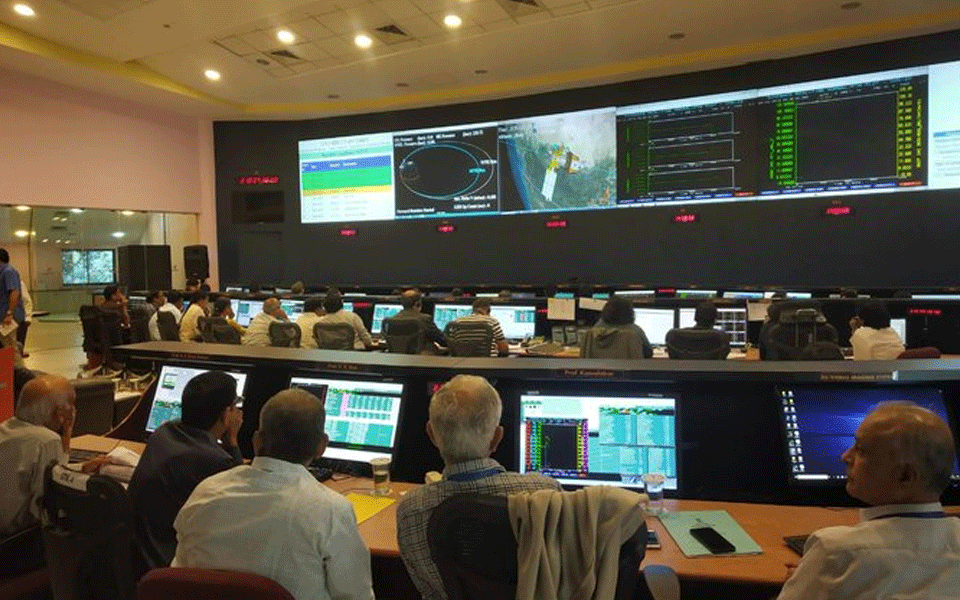
The health of the spacecraft is being continuously monitored from the Mission Operations Complex (MOX) at ISRO Telemetry, Tracking and Command Network (ISTRAC) in Bengaluru with support from Indian Deep Space Network (IDSN) antennas at Bylalu, near Bengaluru, the space agency has said.
The orbiter carries eight scientific payloads for mapping the lunar surface and studying the exosphere (outer atmosphere) of the Moon while the lander carries three scientific payloads to conduct surface and subsurface science experiments.
The rover carries two payloads to enhance the understanding of the lunar surface. India's second lunar expedition -- would shed light on a completely unexplored section of the Moon, its South Polar region.
According to ISRO, the objective of the Rs 978 crore Chandrayaan-2 is to develop and demonstrate the key technologies for end-to-end lunar mission capability, including soft-landing and roving on the lunar surface.
On the science front, this mission aims to further expand knowledge about the moon through a detailed study of its topography, mineralogy, surface chemical composition, thermo-physical characteristics and atmosphere, leading to a better understanding of the origin and evolution of the moon, the space agency had said.
On successful completion, it will make India the fourth country after Russia, the US and China to pull off a soft landing on the moon.
Let the Truth be known. If you read VB and like VB, please be a VB Supporter and Help us deliver the Truth to one and all.
Man arrested with Rs 2.54-crore heroin in Mumbai

Mumbai (PTI): Police have arrested a man and seized over 500 grams of heroin worth Rs 2.54 crore in the illicit market from him in Mumbai, officials said on Friday.
The police's Anti-Narcotics Cell (ANC) made the drug seizure in Santacruz in the western suburbs. The operation was conducted by the Kandivali unit of the ANC on Thursday as part of a special crackdown against drug trafficking in the area, they said.
Acting on specific inputs, an ANC team conducted a raid in Santacruz (East) and intercepted a man. During a search, the team recovered 508 grams of high-grade heroin from his possession, an official said.
The seized contraband, a highly addictive, opioid drug derived from morphine, is estimated to be worth Rs 2.54 crore in the international market, he informed.
Following the seizure, a case was registered against the man under relevant sections of the Narcotic Drugs and Psychotropic Substances (NDPS) Act, 1985, and he was formally placed under arrest in the early hours of Friday.
The police are currently investigating the source of the drug and trying to identify the intended recipients of the consignment, he said.