Five-judge SC bench refuses to grant legal recognition to same-sex marriage
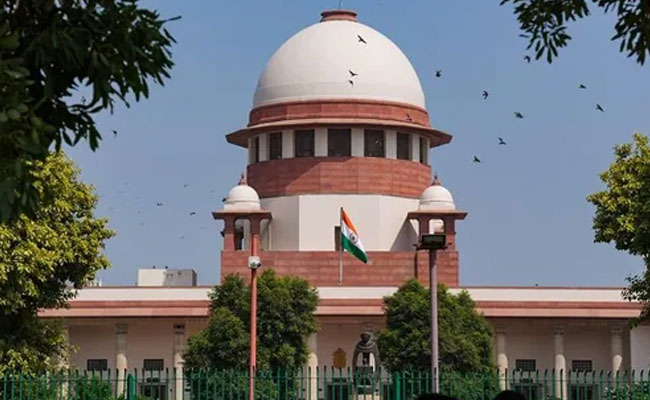
New Delhi (PTI): A five-judge Constitution bench of the Supreme Court on Tuesday refused to grant legal recognition to same-sex marriages.
Chief Justice of India D Y Chandrachud, who was heading the bench pronouncing its verdict on 21 pleas seeking legal validation for same-sex marriages, said the court can't make law but only interpret it and it is for Parliament to change the Special Marriage Act.
At the outset, Justice Chandrachud said there are four judgments -- by himself, Justices Sanjay Kishan Kaul, S Ravindra Bhat and P S Narasimha -- in the matter. Justice Hima Kohli is also a part of the five-judge bench.
Directing the Centre, states and Union Territories (UTs) to ensure the queer community is not discriminated against, the CJI, who is heading the constitution bench, said queer is a natural phenomenon known for ages and is neither urban nor elitist.
Justice Kaul said he agrees with the CJI on grant of certain rights to queer couples.
"Non-heterosexual and heterosexual unions must be seen as both sides of same coin," he said, adding that legal recognition of non-heterosexual unions is step towards marriage equality.
Justice Bhat, who read out the operative portion of his verdict, said he agrees and differs with views of the CJI on certain points.
Delivering his verdict on the critical issue, the CJI said it is for Parliament to decide whether there is need for a change in the regime of the Special Marriage Act.
"This court can't make law. It can only interpret it and give effect to it," he said.
Justice Chandrachud said the court has recorded Solicitor General Tushar Mehta's statement that the Centre will form a committee to decide the rights and entitlements of persons in queer unions.
While reading out the operative portion of his verdict, he directed the Centre, states and UTs to take steps to sensitise public about queer rights and ensure that inter-sex children are not allowed sex-change operations at an age they cannot fully comprehend consequence.
The CJI directed the police to conduct preliminary enquiry before registering an FIR against queer couple over their relationship.
He said homosexuality or queerness is not an urban concept or restricted to the upper class.
To imagine queer as existing only in urban spaces would be like erasing them and queerness can be regardless of one's caste or class, Justice Chandrachud said.
He said it would be incorrect to state that marriage is a "static and unchanging institution".
Justice Chandrachud said the ability to choose a life partner goes to the roots of the right to life and liberty under Article 21 of the Constitution.
The right to enter into a union includes the right to choose a partner and its recognition, the CJI said, adding that failure to recognise such an association would be discriminatory.
"All persons, including those queer, have right to judge moral quality of their lives," he said.
The CJI said this court has recognised that equality demands that queer persons are not discriminated against.
He said the law cannot assume that only heterosexual couples can be good parents as it would amount to discrimination against queer couples.
On May 11, the bench reserved its verdict on the pleas after a marathon hearing of 10 days.
During the arguments, the Centre had told the apex court that any constitutional declaration made by it on the petitions seeking legal validation for same-sex marriage may not be a "correct course of action" as the court will not be able to foresee, envisage, comprehend and deal with its fallout.
The apex court had commenced hearing arguments in the matter on April 18.
The bench had made it clear during the arguments that it will not go into personal laws governing marriages while deciding the pleas seeking judicial validation for same-sex marriages and said the very notion of a man and a woman, as referred to in the Special Marriage Act, is not "an absolute based on genitals".
Some of the petitioners had urged the apex court to use its plenary power, "prestige and moral authority" to push the society to acknowledge such a union which would ensure LGBTQIA++ lead a "dignified" life like heterosexuals.
LGBTQIA++ stands for lesbian, gay, bisexual, transgender, queer, questioning, intersex, pansexual, two-spirit, asexual and ally persons.
On May 3, the Centre had told the court it will constitute a committee headed by the cabinet secretary to examine the administrative steps that could be taken for addressing "genuine humane concerns" of same-sex couples without going into the issue of legalising their marriage.
On April 27, the court asked the Centre whether social welfare benefits such as opening joint bank accounts, nominating a life partner in provident fund, gratuity and pension schemes can be extended to same-sex couples without going into the issue of legal sanction to their marriage.
Let the Truth be known. If you read VB and like VB, please be a VB Supporter and Help us deliver the Truth to one and all.
AIITA welcomes Karnataka’s ban on obscene songs in school events

Bhatkal: The Karnataka unit of the All India Ideal Teachers Association (AIITA) has welcomed the Karnataka government’s decision to strictly ban school children from dancing to obscene songs during educational and cultural programmes in government, aided, and private schools across the state.
AIITA Karnataka State President M. R. Manvi congratulated the government for taking what he termed an important step to preserve the sanctity of education.
“Such decisions to safeguard the dignity of school children and uphold the values of education are the need of the hour. This rule should not be limited to government schools alone but must be strictly implemented in all private educational institutions as well,” he said.
He further urged the government to address other concerns within school programmes.
“The government should not only prohibit obscene dances in the name of school anniversaries, but also ensure that plays and dialogues that incite religious hatred are avoided. Schools should be centres of harmony, not platforms for spreading hatred,” he added.
According to a recent circular issued by the Department of School Education and Literacy, obscene dances are adversely affecting the mental health and moral values of students.
In this regard, schools have been advised to use songs that promote nationalism, positive thinking, the greatness of Kannada culture, and value-based traditions instead of inappropriate content during programmes.
The circular also emphasises that students should be dressed in decent attire.
AIITA also backed the department’s warning that disciplinary action would be taken against head teachers if such guidelines are violated. The association has further demanded that district Deputy Directors of Public Instruction strictly monitor the implementation of these rules.