Flawed measure of 'hunger' that doesn't reflect true position: Govt on India's rank of 111th in GHI
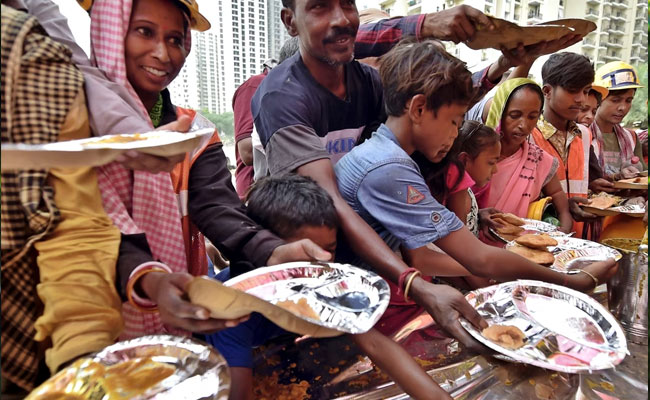
New Delhi (PTI): The government has rejected the 2023 Global Hunger Index in which India ranked 111th, calling it a flawed measure of "hunger" that does not reflect the country's true position.
The Women and Child Development Ministry said the index suffers from "serious methodological issues and shows a malafide intent".
India ranked 111th out of 125 countries in the Global Hunger Index-2023, released on Thursday, with the country reporting the highest child wasting rate at 18.7 per cent.
The Global Hunger Index (GHI) is a tool for comprehensively measuring and tracking hunger at global, regional, and national levels.
Rejecting India's ranking at the index, the Women and Child Development Ministry said the Global Hunger Index continues to be a flawed measure of "hunger" and does not reflect India's true position.
"The index is an erroneous measure of hunger and suffers from serious methodological issues. Three out of the four indicators used for calculation of the index are related to the health of children and cannot be representative of the entire population. The fourth and most important indicator 'Proportion of Undernourished (PoU) population' is based on an opinion poll conducted on a very small sample size of 3,000," it said.
The ministry said that since April 2023, the measurement data of children under five years uploaded on the Poshan Tracker has consistently increased - from 6.34 crore in April 2023 to 7.24 crore in September 2023.
"The percentage of child wasting, as seen on the Poshan Tracker, has been consistently below 7.2 per cent, month-on-month, as compared to the value of 18.7 per cent used for child wasting in the Global Hunger Index 2023," the ministry said in a statement.
According to the index, the rate of undernourishment in India stood at 16.6 per cent and under-five mortality at 3.1 per cent.
The ministry further said two other indicators, namely stunting and wasting, are outcomes of complex interactions of various other factors like sanitation, genetics, environment and utilisation of food intake apart from hunger which is taken as the causative/outcome factor for stunting and wasting in the GHI.
Also, there is hardly any evidence that the fourth indicator -- child mortality -- is an outcome of hunger, it said.
Let the Truth be known. If you read VB and like VB, please be a VB Supporter and Help us deliver the Truth to one and all.
AIITA welcomes Karnataka’s ban on obscene songs in school events
Bhatkal: The Karnataka unit of the All India Ideal Teachers Association (AIITA) has welcomed the Karnataka government’s decision to strictly ban school children from dancing to obscene songs during educational and cultural programmes in government, aided, and private schools across the state.
AIITA Karnataka State President M. R. Manvi congratulated the government for taking what he termed an important step to preserve the sanctity of education.
“Such decisions to safeguard the dignity of school children and uphold the values of education are the need of the hour. This rule should not be limited to government schools alone but must be strictly implemented in all private educational institutions as well,” he said.
He further urged the government to address other concerns within school programmes.
“The government should not only prohibit obscene dances in the name of school anniversaries, but also ensure that plays and dialogues that incite religious hatred are avoided. Schools should be centres of harmony, not platforms for spreading hatred,” he added.
According to a recent circular issued by the Department of School Education and Literacy, obscene dances are adversely affecting the mental health and moral values of students.
In this regard, schools have been advised to use songs that promote nationalism, positive thinking, the greatness of Kannada culture, and value-based traditions instead of inappropriate content during programmes.
The circular also emphasises that students should be dressed in decent attire.
AIITA also backed the department’s warning that disciplinary action would be taken against head teachers if such guidelines are violated. The association has further demanded that district Deputy Directors of Public Instruction strictly monitor the implementation of these rules.