Flight delays, cancellations likely over issue with A320 family aircraft; over 200 planes impacted
_vb_78.jpeg)
New Delhi (PTI): IndiGo, Air India and Air India Express flight operations will see disruptions as they work on fixing a potential issue related to flight controls in their A320 family planes and 200-250 aircraft will be impacted in the country, according to sources.
Airbus on Friday said intense solar radiation might corrupt data critical to flight controls in a significant number of A320 family aircraft and that the software changes required to fix the issue would lead to operational disruptions.
With many of the narrow-body A320 family planes of the domestic carriers set to undergo software changes or in some cases hardware realignment, there will be operational disruptions as the aircraft have to be grounded, the sources said.
Indian operators have about 560 A320 family aircraft and 200-250 of them will need software changes or hardware realignment, they added.
The European Union Aviation Safety Agency (EASA) said Airbus asked airline operators to install a serviceable Elevator Aileron Computer (ELAC) in the impacted aircraft.
Generally, ELAC is for flight controls.
EASA has directed that the issue should be addressed before the next flight to be operated by the impacted aircraft by replacing or modifying the affected ELAC.
On Saturday, the country's largest airline IndiGo said it is aware of a notification issued by Airbus, the manufacturer of the majority of our fleet, pertaining to the A320 family planes.
"We are working closely with Airbus to ensure implementation as per Airbus notification. While we carry out the necessary inspections, we are making every effort to minimise disruptions," it said in a statement.
In a statement Air India Express said, "We have initiated immediate precautionary action in response to an alert requiring a software fix on the Airbus A320 fleet. While a majority of our aircraft are not impacted, the guidance applies to operators worldwide and may result in adjustments to flight operations, including potential delays or cancellations."
A source said that 31 A320 family planes of Air India Express will be impacted.
In a post on X, Air India said it is aware of an Airbus directive related to its A320 family aircraft currently in-service across airline operators.
"This will result in a software/hardware realignment on a part of our fleet, leading to longer turnaround time and delays to our scheduled operations.
"Air India regrets any inconvenience this may cause to passengers till the reset is carried out across the fleet," the airline said.
The three airlines did not disclose the number of aircraft that have been impacted.
A320 family aircraft includes A319s, A320 ceos and neos, A321 ceos and neos.
In an Emergency Airworthiness Directive, EASA said Airbus has asked airline operators to install a serviceable ELAC in the impacted aircraft.
Airbus said an analysis of a recent event involving an A320 family aircraft has revealed that intense solar radiation may corrupt data critical to the functioning of flight controls.
"Airbus has consequently identified a significant number of A320 family aircraft currently in-service which may be impacted," it said in a release.
Airbus said it acknowledges these recommendations will lead to operational disruptions to passengers and customers. "We apologise for the inconvenience caused and will work closely with operators, while keeping safety as our number one and overriding priority."
The aircraft maker said it has worked proactively with the aviation authorities to request immediate precautionary action from operators via an Alert Operators Transmission (AOT) in order to implement the available software and/or hardware protection, and ensure the fleet is safe to fly.
According to the EASA, an Airbus A320 aeroplane recently experienced an uncommanded and limited pitch down event.
"The autopilot remained engaged throughout the event, with a brief and limited loss of altitude, and the rest of the flight was uneventful.
"Preliminary technical assessment done by Airbus identified a malfunction of the affected ELAC as possible contributing factor," it said.
This condition, if not corrected, could lead in the worst-case scenario to an uncommanded elevator movement that may result in exceeding the aircraft's structural capability, the EASA said.
It added that to address the potential unsafe condition, a serviceable ELAC has to be installed in the impacted planes.
Let the Truth be known. If you read VB and like VB, please be a VB Supporter and Help us deliver the Truth to one and all.
Have no personal involvement in Cong’s action against some minority leaders: Shivakumar
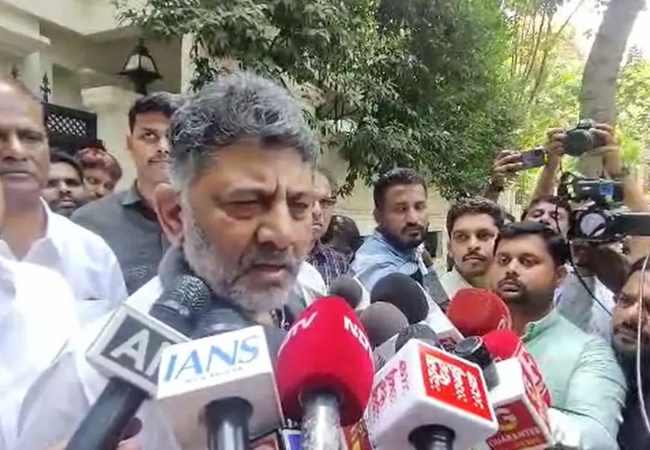
Bengaluru (PTI): Karnataka Deputy Chief Minister D K Shivakumar on Friday said he has no personal involvement in action taken against certain Congress leaders from the minority community following allegations of an internal conspiracy during the recently held Davanagere South bypolls.
He clarified that the decisions were taken by the party high command based on available reports.
Asserting that party discipline is of utmost importance, Shivakumar, who is also the Karnataka Pradesh Congress Committee (KPCC) president, sought to downplay concerns that action against minority leaders may send the message that “Muslims are being targeted.”
“I don’t have any personal involvement in this. Whatever decisions are taken are made by the party leadership. The party has its own reports. Decisions regarding MLAs or MLCs cannot be taken at the state level without instructions from Delhi,” he said.
Speaking to reporters, he added, “People may blame me; I am not concerned. Everyone must function in accordance with party discipline.”
Responding to concerns within sections of the party that recent actions may convey the impression that minority leaders are being targeted, he said the Congress exists for the welfare of Scheduled Castes, Scheduled Tribes, minorities, backward classes, farmers, and all sections of society.
The Congress has suspended MLC K Abdul Jabbar from primary membership and relieved another MLC, Naseer Ahmed, from the post of Chief Minister’s political secretary.
The action followed allegations by a group of Muslim leaders that certain party members conspired to defeat the official candidate in Davanagere South.
Following the action, speculation has emerged that Housing Minister B Z Zameer Ahmed Khan may also face disciplinary measures during the next cabinet reshuffle.
The three leaders had reportedly sought a Muslim candidate for the Davanagere South bypoll ticket, which the party instead allotted to the late MLA Shamanur Shivashankarappa’s grandson, Samarth Mallikarjun.
They were also said to have not actively participated in the campaign.
Shivakumar also rejected claims of factionalism within the ruling party amid speculation that leaders close to Chief Minister Siddaramaiah were being targeted.
Naseer Ahmed and Zameer Ahmed Khan are considered close to the CM.
Rejecting allegations of factionalism within the party, Shivakumar said, “We speak to each other every day. It is the media that creates divisions. Where is my faction? Has anyone put up a board saying they belong to the Siddaramaiah faction? Have I put up any such board?”
“All 139 legislators are my people, and they are all Siddaramaiah’s people as well. Everyone belongs to the Congress,” he added, saying there are no factions within the party and that such claims are media-driven.
Public Works Department (PWD) Minister Satish Jarkiholi met Shivakumar on Friday, a day after expressing concerns that disciplinary action against minority leaders may send the wrong message.
Shivakumar said he discussed with Jarkiholi the need to decongest Bengaluru traffic by diverting vehicles entering the city from state and national highways, along with party-related issues.
“We also discussed political matters in the interest of the party and the need to work together,” he said.
Later, speaking to reporters, Jarkiholi said he discussed with Shivakumar the issue of withdrawing Jabbar’s suspension. He said he will also visit New Delhi next week to meet the high command and discuss state developments.
“Jabbar’s suspension was discussed (with Shivakumar). It should be withdrawn. Let’s issue him a notice and allow him to reply. Then let’s send the report to the high command and seek their approval. High command approval is necessary because the instructions came from there. It may take some time,” he said.
Stating that he met the KPCC chief for “damage control,” the minister said, “We have tried to convince him. Sometimes certain decisions happen that need rectification.”
_vb_33.jpeg)