Forced to travel 50 km for online classes, children in Maha villages reach out to NCPCR for Internet

New Delhi: Around 200 children were forced to travel 50 kilometers everyday from remote coastal villages in Maharashtra to reach an area with Internet connection to attend online classes after they were hit first by COVID-19 lockdown and then by cyclone Nisarga.
Hit by a pandemic and then a natural disaster, the children had to deal with Internet disruptions since early June when connectivity along the coastal area of Ratnagiri district became patchy.
But when even after a month the situation did not improve, one of the students finally reached out to the apex child rights body NCPCR for help.
The National Commission for Protection Child Rights, in turn, ensured that the connectivity is restored in the fastest possible manner by reaching out to cellular companies and the district magistrate of the area, NCPCR Chairman Priyank Kanoongo said.
In his letter to the district magistrate of the area, Kanoongo stressed that the authorities must ensure that the issue gets resolved at the earliest.
"The commission has taken cognizance of a complaint received regarding poor and disrupted network connectivity along coastal area of Ratnagiri District, Maharashtra, particularly in the area of PIN Code 415714, which was deadly hit by cyclone Nisarg on June 3, 2020 and since then, the residents of area do not have mobile and data connectivity," Kanoongo said in the letter to the district magistrate on July 25.
"As a result, around 200 students are facing difficulties in online educational activities due to corona lockdown. Besides, the students are taking pain to travel about 50 kms a day to access data connectivity for their online education activities," he said.
He sought the immediate intervention from the Ratnagiri district magistrate on the matter.
"I hereby draw the kind attention of DM, Ratnagiri to immediately intervene in the matter, make liaison and issue suitable directions to the cellular service provider concerned to get Internet connectivity restored at the earliest so that no child becomes victim of undue pressure or stress concerning their education," Kanoongo said in the letter.
In a second letter to the district magistrate on July 30, the NCPCR sought an action taken report in the matter.
"Since the children are facing problems in undertaking their online educational activities in absence/disruption of Internet connectivity in view of prevailing situation of COVID 19, the possibility of any child becoming the victim of taking undue pressure or stress concerning their education, cannot be ruled out," the letter said.
The cellular companies were told that the child rights body "expect immediate intervention in the matter to get the internet connectivity restored at the earliest".
Speaking to PTI, Kanoongo said the NCPCR continuously followed up with the authorities and finally the Internet connection in the area was restored by one of the cellular networks while the rest of them assured that they will resolve the issue at the earliest.
"We intervened and wrote to the district magistrate and cellular companies and we dealt with it as a policy intervention in which NCPCR has to play a role in helping children. As a result, action was taken on a priority basis and internet connectivity of the village was restored," he said.
He further stressed that it is very important to ensure barrier-free Internet facility for the children in these times.
"It is very important that if children are dependent upon the Internet for their education then it needs to be ensured that they get barrier-free Internet facility," he said.
The nationwide lockdown induced by COVID-19 in March prompted schools and colleges to move to the virtual world for teaching and learning activities. But a weak internet penetration has turned e-education into a distant dream for many children in the rural areas.
According to official statistics, there are over 35 crore students in the country.
Let the Truth be known. If you read VB and like VB, please be a VB Supporter and Help us deliver the Truth to one and all.
Huge turnout amidst SIR shadow caps ballistic battle for Bengal
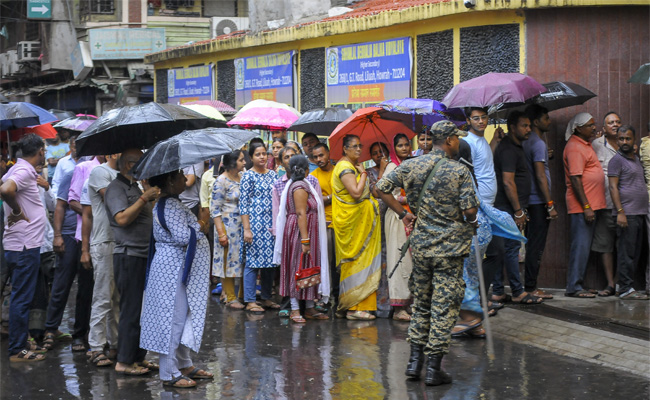
Kolkata (PTI): The West Bengal assembly polls ended on Wednesday with what the election watchdog said was the state's highest-ever voter turnout of 92.84 per cent, leading to mouth-watering anticipation ahead of the announcement of results on Monday as both contenders sounded sanguine about their victory prospects.
Wednesday's second phase saw a 92.48 per cent turnout. The concluding phase covering 142 constituencies in south Bengal appears poised to match the first phase's record voter participation of 93.19 per cent by the time final numbers are collated.
The figures put the combined poll percentage over the two-phases at 92.84 per cent. The first phase of polling was held on April 23.
"This is the highest-ever recorded poll participation since Independence in West Bengal," it said.
The capital Kolkata recorded a turnout of 88.59 per cent, with Purba Bardhaman district topping the charts at 93.78 per cent.
The scale of participation sent out an overarching political message — practically every single eligible voter in the state felt personally invested in the electoral process and its outcome. They turned out in numbers large enough to make every narrative contested and every claim of momentum politically loaded. If the first phase tested whether the BJP could retain its north Bengal citadel, the second and final round was always the real battle for the saffron party on whether it could breach the ruling TMC’s southern fortress of Kolkata, Howrah, Hooghly, Nadia, North and South 24 Parganas and Purba Bardhaman.
At the centre of the larger political fight stood Bhabanipur, no longer merely a south Kolkata constituency but Banerjee’s political refuge, her emotional home turf and the BJP’s chosen psychological battlefield.
Banerjee, 71, seeking a fourth consecutive term after 15 years in power, faced Leader of Opposition Suvendu Adhikari in a prestige battle widely seen as a symbolic rematch of Nandigram, where Adhikari had defeated her in 2021 after crossing over from the TMC to the BJP.
Five years later, the duel shifted to Banerjee’s own bastion. For the TMC, retaining Bhabanipur is about protecting the chief minister’s authority in her own backyard. For the BJP, breaching it would puncture the aura of invincibility around Bengal’s most powerful political figure.
The constituency witnessed nearly 87 per cent polling, sharply up from around 61 per cent in the 2021 assembly polls and 57 per cent in the bypoll that brought Banerjee back to the House.
Banerjee – who usually votes later in the day and prefers staying indoors on the day of polls – broke convention and hit the ground before 8 am, moving through Chetla, Padmapukur and Chakraberia areas following complaints of alleged intimidation of local TMC leaders.
As she sat outside a booth amid heavy deployment of central forces, Adhikari arrived there and declared, "I will not allow any hooliganism." He opposed Banerjee moving around with "50-60 people" with her.
Banerjee accused the BJP of trying to "rig" the election by using central forces, election observers and officials.
"The BJP wants to rig this election. Polls in Bengal are usually peaceful. Is there a goonda raj here?" she said, alleging intimidation of TMC polling agents and late-night visits by CRPF personnel to party workers’ homes.
"The atrocities by the central forces are unprecedented. What is happening is not at all free and fair polls. But despite all this, we have full faith that we will win," she said after casting her vote.
Adhikari dismissed the charges as "frustration", claiming Banerjee had realised that "not a single vote was coming her way".
Tension flared again in Kalighat when Adhikari visited another booth, and TMC workers raised slogans against him. Police resorted to a lathi-charge to disperse the crowd as BJP supporters answered with counter-slogans. Reports of sporadic tension were also received from some other areas amid sights of long queues at polling stations, booth-level flare-ups, and political bickering.
In Kolkata's Entally, BJP candidate Priyanka Tibrewal alleged that the TMC's polling agents tried to assault her after she objected to overcrowding inside a booth and a lack of voter privacy.
In Panihati, BJP candidate and the R G Kar victim's mother, Ratna Debnath, faced protests, while her party colleague in Basanti, Bikash Sardar, alleged that "200 to 250 TMC goons" attacked his vehicle and assaulted his driver.
The TMC, meanwhile, accused the central forces of exercising brute force on the general voters at Falta's Belsingha village, especially women, who were beaten up during a move to disperse a crowd from near a polling station.The party also alleged CAPF high-handedness on women and a four-year-old child at Sathachhia in Howrah and on villagers at Ausgram in Purba Bardhaman district.
"In the name of ensuring security, central force jawans are not sparing even women who were brutally lathi-charged. TMC protests this highhandedness of the male jawans who exercised brute force on unarmed villagers. We draw the EC's attention to such illegal actions of the CAPF and ask the poll body to issue cease-and-desist orders against such use of force. We believe, people of Bengal will respond to this on EVMs," Anirban Banerjee, party spokesperson, said.
The BJP alleged that in several polling stations in Falta, the option to vote for the party was blocked using a tape over EVM poll buttons, and demanded repolls in the affected booths.
The state’s Chief Electoral Officer Manoj Agarwal said repolling was likely to be announced in booths where EVMs were found tampered with. However, the order will only be issued after authorities receive reports from the district election officer or election observers regarding allegations of EVM tampering, such as using tapes or a blot of ink, he said.