Former RBI chief Urjit Patel says Centre didn’t manage economy well, admits banks were over-lending
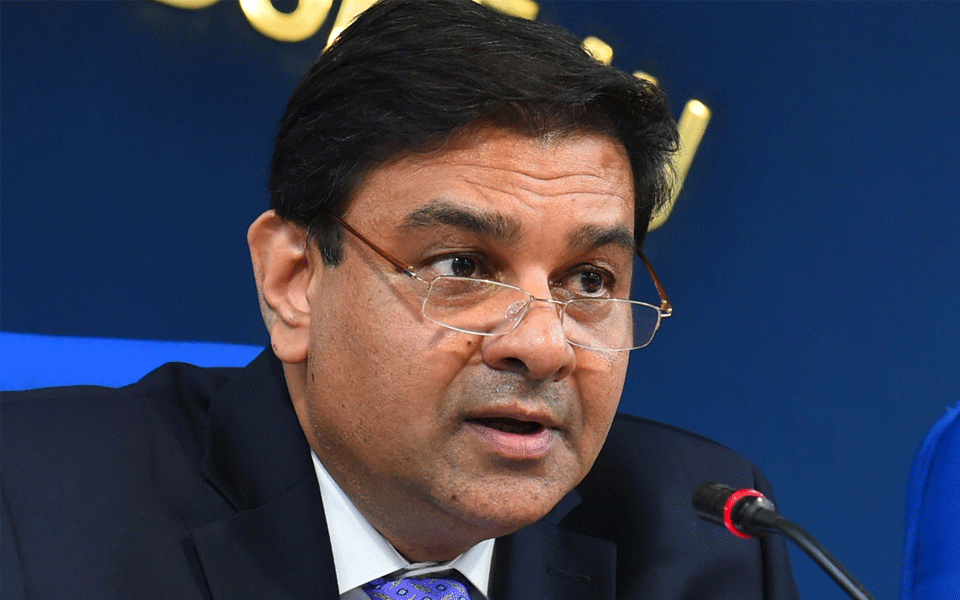
New Delhi: Former Reserve Bank of India Governor Urjit Patel admitted last month that Indian banks indulged in over-lending and said that the government did not fully play its role as principal manager of the country’s economic health. In his first public comments after resigning as RBI chief, he said that this has resulted in the current bad loan mess and the resultant low capital buffers.
Patel made these remarks at Stanford University’s ‘Annual Conference on Indian Economic Policy’ on June 3.
In December 2018, Urjit Patel – who had replaced Raghuram Rajan as RBI governor just before demonetisation, but later developed sharp differences with the government over the question of the central bank’s reserves – resigned due to “personal reasons.” Patel was the first central bank governor in decades to resign before his term ended.
Patel said in the presentation that the banks had failed to maintain balanced credit lending growth and that they had applied very little risk analysis and management in sifting good assets from bad. The regulators, he said, failed to react quickly to improve recovery or cut losses.
He blamed the government for not stepping in because “it was receiving significant dividends”.
Patel said the current capital adequacy of public sector banks was “in effect, overstated” if one sees how Indian lenders stand compared to their global counterparts. He pointed out that three big public sector banks – State Bank of India, Canara Bank and Central Bank of India – may require over Rs 250 billion in estimated capital in the 2019-’20 financial year.
“How did we get here? Plenty of blame to go around! Prior to 2014, all stakeholders failed to play their role adequately. Banks, the regulator and government,” Patel said in his first comments after his resignation.
He argued that the provision coverage ratio of Indian banks is lower than that of most other countries, while their net non-performing assets are higher than those of their global counterparts. He said provisions as a percentage of capital jumped from 12% in 2011 to 42% in 2017 – much higher than what is in countries such as South Africa, South Korea, Brazil, and China.
“Temptation to reset ‘back to the past’ should be eschewed,” Patel advised the government, adding that “episodic concerns” on stability are possible if there is “foot dragging, or, worse, back-peddling and the concomitant delays.”
“Short-cuts/sweeping the problem under the carpet is unlikely to work; but will only delay unlocking of capital, and come in the way of financing future investment efficiently,” he warned.
In 2014, the RBI had started an asset quality review, which led to the recognition of the huge pile of hidden stress in the system and resolution through the introduction of bankruptcy laws.
Courtesy: scroll.in
Let the Truth be known. If you read VB and like VB, please be a VB Supporter and Help us deliver the Truth to one and all.
Veteran Congress leader Mohsina Kidwai passes away at 94

New Delhi (PTI): Veteran Congress leader and former Union minister Mohsina Kidwai passed away on Wednesday, her family said. She was 94.
Kidwai passed away at Noida's Metro Hospital early in the morning. She was suffering from age-related ailments, her son-in-law Razi Ur Rehman Kidwai said.
She will be cremated at the graveyard in Nizamuddin around 5 pm, he said.
Kidwai is a former Union minister who held important portfolios in the Rajiv Gandhi government. She has been a member of both the Lok Sabha and the Rajya Sabha at various points in time.
Kidwai has also served as a member of the Congress Working Committee and the party's Central Election Committee in the past.