Four days of market slump wipes out Rs 24.69 lakh cr of investors' wealth
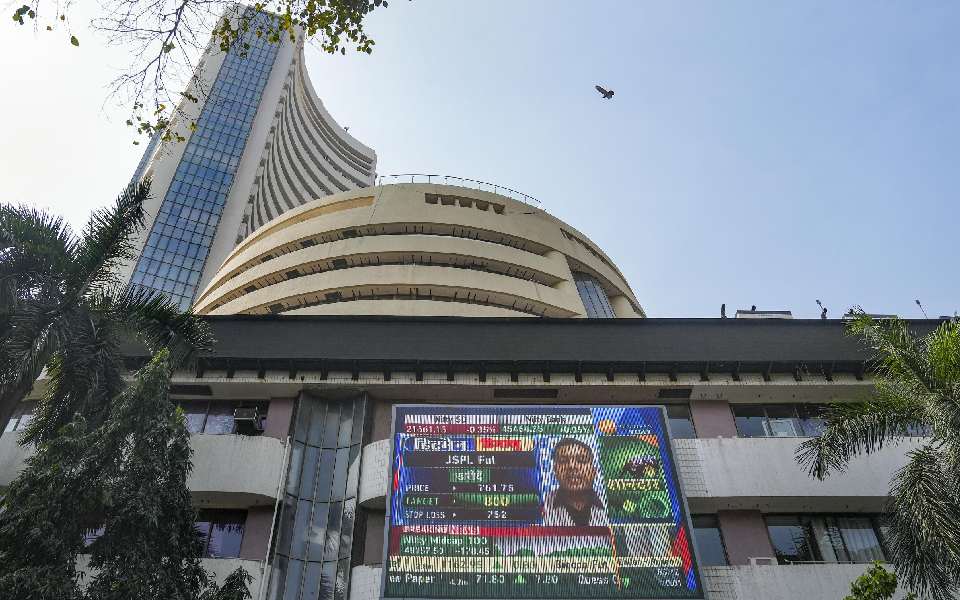
New Delhi, Jan 13: Investors lost Rs 24.69 lakh crore in market valuation in the last four days of severe drubbing in the equity market.
Spike in global crude prices, unabated foreign fund outflows, a strong US jobs data diminishing early rate cut expectations, and the rupee logging its steepest single-day fall in nearly two years dampened investors' sentiment.
The BSE Sensex tanked 1,869.1 points, or 2.39 per cent, in the past four trading sessions.
Falling for the fourth straight session on Friday, the 30-share BSE benchmark Sensex tumbled 1,048.90 points, or 1.36 per cent, to finally settle at 76,330.01. During the day, it plunged 1,129.19 points, or 1.45 per cent, to 76,249.72.
The market capitalisation of BSE-listed firms eroded by Rs 24,69,243.3 crore to Rs 4,17,05,906.74 crore (USD 4.82 trillion) in four days. With Monday's sharp fall in equities, the market cap of BSE-listed firms dived below the USD 5-trillion mark.
On Monday alone, investors' wealth dropped Rs 12.61 lakh crore.
"Continued foreign institutional investor selling crossed Rs 20,000 crore this month, contributing to the negative sentiments. Indian rupee touched a fresh low against the dollar during the session, pressured by stronger-than-expected US non-farm payrolls data which further dampened the sentiment, resulting in a firm dollar index.
"Meanwhile, oil prices hit their highest level in over three months amid expanded US sanctions disrupting Russian crude supplies, further adding to global uncertainties," Siddhartha Khemka, Head - Research, Wealth Management, Motilal Oswal Financial Services Ltd, said.
From the 30-share blue-chip pack, Zomato cracked over 6.50 per cent. Power Grid, Adani Ports, Tata Steel, NTPC, Tata Motors, Mahindra & Mahindra, Asian Paints, Tech Mahindra, UltraTech Cement, and Sun Pharma were the other major laggards.
In contrast, Axis Bank, Tata Consultancy Services, Hindustan Unilever, and IndusInd Bank were the gainers.
"US imposing sanctions on Russian oil exports pushed the rupee to a fresh low against the dollar, which in turn triggered massive correction in domestic equity markets as overseas investors continued to desert the local share market. Wide-spread selling across the sectors fuelled along with massive exits in mid and smallcap stocks further worsened the sentiment.
"Rising crude oil prices would raise concerns of a spike in domestic inflation, which could further delay any rate cut hopes from the RBI in the near to medium term," Prashanth Tapse, Senior VP (Research), Mehta Equities Ltd, said.
Global oil benchmark Brent crude jumped 1.43 per cent to USD 80.90 a barrel.
As many as 3,562 stocks declined, while 555 advanced and 131 remained unchanged on the BSE.
Also, 508 stocks hit their 52-week lows while 120 stocks reached the one-year high level.
The BSE midcap gauge dropped 4.17 per cent, and smallcap index tanked 4.14 per cent.
All BSE sectoral indices ended lower. Realty slumped 6.59 per cent, utilities (4.38 per cent), services (4.35 per cent), power (4.23 per cent), industrials (4.09 per cent), consumer discretionary (4.04 per cent), consumer durables (3.96 per cent), and commodities (3.69 per cent).
Let the Truth be known. If you read VB and like VB, please be a VB Supporter and Help us deliver the Truth to one and all.
Rajnath to top commanders: Outmaneuver adversaries with strategic surprise
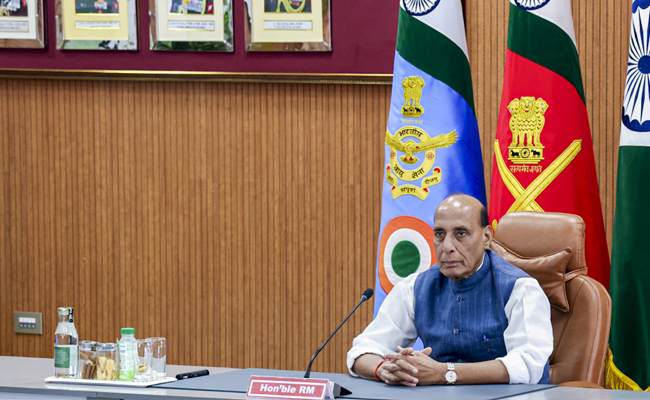
Jaipur/New Delhi (PTI): Defence Minister Rajnath Singh on Friday directed the top military commanders of the three services to integrate an "element of surprise" into modern warfare to outmaneuver India's adversaries and bolster strategic posture.
In his address at the joint commanders conference in Jaipur, Singh also described the Operation Sindoor as a testament to the "swift, precise, and joint response" of the Indian armed forces to safeguard national interests and called upon the military to remain ready to deal with any security challenges.
In their two-day deliberations, the commanders carried out a comprehensive review of the combat preparedness of the military in the wake of the evolving regional security situation.
Operation Sindoor was a demonstration of India's growing capabilities and a symbol of the nation's collective resolve and new military ethos, Singh said, a day after the first anniversary of Operation Sindoor.
He also unveiled a 'Joint Doctrine for Integrated Communication Architecture' that is aimed at strengthening doctrinal clarity, interoperability and integrated communications across the armed forces in future multidomain operations.
The joint commanders' conference, themed 'Military Capability in New Domains', brought together the top leadership of the defence ministry and the three services to deliberate on emerging security challenges and future readiness.
Comprehensive deliberations were held on future warfare, multidomain operations, technological transformation and joint capability development.
The conference witnessed extensive discussions on cognitive warfare, cyber resilience against evolving quantum and AI-enabled threats, military capability development in emerging domains, indigenous innovation and AI-enabled warfighting concepts.
It was attended by Chief of Defence Staff Gen Anil Chauhan, Chief of the Naval Staff Admiral Dinesh Kumar Tripathi, Chief of the Army Staff Gen Upendra Dwivedi, Chief of the Air Staff Air Chief Marshal AP Singh and Defence Secretary Rajesh Kumar Singh among others.
In his remarks, Singh asked the commanders to remain "future-ready" by learning from the operation as well as the current global security landscape.
He underscored the need to strengthen capabilities in artificial intelligence, autonomous systems, data analytics and secure communication networks to stay prepared in the rapidly evolving geopolitical security scenario. He emphasised that future conflicts will increasingly be shaped by hybrid threats, information dominance and operations conducted simultaneously across cyber, space, electromagnetic and cognitive domains, according to an official readout.
Highlighting the transformative impact of emerging technologies, Singh stressed on the importance of ensuring integrated national preparedness across all spectrums of conflict, it said.
Singh's remarks at the conference came a day after the first anniversary of Operation Sindoor.
The defence minister appreciated the progress achieved in enhancing jointness, integration and technological adoption across the three services, the readout noted.
Singh said that jointness constitutes a pivotal dimension within the transformative changes sweeping across the global defence sector.
"Future wars will not be won solely through weaponry, but through innovative thinking and enhanced synergy," he said.
The defence minister exhorted the commanders to cultivate the "element of surprise" to remain unpredictable to the nation's adversaries and secure a strategic edge in any given situation.
He, however, urged them to remain vigilant of the element of surprise of the enemy and always stay two steps ahead.
Singh also reiterated the Narendra Modi government's commitment to enhancing the capabilities of the defence forces through state-of-the-art weapons and platforms. He added that special focus is being laid on research in niche domains.
During the conference, he released a documentary film on Operation Sindoor.
The film reaffirms the nation's and defence forces' commitment to operational preparedness and decisive national response capabilities.
Demonstrations of advanced systems and platforms developed for intelligence fusion, operational planning and information management were also showcased during the conference reflecting growing integration of cutting-edge technologies into joint operational structures, according to the defence ministry.
The discussions will contribute significantly towards shaping India's future military transformation and integrated operational preparedness, it said.