Four MLAs quit JJP in Haryana
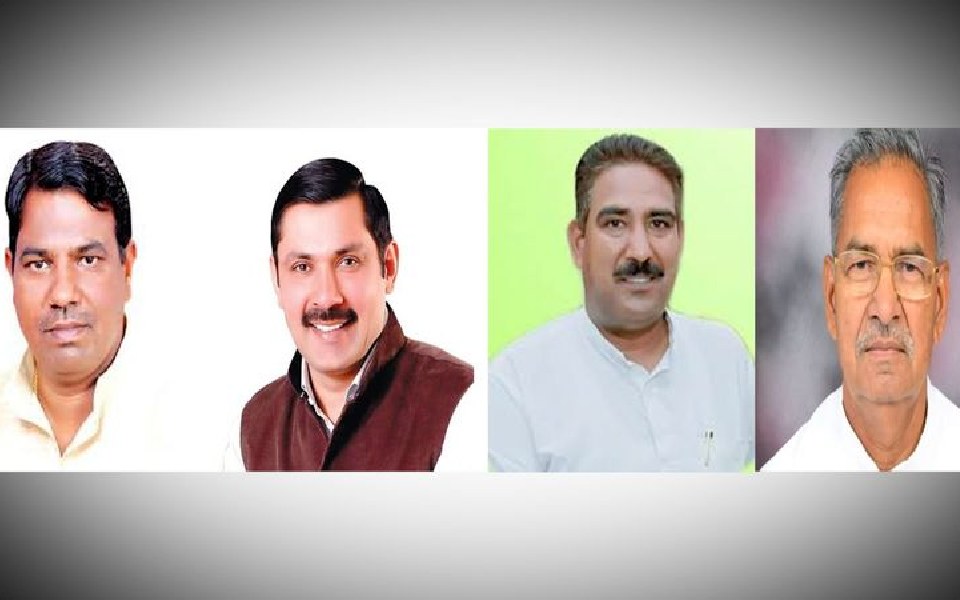
Chandigarh, Aug 17: In a jolt to the JJP ahead of the assembly elections in Haryana, four of its MLAs quit the party, sources said on Saturday.
Anoop Dhanak, Ram Karan Kala, Devender Babli and Ishwar Singh quit the party citing personal reasons, the sources said.
The Election Commission on Friday announced that assembly polls in Haryana would be held in a single phase on October 1 and the results declared on October 4.
The Jannayak Janata Party (JJP) had won 10 seats in the 2019 assembly polls.
Dhanak, a minister in the Manohar Lal Khattar-led BJP-JJP coalition government, was elected from the Uklana constituency in Hisar while Babli had won from the Tohana seat in Fatehabad.
Babli was also a minister in the Khattar government.
Singh is the MLA from Guhla-Chika in Kaithal while Kala is the legislator from Shahabad in Kurukshetra.
Two party MLAs -- Ram Niwas Surjakhera from the Narwana seat and Jogi Ram Sihag from the Barwala constituency -- are facing disqualification charges.
The JJP joined hands with the BJP after the saffron party failed to win a majority in the 90-member House in the 2019 polls.
The alliance came to an end in March after Nayab Singh Saini replaced Khattar as chief minister.
Let the Truth be known. If you read VB and like VB, please be a VB Supporter and Help us deliver the Truth to one and all.
Vartha Bharati–Sankalp predictions align closely with Karnataka bypoll results
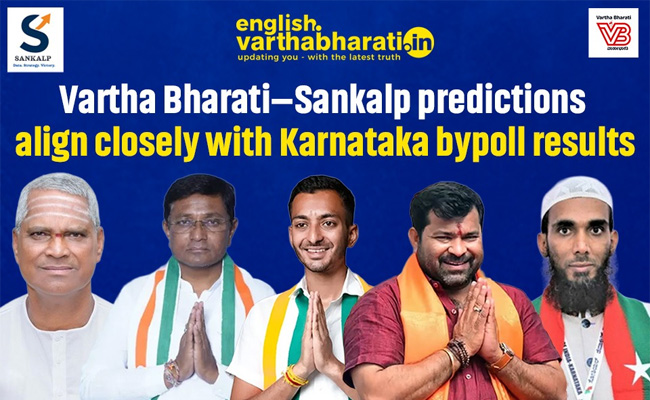
Bengaluru: The Vartha Bharati–Sankalp election analysis has shown a high level of accuracy in predicting the outcome of the recent Karnataka Assembly by-elections held in May 2026, correctly calling winners in both constituencies and closely estimating vote share trends.
The by-elections were held in Bagalkot and Davanagere South, drawing significant political attention as both seats were seen as key tests for the ruling Congress and opposition BJP.
According to the analysis, Vartha Bharati–Sankalp had made three major projections ahead of the results the winning party, vote share percentages, and margin of victory.
In both constituencies, the platform accurately predicted that the Congress would emerge victorious. The outcome matched the projections, with Congress candidates winning in Bagalkot and Davanagere South.
In terms of vote share, the predictions were largely in line with the final results. In Bagalkot, the BJP’s vote share was forecast in the range of 40 to 46 per cent, while the actual figure stood at 42.9 per cent. The Congress vote share, however, exceeded expectations, with the party securing 55.4 per cent against a projected range of 43 to 48 per cent.
The margin of victory in Bagalkot turned out to be significantly higher than anticipated. While the projection had placed the margin between 2,000 and 3,500 votes, the final margin was around 22,332 votes.
In Davanagere South, the predictions also remained largely accurate. The Congress vote share was projected between 43 and 51 per cent, and the final figure stood at 43.9 per cent. The BJP was expected to secure between 42 and 50 per cent but ended with 40.3 per cent.
The analysis had also identified the role of SDPI as a potential spoiler in the constituency. While its vote share was estimated around 6 per cent, the party eventually secured around 12 per cent of the vote.
The margin of victory in Davanagere South was predicted to be between 1,500 and 2,600 votes. The actual margin was higher at around 5,708 votes, though the contest remained relatively close as anticipated.
Overall, the performance of Vartha Bharati–Sankalp stood out for correctly identifying the winning parties in both seats and maintaining close accuracy in vote share estimates, with only limited deviations in specific cases.