"Freebies are never free", let voters know impact: RBI MPC Member Ashima Goyal
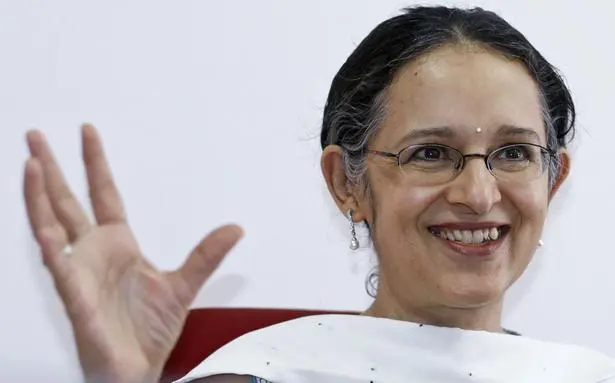
New Delhi, Aug 21: Freebies are never 'free' and when political parties offer such schemes, they must be required to make the financing and trade-offs clear to voters, RBI Monetary Policy Committee (MPC) Member Ashima Goyal said on Sunday, adding this would reduce the temptation towards "competitive populism".
Goyal further said a cost is imposed somewhere when governments provide freebies, but this is worth incurring for public goods and services that build capacity.
"Freebies are never free... specially harmful are subsidies that distort prices," she told PTI in an interview.
Noting that this hurts production and resource allocation and imposes large indirect costs, such as the water table falling in Punjab due to free electricity, Goyal said such freebies come at the cost of low quality health, education, air and water that hurt poor the most.
"When parties offer schemes they must be required to make the financing and such trade-offs clear to voters. This would reduce the temptation towards competitive populism," the eminent economist argued.
Prime Minister Narendra Modi has in recent days hit out at the competitive populism of extending 'rewaris' (freebies) which are not just wastage of taxpayers' money but also an economic disaster that could hamper India's drive to become atmanirbhar (self-reliant).
His comments were seen directed at parties like the Aam Aadmi Party (AAP) which have in the run-up to assembly elections in states like Punjab and more recently Gujarat promised free electricity and water, among others.
Earlier this month, the Supreme Court had suggested setting up a specialised body to examine "irrational freebies" offered to voters during elections.
On India's macroeconomic situation, Goyal, currently emeritus professor at the Indira Gandhi Institute of Development Research, said, "Indian growth is sustaining despite continuing global shocks and rate rises."
While observing that India has done better than most expectations and in comparison to many countries under challenging conditions, she said among reasons for this are growing economic diversity that helps to absorb shocks.
"Large domestic demand can moderate a global slowdown; if industry suffers from lockdown, agriculture does well," she said, adding that services compensate for less contact-based delivery with digitisation, distance work and exports.
According to Goyal, even if global growth slows, diversification from China, India's digital advantage and government efforts to promote exports would support India's outbound shipments.
Emphasising that a rise in the currently very small Indian share in world exports remains feasible, Goyal said diversity and reforms in the financial sector have improved its stability.
"Coordinated fiscal and monetary policy action to reduce inflation while maintaining adequate demand has worked well. Rising real policy rates have prevented over-heating and anchored inflation expectations, as they approach positive values," she noted.
The Reserve Bank's MPC at its meeting from August 3 to 5 had decided to increase the benchmark lending rate by 50 basis points to 5.40 per cent to quell inflation. This was the third consecutive increase since May.
Asked whether high inflation will become the norm in India and if the country's inflation targeting regime faces its biggest test at the moment, Goyal said, "The big test is already past and looks like flexible inflation targeting (FIT) is winning."
Pointing out that inflation peaked in April and has been falling since then, she said July was only the sixth month when inflation slightly exceeded the tolerance band but it has reversed and may fall below 6 per cent before October or slightly later.
"Inflation expectations have fallen. The attempt will be to further slowly guide them towards the target in a soft landing, even as a robust growth recovery takes hold," Goyal said.
The retail inflation was at 7.01 per cent in June and eased to 6.71 per cent in July. RBI has been mandated by the government to ensure that inflation remains at 4 per cent with a margin of 2 per cent on either side.
Replying to a question on weakening of the Indian rupee, Goyal said the dollar has strengthened against all currencies because of the strong US recovery and rising interest rates.
"But Indian reserves and forex intervention has ensured the rupee depreciation was only about half of the USD rise and much less compared to other countries," she said, adding the intervention is aimed at smoothing excess over- or under-shooting while letting the market determine exchange rates.
Goyal noted that some nominal depreciation is required in line with the country's major export competitors and its excess inflation.
"India's depreciation is about the same as China's," she said.
Let the Truth be known. If you read VB and like VB, please be a VB Supporter and Help us deliver the Truth to one and all.
Vijay secures majority support, set to stake claim to form Tamil Nadu govt
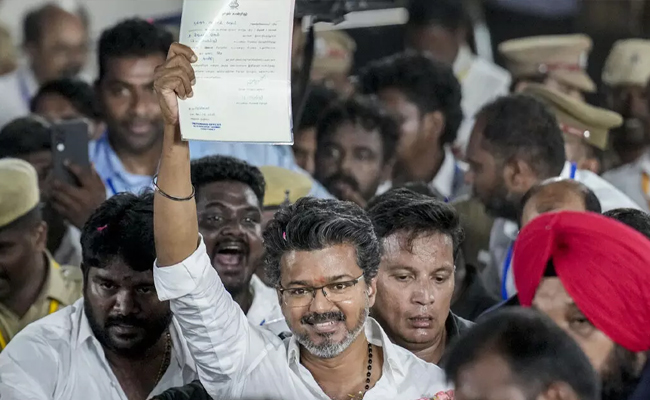
Chennai: After four days of political uncertainty and intense negotiations in Tamil Nadu, actor-politician Vijay is learnt to have secured the numbers required to form the government, sources said.
Supporters gathered outside Vijay’s residence in Chennai on Friday evening, raising slogans in support of Tamilaga Vettri Kazhagam soon after reports emerged that the party had managed to secure majority support.
Sources said Vijay is expected to meet Tamil Nadu Governor R. V. Arlekar on Friday evening to stake claim to form the government. The meeting is likely to take place around 6 pm.
In its electoral debut in the Tamil Nadu Assembly elections, TVK won 108 out of the 234 seats, dealing a major blow to the 62-year political dominance of Dravida Munnetra Kazhagam and All India Anna Dravida Munnetra Kazhagam.
However, Governor Arlekar had reportedly made it clear that the party would not be invited to form the government without proving a clear majority. Even after two rounds of discussions on Wednesday and Thursday, the Governor is learnt to have maintained his stand that letters of support from at least 118 MLAs must be submitted in the 234-member Assembly.
Apart from Vijay, TVK had the backing of 107 MLAs. Vijay had contested from Tiruchy (East) and Perambur constituencies and won both seats, meaning he would have to resign from one seat before taking oath. This increased the need for additional support.
Amid the political developments, five MLAs from the Congress party, which reportedly moved away from the DMK-led alliance, extended support to Vijay. Vijay also held discussions with leaders of Viduthalai Chiruthaigal Katchi, Communist Party of India (Marxist) and Communist Party of India.
The VCK, CPI(M) and CPI had so far been allies of the DMK. At the same time, political discussions intensified in the state over speculation that the DMK could even explore a post-poll understanding with its long-time rival AIADMK to prevent an alternative government from taking shape.
Reports had been circulating since Friday afternoon that the VCK and Left parties were likely to support Vijay. Sources later said that the VCK, CPI(M) and CPI agreed to extend the support of two MLAs each, helping TVK cross the required majority mark.
All eyes are now on the Governor’s next move and the official announcement regarding the formation of the new government in Tamil Nadu.