From conflicts to climate crisis, Mahatma Gandhi's ideas have answers to today's challenges: PM Modi
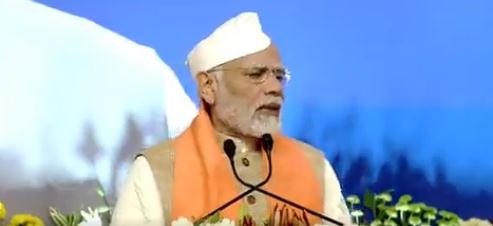
Dindigul (TN), Nov 11: Prime Minister Narendra Modi on Friday said the ideas of Mahatma Gandhi have answers for modern day challenges, including climate crisis, and asserted his government was inspired by Gandhi to work towards its self-reliance goal of 'Atmanirbhar Bharat'.
In his address at the 36th convocation of the Gandhigram Rural Institute here, the Prime Minister said "Gandhian values are becoming very relevant".
"Whether it is about ending conflicts or the climate crisis, Mahatma Gandhi's ideas have the answers to many of today's challenges. As students of the Gandhian way of life, you have a great opportunity to make a big impact," he said.
"The best tributes to Mahatma Gandhi is to work on ideas close to his heart," Modi added.
The Mahatma saw khadi as a "tool of self-governance" in villages and inspired by him, the Centre was working towards the country's 'Atmarnibharta', the Prime Minister pointed out.
"Khadi had been neglected for a long time. But through the call of 'from khadi for nation to khadi for fashion', it has become very popular," and has shown a 300 per cent increase in sales over the last eight years, he said.
The Khadi and Village Industries Commission (KVIC) has had a record turnover of Rs 1 lakh crore last year.
"Now, even global fashion brands are taking to khadi because it is an eco-friendly fabric good for the planet. This is not a revolution of mass production. This is a revolution of production by the masses," the Prime Minister said.
Mahatma Gandhi saw khadi as a tool of self-reliance in villages. In the self-reliance of villages, he sowed the seeds of self-reliant India. "Inspired by him, we are working towards 'atmanirbharta'," Modi said.
He noted that Tamil Nadu was a key centre of the Swadeshi movement and that it will once again play an important role in the 'Atmanirbharta movement.
Mahatma Gandhi wanted villages to progress, and at the same time preferred the values of rural life to be conserved, Modi said.
"Our vision is 'Atma gaaon ki, suvidha shaher ki," (soul of the village, facilities of the city)," he said.
Reiterating the slogan in Tamil, he said, 'Gramathin aanma, nagarathin vasathi'.
"It is fine for urban and rural areas to be different. Difference is fine, disparity is not. For a long time, inequality between urban and rural areas remained. But today, the nation is correcting this," Modi said and listed out his government's various efforts towards rural development.
This included, tap water coverage to six crore homes and 2.5 crore power connections.
Sanitation was a concept very dear to Mahatma Gandhi and this has been revolutionised through Swachch Bharat "but we are not stopping at just delivering the basics."
"Today, even the benefits of science and technology are reaching the villages. Six lakh kilometres of optic fibre cables have been laid to connect nearly two lakh gram panchayats. Rural areas have benefitted from low costs of internet data," he pointed out.
Holding that sustainable agriculture is crucial for the future of rural areas, Modi said there is great enthusiasm for natural farming, and for chemical-free faming. It reduces the country's dependence on fertilizer imports. It is also good for soil health and human health. "We have already begun work in this direction."
"Our organic farming scheme is doing wonders, especially in the northeast. In last year's Budget, the Centre came out with a policy related to natural faming," he recalled.
"Regarding sustainable farming, there is one more important point you must focus on -- the time has come to save agriculture from monoculture. Many native varieties of grains, millets and other crops need to be revived...they are nutritious and climate resilient. Moreover, crop diversification can save soil and water," Modi noted.
On renewable energy, he said solar energy's installed capacity has increased almost 20-fold in the last eight years. If solar energy becomes widespread in villages, India can become sell-reliant in energy too, he added.
He further said that Gandhian thinker Vinobha Bave had stated that elections for village-level bodies tend to be 'divisive' as communities and families end up breaking.
In Gujarat, to counter this, the state government had started a scheme where villages that choose leaders through mutual agreement were given separate incentives. "This greatly reduced social conflicts. Young people can work with villagers to develop a similar mechanism across India," he added.
"If villages can be united, they can fight problems like crime, drugs and anti-social elements. Mahatma Gandhi fought for a united and independent India. Gandhigram itself is a story of unity. This is where thousands of villagers came through trains to have a glimpse of Gandhi ji," he said.
Tamil Nadu has always been the home of national consciousness and Swami Vivekananda received a heroic welcome on his return from the West, the Prime Minister said.
Referring to the people's 'Veeravanakkam' (brave salute) to deceased Chief of Defence Staff, General Bipin Rawat, who was killed in a helicopter crash in Tamil Nadu's Nilgiris, he said it "was deeply moving."
On the Kashi Tamil Sangamam event, he said it will soon happen in the northern town and will celebrate the bond between Kashi and Tamil Nadu.
"The people of Kashi are eager to celebrate Tamil Nadu's language and culture. This is 'Ek Bharat, Shresht Bharat' in action. This love and respect for each other is the basis of our unity."
At a time when the world faced a global crisis not seen in a century, India has been a bright spot, he said.
"Be it the world's largest vaccine drive, food security for the poorest or being the world's growth engine, India has shown what it is made of. The world expected India to do great things because India's future is in the hands of a 'can do' generation of youth."
"Youth who not only accept challenges but also enjoy them, who not only question but also find the answers. Youth who are not only fearless but also tireless. Youth who not only aspire, but also achieve," he added.
Tamil Nadu Governor R N Ravi and Chief Minister M K Stalin also participated in the convocation, in their first public appearance days after the ruling DMK in Tamil Nadu urged President Droupadi Murmu to sack Ravi, claiming many acts of his were 'unbecoming' of a Governor.
In his address, Stalin focussed on the need for education and highlighted the various initiatives in the sector, including reservation benefits.
"Education is the only asset, that can never be snatched by anyone under any situation. It is the duty of a state government to impart the wealth of education. Hence, I appeal to the Union Government, to support and encourage such efforts of state government, by bringing back Education, under the State list."
"When the Constitution was framed, and came into force, Education was originally placed in the State list. It was moved to the Concurrent list only during the period of Emergency. I request, that the Union government, especially Honourable Prime Minister, shall attempt, to move Education, back to the State list," Stalin said.
A number of students graduated, with the Prime Minister presenting gold medals to four achievers. Musician Ilayaraja and Carnatic music exponent Umayalpuram K Sivaraman were awarded honorary doctorates by the varsity.
The Prime Minister was earlier accorded a warm reception. Chief Minister Stalin presented a shawl and an English translation of Tamil historical fiction 'Ponniyin Selvan' to Modi when the latter arrived in Dindigul.
Let the Truth be known. If you read VB and like VB, please be a VB Supporter and Help us deliver the Truth to one and all.
EAM Jaishankar meets Jamaican PM, gifts over 10 BHISHM Cubes
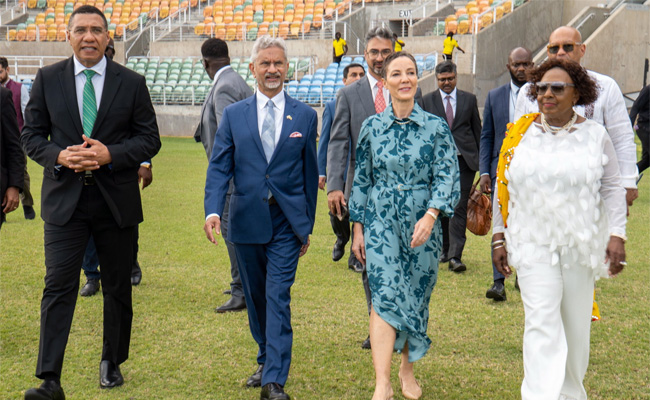
Kingston (PTI): External Affairs Minister S Jaishankar on Monday met Jamaican Prime Minister Andrew Holness and discussed ways to further deepen "political, economic and people-to-people cooperation."
Jaishankar also conveyed greetings from Prime Minister Narendra Modi to Holness.
"Pleased to call on Prime Minister @AndrewHolnessJM in Kingston. Conveyed the greetings of PM @narendramodi," Jaishankar posted on X.
"Discussed deepening our political, economic and people-to-people cooperation. Value his commitment towards further strengthening India-Jamaica relations," the post further read.
Also, the external affairs minister handed over 10 BHISHM (Bharat Health Initiative for Sahyog Hita & Maitri) Cubes as a gift to Jamaica.
"Formally handed over 10 BHISHM Cubes as a gift from India to Jamaica, in the presence of PM @AndrewHolnessJM, Health Minister @christufton and FM @kaminajsmith," Jaishankar posted on X.
"The BHISHM Cube mobile hospital system, designed for rapid deployment, will help Jamaica during disasters and emergencies. The gift of these cubes is a statement of friendship, a commitment to disaster preparedness, and an outcome of innovation," the post said.
Jaishankar arrived in Kingston on Saturday evening, marking the first leg of his nine-day tour of Jamaica, Suriname, and Trinidad and Tobago, aimed at further strengthening India's strategic and cultural ties with the Caribbean nations.
Earlier in the day, he interacted with the Indian diaspora and discussed India's ongoing transformation in infrastructure, human development and technology-driven governance and entrepreneurship with them.
He also highlighted the cricket bond between both countries as India gifted a scoreboard to Jamaica.
A scoreboard was dedicated at Sabina Park in Kingston. It is the home of the Jamaica cricket team and is the only Test cricket ground in the Caribbean island nation.
The minister expressed hope that the new scoreboard would witness many memorable innings, including those symbolising the enduring friendship between the two countries.
Cricket has long been a strong cultural bridge between India and Jamaica, which is part of the West Indies cricket team.
Jamaican players, including Chris Gayle, Courtney Walsh and Michael Holding, have played a major role in shaping the legacy of West Indies cricket in the international arena, contributing to its dominance in earlier decades and its continued global appeal.