From seeking alms to prescribing balms: Journey of a child beggar from HP who became doctor
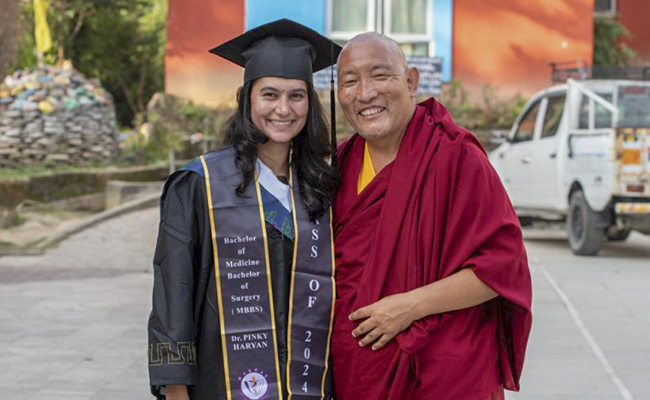
Shimla (PTI): As a child, Pinki Haryan, along with her parents, begged on the streets and scavenged for food in garbage dumps in Mcleodganj. Twenty years and a Chinese medical degree later, she is now burning the midnight oil to clear an exam that will make her eligible to practice medicine in India.
It was in 2004 when Lobsang Jamyang, a Tibetan refugee monk and the director of Dharamshala-based charitable trust, spotted Haryan begging. Days later, he visited the slum cluster at Charan Khud and recognised the girl.
Then began the uphill task of convincing her parents, especially her father Kashmiri Lal, to let her pursue education. After hours of persuasion, Lal agreed.
Haryan got admission into the Dayanand Public School at Dharamshala and was among the first batch of students at a hostel for destitute children set up by the charitable trust in 2004.
Ajay Srivastava, president of NGO Umang Foundation, who has been associated with Jamyang for the last 19 years, said initially, Haryan missed her home and parents but kept her focus on studies, which she realised was her ticket out of poverty.
Soon enough, the results were proof of her dedication.
She passed the senior secondary examination and also cleared the National Eligibility cum Entrance Test (Undergraduate). The NEET is an all-India entrance exam for admission to undergraduate medical courses, Srivastava said.
However, the doors of private medical colleges remained shut for her due to the exorbitant fees. With the help of the Tong-Len Charitable Trust in the United Kingdom, she got admission to a prestigious medical college in China in 2018 and has returned to Dharamshala recently after completing her MBBS course, Srivastava said.
After a wait of 20 years, Haryan is a qualified doctor raring to serve the destitute and give them a better life.
"Poverty was the biggest struggle since childhood. It was painful to see my family in distress. As I got into school, I had an ambition to become successful in life," Haryan told PTI.
"As a child, I lived in a slum so my background was my biggest motivation. I wished for a good and financially stable life," she added.
Sharing a childhood memory, Haryan recalled that during her school admission interview as a four-year-old, she expressed her ambition to become a doctor.
"At that point in time, I had no idea what work a doctor does, but I always wanted to help my community," said Haryan who is preparing for the Foreign Medical Graduate Examination (FMGE) to become eligible to practice medicine in India.
Haryan, whose brother and sister have enrolled in a school after drawing inspiration from her, credited Jamyang for her "slum-dweller to doctor" success story.
"He (Jamyang) had a vision to help destitute and poor children. He was the biggest support system I had while I was in school. His belief in me was a big inspiration to do well," she said, adding that there were several others like her who have made it big in life due to the support from the trust.
Meanwhile, Jamyang said he had set up the trust in the hope of imparting basic education to destitute children so that they can lead a respectful life.
"I did not realise that these children were so full of talent... They have become role models and are inspiring others," he said.
Srivastava said Jamyang believes that children should not be treated as "machines to earn money". Instead, he says that they should be encouraged to become good human beings.
"He has dedicated his entire life to the children living in slums. Several of them, who once languished in the streets, were adopted by him and have today become engineers, doctors, and journalists," Srivastava said.
Let the Truth be known. If you read VB and like VB, please be a VB Supporter and Help us deliver the Truth to one and all.
Jammu: BJP opposes anti-encroachment drive, seeks regularisation of illegal structures
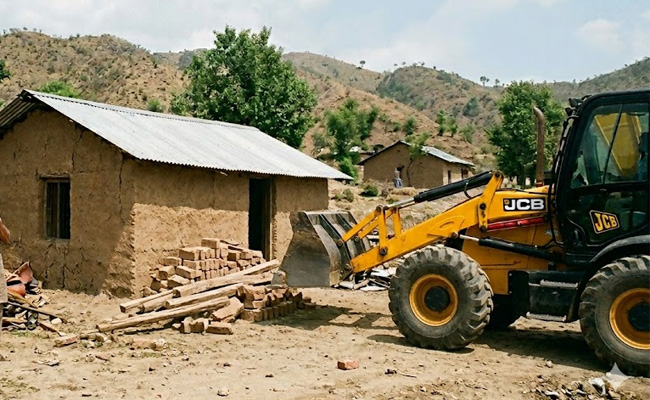
Jammu (PTI): The BJP has opposed the ongoing anti-encroachment drive carried out by the Jammu Development Authority (JDA), demanding a halt to the operation, regularising existing constructions and action against "erring" officials.
On May 4, the JDA demolished more than 15 structures built without permissions on the Ring Road, along the Jamm-Samba belt, to curb illegal constructions and enforce planning norms.
Tensions escalated when BJP MLA Rajeev Kumar Bhagat, along with locals, intervened and stood in front of bulldozers in the Bisnah area to stop the demolition of a three-storey structure. Several party leaders joined the protest.
Later, a delegation of BJP leaders, comprising Rajeev Kumar Bhagat, Garu Ram Bhagat, Surinder Bhagat and former MLA Chander Prakash Ganga, met JDA Vice Chairman Rupesh Kumar on May 5 and sought suspension of demolition drives and called for registration and regularisation of existing structures.
Addressing reporters, Rajeev Kumar Bhagat alleged that JDA’s enforcement wing failed in its duty and accused the lower-level staff of misleading people.
“We have repeatedly said JDA should inform people where construction is permitted. Instead, staff took money, allowed structures to come up, and then demolished them when the buildings reached the third floor (exceeding permitted height limits),” he said.
He questioned the timing of the drive, saying, “What kind of emergency was it that officials arrived at 4 am to carry out demolition?”
Bhagat also cited the case of a farmer whose land was partly acquired for the Ring Road, leaving him with limited land on which he had begun construction.
The MLA demanded strict action against JDA officials, including suspension of enforcement staff, alleging that illegal constructions had flourished due to administrative lapses.
He also sought a probe by the Anti-Corruption Bureau into alleged irregularities by them.
Garu Ram Bhagat said the meeting with JDA authorities was held in a “positive atmosphere” and claimed that assurances were given that already constructed structures would not be demolished immediately.
He said that people would be allowed to apply online for No Objection Certificates and resume construction after approvals.
BJP MLA Surinder Bhagat said they had intervened to prevent demolition and protect people’s interests while maintaining that they support lawful action.
“We will not support any illegal activity, but harassment of poor people in the name of law will not be accepted,” he said.
The legislators also flagged a lack of coordination between departments, particularly between JDA and Revenue authorities, claiming conflicting land-use classifications were creating confusion for residents.
They said a joint meeting with the district administration would be convened to streamline land records, clarify jurisdiction and ensure transparency in permissions.
JDA officials maintained that the demolition drive was carried out after due notice and was aimed at enforcing building regulations and ensuring planned urban development.