Gaganyaan mission: ISRO, Navy carry out crew module recovery trials
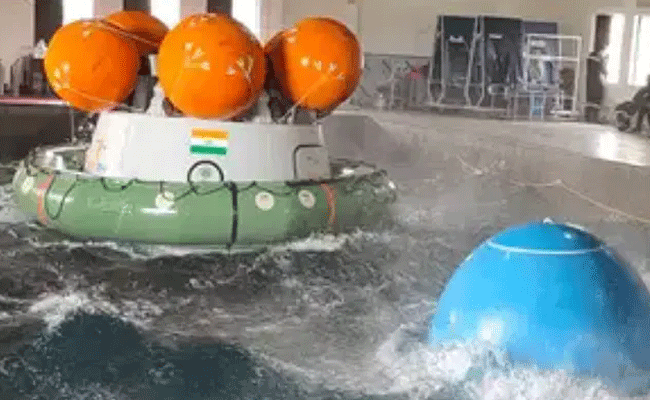
Bengaluru (PTI): The Indian Space Research Organisation, along with Indian Navy, carried out initial recovery trials of Crew Module in the Water Survival Test Facility (WSTF) as part of preparations for the Gaganyaan mission.
A Crew Module Recovery Model (CMRM) that simulates the mass, center of gravity, outer dimensions, and externals of the actual Crew Module at touchdown was used for the trials at WSTF of Navy at Kochi in Kerala, the space agency said.
The trials were part of the preparation for crew module recovery operations for the Gaganyaan mission that will be carried out in Indian waters with the participation of Indian Government agencies, the overall recovery operations being led by Indian Navy.
The sequence of operations required for the recovery of the Crew Module were carried out as part of the trials.
Gaganyaan project envisages demonstration of human spaceflight capability by launching crew of three members to an orbit of 400 km for a three-day mission and bring them back safely to earth, by landing in Indian sea waters, according to ISRO.
"As the safe recovery of the crew is the final step to be accomplished for any successful human spaceflight, it is of paramount importance and it has to be carried out with the minimum lapse of time", an ISRO statement said.
"Hence the recovery procedures for various scenarios need to be extensively practiced by carrying out a large number of trials. The Standard Operating Procedures (SoP) for recovery of Crew and Crew Module need to be finalised. The recovery trials will be initially carried out in a closed pool followed by trials in a harbor and in the open sea", it said.
The operations carried out on Tuesday form the initial recovery trials of Crew Module in a closed pool. Different phases of recovery trials starting with the recovery of the Crew Module to the flight crew training are planned at WSTF.
WSTF is a state-of-the-art facility of the Indian Navy that provides realistic training of aircrew for escape from a ditched aircraft under varied simulated conditions and crash scenarios, the statement said. WSTF simulates different sea state conditions, environmental conditions, and day/night conditions.
These trials assist in validating the SoP, and training recovery teams as well as the flight crew. They provide valuable inputs for the utilisation of recovery accessories, ISRO said.
The feedback from the recovery team/trainers helps improve the recovery operations SoP, design various recovery accessories, and finalise the training plan, it was noted.
Meanwhile, ISRO said in order to enable booster stage recovery in future launch vehicle configurations, the first Throttling demonstration hot test of the Vikas engine was successfully accomplished for a targeted 67 per cent thrust level throttling for a duration of 43 seconds.
Vikas engine has been the workhorse engine for the launch vehicles of Bengaluru-headquartered ISRO.
The engine with a nominal thrust of 80 ton is powering the second stages of PSLV & GSLV, liquid strapons of GSLV and the core liquid stage of LVM3.
Liquid engines that support throttling of the engine thrust facilitate booster stage recovery in launch vehicles.
Throttling of the engine was achieved by a closed loop thrust regulation system and the engine had been successfully throttled from the chamber pressure of 58.5 bar in steps of 50 bar, 45 bar & 40 bar, with dwelling at each pressure level for seven seconds. In addition, the Vikas engine was also throttled down to 45 per cent for the last three seconds before the engine shut down.
The results of the first hot test of Throttleable Vikas Engine on January 30 indicate stable combustion and subsystem performed in accordance with the prediction, ISRO said.The overall performance of engine sub-systems, control systems & test facility systems were as expected, it added.
Let the Truth be known. If you read VB and like VB, please be a VB Supporter and Help us deliver the Truth to one and all.
RS Chairman accepts merger of 7 AAP MPs with BJP
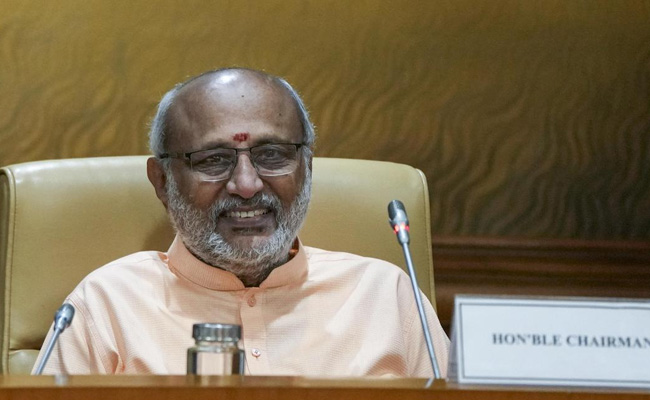
New Delhi (PTI): Rajya Sabha Chairman C P Radhakrishnan on Monday officially accepted the merger of seven Aam Aadmi Party (AAP) MPs with the BJP, reducing the strength of Arvind Kejriwal's party in the Upper House to three.
After this transition, the BJP's strength in the Upper House has increased to 113.
Raghav Chadha, Ashok Mittal, Harbhajan Singh, Sandeep Pathak, Vikramjit Sahney, Swati Maliwal, and Rajinder Gupta are the seven MPs who have merged.
ALSO READ: J-K: Six held with drugs, assets worth Rs 73 lakh attached in Udhampur
The Rajya Sabha website now shows that the seven MPs are part of the BJP list of members.
The seven MPs had on Friday petitioned the Rajya Sabha Chairman to be treated as BJP MPs after the merger and the same has been accepted, sources said.
The AAP had on Sunday moved a petition before the RS Chairman seeking the termination of the membership of the seven MPs, who had switched sides.
Aam Aadmi Party MP Sanjay Singh said he has submitted a petition to Chairman Radhakrishnan seeking the disqualification of the seven party MPs in the Upper House, who recently quit the AAP and announced their merger with the BJP.
On Friday last, the AAP suffered a jolt when the seven Rajya Sabha MPs quit and announced merger with the BJP, alleging that the Kejriwal-led party had strayed from its principles, values and core morals.