GoM formed to look into Kerala's demand for calamity cess: Arun Jaitley
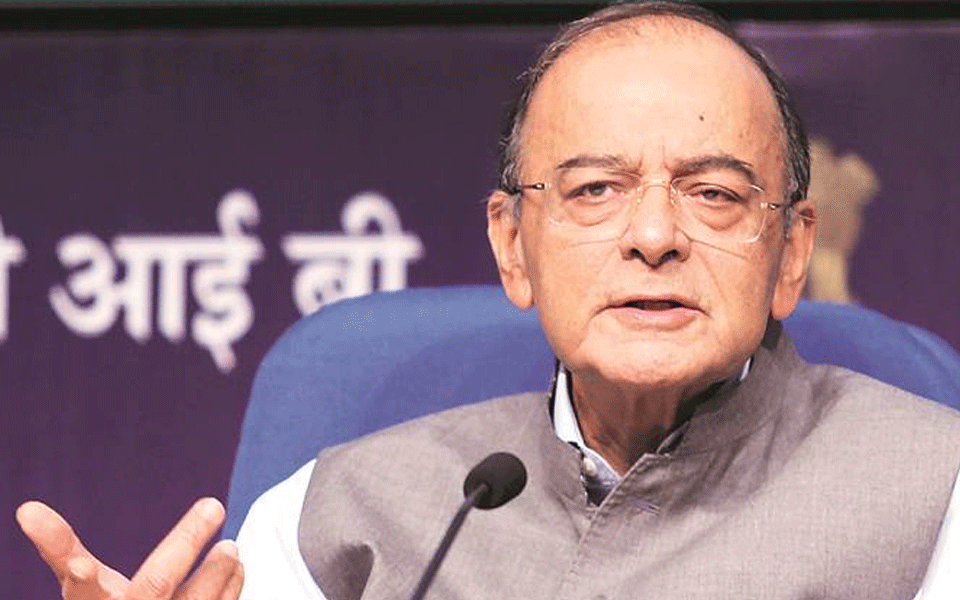
New Delhi, Sep 28: The GST Council on Friday decided to set up a seven-member Group of Ministers (GoM) to look into Kerala's demand for imposing an additional cess over GST to meet the financial requirements in case of a natural calamity.
Apart from senior union ministers, the committee would comprise members from the North Eastern, hill and coastal states which are most vulnerable to natural calamities, Finance Minister Arun Jaitley told reporters here after the council meeting.
He said the GoM would evaluate all possibilities and present its recommendations in the next few weeks after which another meeting of the GST Council will be called.
Jaitley said it was important to have a mature view on the issue instead of acting in haste as this would set a precedent for future natural calamities as well.
The Minister said that while there were various views among the council members, all states agreed that something must be done to address the devastating Kerala floods and similar calamities in future.
"One view expressed in the Council was 'Must the entire burden be borne by the people of the state suffering from natural calamities?'. There was a counter view that this defies the one-nation one-tax principle," Jaitley said.
He added another view was whether there should be an all-India levy and should it be confined only to some luxury and sin products or on all products.
"There was also a discussion on if the cess should be imposed in the case of all natural calamities or if there should be a distinction. For example, if one or two districts of a state are affected, should there be a levy in that case," he said.
The Minister said there was a need to have best legal methodologies to address the issue while keeping the constitutional provisions in mind.
He said there was currently a provision to have earmarked funds for natural calamities on state as well as national level in the form of State Disaster Relief Fund (SDRF) and National Disaster Relief Fund (FDRF) which have nothing to do with taxes.
Jaitley said the GoM would also consider if the SDRF and NDRF mechanism were sufficient to address the issue or if more was needed to be done.
Let the Truth be known. If you read VB and like VB, please be a VB Supporter and Help us deliver the Truth to one and all.
TN Assembly elections: Eight-month pregnant homemaker wins Thiru Vi Ka Nagar seat for TVK

Chennai (PTI): Before giving birth, she had already delivered a mandate—a symbol of hope for Thiru Vi Ka Nagar.
Echoing Delhi’s 2013 “common citizen” political churn associated with the rise of the Aam Aadmi Party (AAP), an eight-month-pregnant homemaker, M R Pallavi, has been elected as an MLA from Chennai’s Thiru Vi Ka Nagar constituency, emerging as one of the notable first-time faces of the Vijay-led TVK in the recently held Tamil Nadu Assembly elections.
In the narrow lanes of Thiru Vi Ka Nagar, a steady stream of media personnel has been making their way to Pallavi’s residence—a scene reminiscent of the result day in Delhi when journalists thronged the modest home of Rakhi Birla, who had won from Mangolpuri on an AAP ticket.
Pallavi, 36, a homemaker educated up to class XII, defeated the DMK candidate K S Ravichandran by a margin of 22,333 votes in the reserved Thiru Vi Ka Nagar Assembly constituency.
Tamilaga Vettri Kazhagam emerged as the single largest party by winning 108 seats, while DMK and AIADMK got 59 and 47, respectively.
Pallavi’s victory has drawn attention due to her personal circumstances. She campaigned extensively while eight months pregnant, going door-to-door to reach voters.
According to local accounts, she even fainted once during the campaign but continued her outreach.
She has not spoken to the media following her victory, as doctors have advised her to rest. Her husband, Rajesh, briefly recounted her campaign efforts.
A self-professed admirer of actor-turned-politician Vijay, Pallavi joined TVK soon after its formation and is now among its first-time legislators.
Doctors have advised her to be hospitalised around May 20, as she is expecting her second child. Ahead of that, voters in Thiru Vi Ka Nagar have entrusted her with representing them in the state Assembly.
Political observers say the rise of candidates like Pallavi signals a possible shift in Tamil Nadu’s political landscape, with voters backing a new party and candidates from non-traditional backgrounds.