Government introduces Aadhaar amendment bill in Lok Sabha
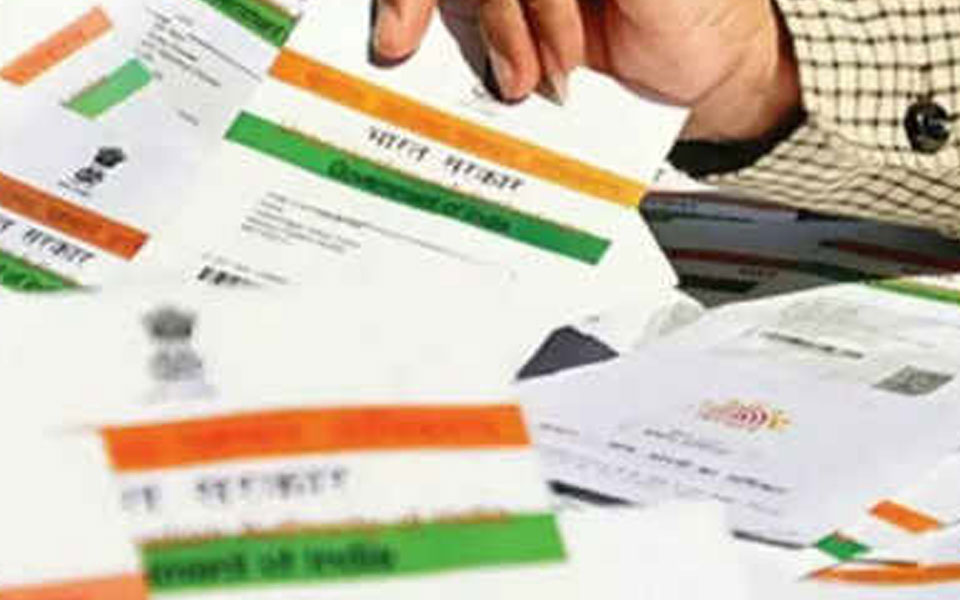
New Delhi, Jan 2 : The government on Wednesday introduced an amendment bill in Lok Sabha to provide legal backing for voluntary seeding of biometric Aadhaar ID with mobile numbers and bank accounts after the Supreme Court barred mandatory use of the 12-digit unique identifier by private firms.
As the Oppositions raised concerns, Law Minister Ravi Shankar Prasad asserted that the proposed amendment is in compliance with the Supreme Court judgement and that there will be no infringement of privacy.
He also said that the government has prepared a data protection bill and it will be introduced in Parliament soon.
"Let me clarify at the outset that the proposed amendment is done in compliance with the Supreme Court judgement. It (linking) is not mandatory at all," he said.
Regarding privacy issue, he said privacy is "not being invaded at all" from these amendments. The parallel authentication norms is there to safeguard privacy issues, he added.
"We should not forget that Aadhaar has led to saving of Rs 90,000 crore" through Direct Benefit Transfers (DBT), the minister said, adding multilateral organisations such as World Bank and IMF have hailed Aadhaar as a unique innovation of India.
Objections were raised on the bill by Shashi Tharoor (INC), Saugata Roy (Trinamool Congress) and N K Premachandran (RSP). Opposing the bill, Roy said that the proposed amendments infringe the Supreme Court judgement on Aadhaar matter.
The proposed amendment will circumvent that judgement and it was brought without stakeholders' consultation, he claimed, adding "the bill should not be introduced".
Tharoor said that the bill is in violation of the apex court judgement.
"The bill is premature because first we need enactment of data protection law," he said asking "where is the draft" of the data protection law.
"The bill must be withdrawn and revised," he added. Endorsing these views, Premachandran alleged that the bill infringes the right of privacy.
The Minister said these objection are "misplaced" and "we are not violating the Supreme Court" judgement.
The bill to amend the Aadhaar (Targeted Delivery of Financial and Other Subsidies, Benefits and Services) Act, 2016 and another bill to amend the Indian Telegraph Act, 1885 and Prevention of Money-laundering Act, 2002 was introduced in Lok Sabha amid ruckus by members of AIADMK and TDP over various issues.
The Lok Sabha Speaker immediately adjourned the House till 2 PM after the introduction of these bills. In December 2018, the Union Cabinet had approved amending the existing Aadhaar law.
The Cabinet headed by Prime Minister Narendra Modi approved amendments to the Telegraph Act and the Prevention of Money Laundering Act (PMLA) after the Supreme Court in September imposed restrictions on the use of Aadhaar by private companies.
The two Acts are being amended to provide for voluntary sharing of the 12-digit identification number for obtaining new mobile phone connections and for the opening of bank accounts.
The changes in the relevant sections of the Telegraph Act and PMLA will be effected through the original Aadhaar Act.
Under the amendments, an Aadhaar holder can opt for offline verification through QR code and will not require to share his or her actual Aadhaar number.
The Supreme Court had struck down Section 57 of the Aadhaar Act that made seeding of the biometric ID with SIMs and bank accounts mandatory, saying it had no legal backing.
Let the Truth be known. If you read VB and like VB, please be a VB Supporter and Help us deliver the Truth to one and all.
Two tribal girls gangraped in Chhattisgarh's Surguja; three arrested, three juveniles detained

Ambikapur (PTI): Two tribal girls were raped allegedly by six persons, including three juveniles, in a village in Chhattisgarh's Surguja district, a police official said on Thursday.
Three accused have been arrested and three minors were detained in connection with the incident that took place on the night of April 24 under Sitapur police station limits, he informed.
"The motorcycle-borne accused intercepted the victims when they, along with two other friends, were returning home on foot after attending a wedding. Two of the girls managed to escape. The two victims, one aged 15 years and another 13 years, were forced onto a motorcycle, taken to a secluded place and sexually assaulted," he said.
One of the victims returned home the same night and informed her family the next day, following which a case was registered under Bharatiya Nyaya Sanhita and Protection of Children from Sexual Offences (POCSO) Act at Sitapur police station on April 26 for gangrape and other offences, he said.
Medical examinations of the victims were conducted at the Sitapur Community Health Centre on April 26 and 27, the official said.
"Initial medical reports did not confirm sexual assault. However, after the victims' families expressed dissatisfaction with the findings, the girls were sent for fresh medical examination at the district hospital in Ambikapur. Based on this medical report, all six accused were taken into custody by April 30," he said.
The arrested accused have been identified as Anand Bek (27), Vikas Tigga (24) and Manish Khalkho (18), all residents of the Sitapur area. The three juveniles, two of them aged 17 years, have been detained, he said.