Government May Not Have Data on Migrant Labourers, But a Website Built by 4 Volunteers Does
The database has recorded 906 deaths between March 14 and July 4, 2020
This news story was published by The wire and has been shared here without any changes and alterations. CLICK HERE to read the original post.
New Delhi: On the opening day of the monsoon session in Parliament, the government, in response to at least seven questions posed by Lok Sabha MPs on the lockdown affecting the life and livelihood of migrant labourers, stated that it had no data on migrant labourers who died during the national lockdown.
Union Minister of State for Labour and Employment, Santosh Gangwar, categorically stated to a query on whether thousands of migrant labourers have died during the lockdown – “No such data is available.”
The Union minister, however, could have sought assistance from others’ efforts at creating a public database on the reported deaths of those belonging to migrant families during the lockdown.
Maintained voluntarily by four persons, the database has recorded 906 deaths between March 14 and July 4, 2020, and classified them under 10 categories. The database has chosen to 67 deaths due to the inability to categorise them for want of more details.
Available on thejeshgn.com, the database has been put together by Aman, an assistant professor of legal practice at the Jindal Global School of Law, Thejesh G.N., a public interest technologist and Kanika Sharma and R. Krushna, doctorate students at Emory University (Georgia) and Syracuse University (New York) respectively with help from Roadscholarz, described as a group of freelance scholars and student volunteers interested in action-oriented research, socio-economic rights and related issues.
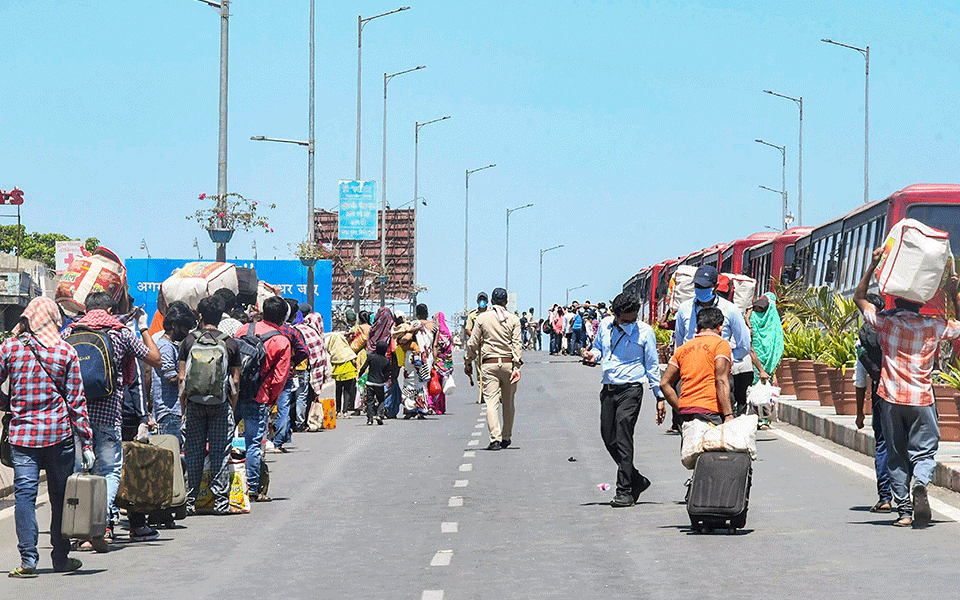
As per the data in the public domain, the highest number of 216 deaths between March 14 and July 4 had taken place due to the combined reasons of starvation and loss of money. As many as 209 deaths had taken place during the national lockdown due to road or train accidents suffered by labourers who had taken to the streets to reach their home states after all means of communication were stopped by the Central government in an overnight move.
During the lockdown, 133 suicides were also reported. While the database shows that 77 persons died due to lack or denial of medical care, 49 of them lost their lives because of alcohol withdrawal.
The database which also gives names, dates of death, along with the districts and occupations of those who died, has shown that 47 people had died of exhaustion, either due to the walk home or because of standing in long queues. As many as 49 migrants died in quarantine centres while 18 succumbed to non-communal, lockdown-associated crimes.
During the lockdown, there were several media reports on police brutality on those who took to the streets for violating the lockdown rules. As per the public database, 12 persons lost their lives in police action.
The database also reflects sources from where the details on the deaths have been collated along with links to the individual stories published in newspapers and online portals, for the public to corroborate them.
As to why they had decided to collect the data so meticulously, the site says, “It is our belief that such deaths must not be lost sight of when assessing the impact of the lockdown. This is one of the many attempts to keep a record of the human costs of the lockdown.” It further adds, “There is an active denial of the crisis caused by the unplanned lockdown, and therefore, it becomes more important to record these deaths for public memory.”
Since it has relied only on published news, it adds, “Only a fraction of deaths are reported by media and we may have missed some deaths reported in local media as well. Therefore, our numbers are an underestimate of the total deaths caused by the lockdown at the ground level.”
Let the Truth be known. If you read VB and like VB, please be a VB Supporter and Help us deliver the Truth to one and all.
AIITA welcomes Karnataka’s ban on obscene songs in school events

Bhatkal: The Karnataka unit of the All India Ideal Teachers Association (AIITA) has welcomed the Karnataka government’s decision to strictly ban school children from dancing to obscene songs during educational and cultural programmes in government, aided, and private schools across the state.
AIITA Karnataka State President M. R. Manvi congratulated the government for taking what he termed an important step to preserve the sanctity of education.
“Such decisions to safeguard the dignity of school children and uphold the values of education are the need of the hour. This rule should not be limited to government schools alone but must be strictly implemented in all private educational institutions as well,” he said.
He further urged the government to address other concerns within school programmes.
“The government should not only prohibit obscene dances in the name of school anniversaries, but also ensure that plays and dialogues that incite religious hatred are avoided. Schools should be centres of harmony, not platforms for spreading hatred,” he added.
According to a recent circular issued by the Department of School Education and Literacy, obscene dances are adversely affecting the mental health and moral values of students.
In this regard, schools have been advised to use songs that promote nationalism, positive thinking, the greatness of Kannada culture, and value-based traditions instead of inappropriate content during programmes.
The circular also emphasises that students should be dressed in decent attire.
AIITA also backed the department’s warning that disciplinary action would be taken against head teachers if such guidelines are violated. The association has further demanded that district Deputy Directors of Public Instruction strictly monitor the implementation of these rules.