Government using armed forces to defend its decisions on Rafale deal: Congress
New Delhi, Sep 12 : The Congress on Wednesday accused the government of making the armed forces "pawn" in its political battle over the Rafale deal and said that it was not prepared to reveal the price at which the fighters jets have been purchased.
Congress Spokesperson Abhishek Manu Singhvi said the party will not drag the services into the political arena after Air Chief Marshal B.S. Dhanoa asserted that the Rafale jets will power the Indian Air Force (IAF) to fight "grave threats" from Pakistan and China.
"It is most distressing, disgusting and deplorable that the government is putting forward our armed forces' persons like this. We respect them, be it the soldiers, be it the chief. In the political arena, I do not want to drag them despite the worst provocation," Singhvi said on Dhanoa's remarks.
He said that it was not appropriate to put the Army, Navy or Air Force chief to defend yourself (government).
"I do not know where your 56 inch chest has gone that you are putting these people in front," he said while taking a dig at Prime Minister Narendra Modi.
Singhvi said that the Congress had made a straightforward political allegation on the deal in the last one year which the Modi government is unable to answer.
"I will deal with your Defence Minister, your Finance Minister, your Prime Minister. But I will not engage the service chief whom we respect. Do not make our service people pawns in this game," he said.
Singhvi accused the Modi government of seeking to derail the issue.
"The rules of the game are changed and an attempt has been made to mislead. Who has ever said that Rafale is not a good aircraft? In one year have we said so? Is it our case?" he asked.
Referring to Finance Minister Arun Jaitley's remarks that the fighter jet purchased by the NDA government from France was nine per cent cheaper than that negotiated by the then UPA government in its basic cost whereas its weaponised version was 20 per cent cheaper, Singhvi said that the government should spell out the figures it was referring to while putting out such calculations.
"Common sense tells me that nine per cent or 20 per cent is less from some figure. Why don't you tell us that figure? A kindergarten student knows that 20 per cent or 9 per cent less has to have a figure from which it is less -- that they will never tell. So, there is no answer to our question -- it remains unanswered. The question is what is the price (of each Rafale jet)?"
"The question is -- why is there no manufacturing in India? Why is there no value addition under the offset? What happened to 'Make in India' initiative? These things will never be answered," he said.
Let the Truth be known. If you read VB and like VB, please be a VB Supporter and Help us deliver the Truth to one and all.
CM Siddaramaiah alleges ‘criminal conspiracy’ in Sringeri recount, vows legal action
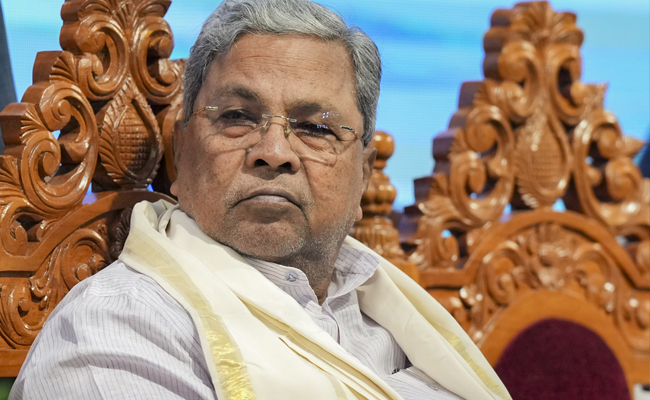
Bengaluru (PTI): Alleging a “criminal conspiracy” by BJP candidate D N Jeevaraj in the Sringeri Assembly poll recounting, Karnataka CM Siddaramaiah on Tuesday said the outcome was manipulated after valid postal ballot votes in favour of Congress leader T D Raje Gowda were tampered with during the recounting process.
Following a Karnataka High Court order on an election petition filed by Jeevaraj, challenging Raje Gowda’s election, the reverification and recounting were conducted on Saturday.
After the reverification and recount of postal ballots for the Sringeri Assembly constituency, votes polled in favour of Raje Gowda were reduced by 255, the returning officer said.
A report on the matter has been submitted to the Election Commission of India for further action, the officer added.
Congress leader Raje Gowda had won the 2023 Assembly polls from Sringeri by 201 votes, defeating his nearest rival Jeevaraj.
Addressing a press conference in Bengaluru, Siddaramaiah said the High Court had directed the recounting of postal ballots and that irregularities were noticed during the exercise conducted on May 2.
“This is a clear case of criminal conspiracy,” Siddaramaiah said, alleging that valid votes cast in favour of Raje Gowda were altered after being accepted by counting agents of all parties, including Congress, BJP, and JD(S).
He claimed that during the recounting of postal ballots, 255 votes were initially accepted as valid by all agents but were later tampered with by subordinate officials.
“There is a second mark on the votes polled in favour of Raje Gowda. They had accepted these as valid votes. Subsequently, another mark was made by officials. This is a clear case of criminal conspiracy,” he said.
When asked who was behind the alleged conspiracy, the CM replied, “It was hatched by Jeevaraj and others. It is planned.”
Siddaramaiah further alleged that the returning officer acted improperly by declaring the result despite the presence of an Election Commission observer during the recounting.
“Immediately after the counting, the returning officer announced the result. He should not have done so; this is against the law,” he said.
He pointed out that Raje Gowda had originally won by 201 votes, but after the recounting, the BJP candidate was declared the winner by 52 votes.
“The BJP has committed a criminal act of conspiracy. This is not vote chori but vote dacoity,” he alleged.
The CM said a police complaint had already been filed by Raje Gowda’s election agent, Sudhir Kumar, and emphasised the need for electoral integrity.
“We want transparency and free and fair elections. That is what our Constitution mandates,” he added.
Stating that the government would pursue legal remedies, Siddaramaiah said, “We are preparing an appeal challenging the returning officer’s announcement in a court of law.”
Responding to a separate query on elections in other states, the CM said there appeared to be an anti-incumbency factor in West Bengal, while results in Tamil Nadu were “surprising,” adding that Vijay’s party was emerging as the largest there.
Following the victory of party candidates in Bagalkote and Davanagere South, Siddaramaiah expressed confidence about future electoral prospects in Karnataka.
“Even in 2028, we will win the Assembly elections. We will come back,” the CM said.
Siddaramaiah added that he would order a forensic examination into the alleged tampering of postal ballots.