Governments criticise judicial activism to cover up their failure: SC
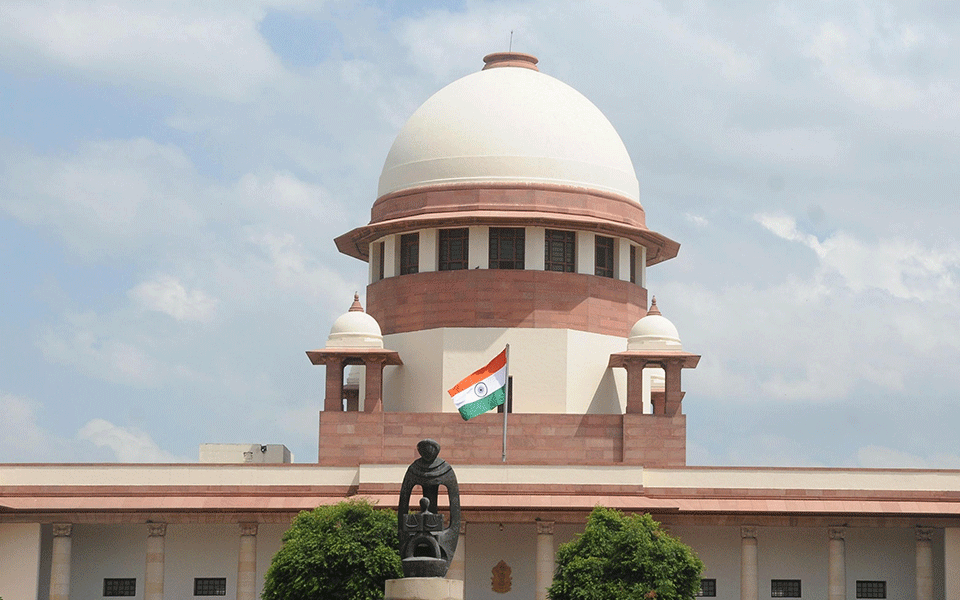
NEW DELHI: The Supreme Court on Tuesday deprecated the tendency of governments to accuse the judiciary for encroaching upon the domain of the executive and the legislature by passing orders for protection of marginalised section of society through PILs.
The top court said that the governments do this to cover up their own failures in providing social justice to the people.
Taking the governments head on for their criticism against the judiciary for entertaining PILs, a bench of Justices Madan B Lokur, S Abdul Nazeer and Deepak Gupta said that the concept of public interest litigation has become a potent and very effective force to bring about immense social change through interventions made and directions issued by the apex court.
“During the last several decades, PILs have compelled this court to consider issues relating to the environment, social justice, violation of human rights and disregard for Article 21 of the Constitution; either because of an absence of governance due to the failure of the state to faithfully and sincerely implement laws enacted by Parliament or due to mis-governance by the state, that is, the central government, the state governments and Union Territory Administrations leading to rampant illegalities,” the bench said.
“In recent times, usually and regrettably, the state has chosen to challenge the idea of PIL or denigrate it by chanting the mantra of judicial activism or separation of powers. In most cases, these mantras are nothing but a fig leaf to cover the failure of the state to recognise the existence of the rule of law and the need for providing social justice to the people of the country, as stated in the Preamble to our Constitution. There must be a realization that PIL has given a voice to millions of marginalized sections of society, women and children,” Justice Lokur, who wrote the judgment, said.
The court passed the observation while delivering a verdict on a PIL on prison reform and appointed a three-member committee headed by its retired judge Amitava Roy to recommend measures to provide reformatory environment along with basic facilities to prisoners to lead a dignified life within jail. The court entrusted the task to the committee to examine 1,382 prisons in the country and file a comprehensive report on improving living conditions there for convicted and under-trial prisoners and to reduce overcrowding in jails.
The committee, also comprising Inspector General of Police, Bureau of Police Research and Development Director General (Prisons) Tihar Jail, is to file its report within a year and would also explore the option of setting up of an open prison.
Hailing the role of PIL in protecting the fundamental rights of people, particularly that of the poor and the deprived sections of society, Justice Lokur said that PIL is one of the most important contributions of India to jurisprudence which is now being adopted by other countries too.
The bench, however, accepted that there is also some misuse of PIL and the court had exceeded its jurisdiction, but said, “it must be emphasised that wherever this court might have exceeded its jurisdiction, it has always been in the interest of the people of the country prompted by administrative mis-governance or absence of governance. There are, therefore, occasional transgressions on both sides, but that cannot take away from the significance of public interest litigation as a non-adversarial source of righting some wrongs and encouraging social change through accountability and, in cases, transparency”.
The court’s observation assumes significance in view of the recent spat between Justice Lokur and Attorney General K K Venugopal in August while hearing a PIL. The top law officer had told the bench that judiciary must exercise self restraint while entertaining PILs and raised question on judiciary donning the mantle for solving all the ills that plagued the country. But the court, however, reminded the Centre how abjectly it had failed in implementing the law framed by Parliament.
“Rest assured that Article 21 (right to life and liberty) would remain there in the Constitution,” Justice Lokur had said, indicating that court would not remain a mute spectator of when rights of people were being violated and funds meant for the poor and disadvantaged is being misused. “We are bound to question the authorities in such cases,” he had said.
Courtesy: timesofindia
Let the Truth be known. If you read VB and like VB, please be a VB Supporter and Help us deliver the Truth to one and all.
BCI urges CJI to take action against Andhra HC judge for sending young lawyer to 24-hour custody

New Delhi (PTI): The Bar Council of India on Wednesday sought the urgent intervention of Chief Justice of India Surya Kant following a "deeply disturbing" incident where a judge of the Andhra Pradesh High Court reportedly sent a young advocate to
24-hour judicial custody over a procedural lapse.
The Bar Council of India (BCI) Chairperson and senior advocate Manan Kumar Mishra, in a formal representation, termed the conduct of Justice Tarlada Rajasekhar Rao "grossly inappropriate" and "damaging to the confidence of the Bar".
“I most respectfully request your Lordship to kindly take immediate institutional cognizance of the matter and call for the video recording of the proceedings, the order passed, and the surrounding circumstances.
“I further request that appropriate administrative action may kindly be considered, including withdrawal of judicial work from the learned Judge pending review, his immediate transfer to some far off High Court, and his nomination for appropriate judicial training/orientation on court management, judicial temperament, Bar-Bench relations, and proportional exercise of contempt/judicial authority,” Mishra wrote.
This representation is made to preserve the “dignity, moral authority and public confidence of the judiciary”, he said, adding, “Judges command the highest respect not by fear, but by fairness, patience, restraint and constitutional humility”.
The communication urged the CJI to intervene at the earliest to ensure that the faith of Bar, particularly young advocates, in the protective and corrective role of the judiciary is restored.
The controversy stems from proceedings on May 5.
According to the BCI, a video circulating online shows Justice Rao rebuking a young advocate who was unable to produce a specific order copy during a hearing.
The letter said that despite the advocate "repeatedly seeking pardon and mercy" and claiming he was in physical pain, the judge remained "unmoved".
The judge allegedly told the lawyer, "now you will learn," and mocked his experience before directing the Registrar and police personnel to take him into custody for 24 hours.
The BCI chairperson said that the judge’s actions lacked proportionality and fairness.
"The dignity of the court is not enhanced when a lawyer is made to beg for grace in open court and is still sent to custody for a procedural lapse," the letter said.
"A young lawyer... is an officer of the Court, still learning, still growing, and entitled to correction without humiliation," it added.
The bar body said that such actions create a "chilling effect" on the legal fraternity, particularly among junior members, and undermine the mutual respect required between the Bench and the Bar.