Govt defends dropping Tipu Sultan, Razia Sultan from NCERT textbooks, cites 'curricular objectives'

New Delhi: The Union government has defended its decision to exclude historical figures such as Tipu Sultan, Razia Sultan, and Nur Jahan from the Class 8 history textbook published by the National Council of Educational Research and Training (NCERT), citing alignment with curricular objectives.
Minister of State for Education Jayant Chaudhary, responding to a written question in Parliament from Trinamool Congress MP Ritabrata Banerjee, stated that the objective of textbooks for Classes 6 to 8 is “to provide a broad survey of Indian civilisation from the pre-historic times till Independence.” He said the inclusion of personalities in the textbooks has been done "contextually and in accordance with curricular objectives."
The government came under fire from educators and academics last month after the release of the new Class 8 social science textbook for the ongoing academic year. Critics pointed out the removal of key historical figures and events, including Tipu Sultan, Haider Ali, the four Anglo-Mysore wars, Razia Sultan, and Nur Jahan.
Chaudhary clarified that the revised textbook is an integrated social science resource divided into four themes: India and the World: Land and the People; Tapestry of the Past; Governance and Democracy; and Economic Life Around Us. “Personalities featured in these themes have been included contextually and in accordance with curricular objectives,” he said, adding that the new textbook also incorporates updated pedagogical methods and emphasizes focused syllabus delivery and improved classroom practices.
In response to concerns over the exclusion of prominent Muslim rulers and key historical events, the minister said that Tapestry of the Past includes women leaders like Rani Durgavati, Ahilyabai Holkar, Rani Abbakka I, and Begum Hazrat Mahal.
Chaudhary also reminded Parliament that education is a subject in the Concurrent List of the Constitution. “The respective state governments may adopt or adapt NCERT textbooks or develop their own textbooks based on the National Curriculum Framework. The states have the flexibility to provide more coverage about regional personalities and events in their textbooks,” he said.
Earlier versions of the Class 7 textbook included detailed sections on the Delhi Sultanate and the Mughal Empire. However, the new Class 7 book now ends before the 12th century, shifting much of that content to the first part of the new Class 8 textbook, albeit with notable omissions.
Let the Truth be known. If you read VB and like VB, please be a VB Supporter and Help us deliver the Truth to one and all.
Rain wreaks havoc in Bengaluru, kills 10
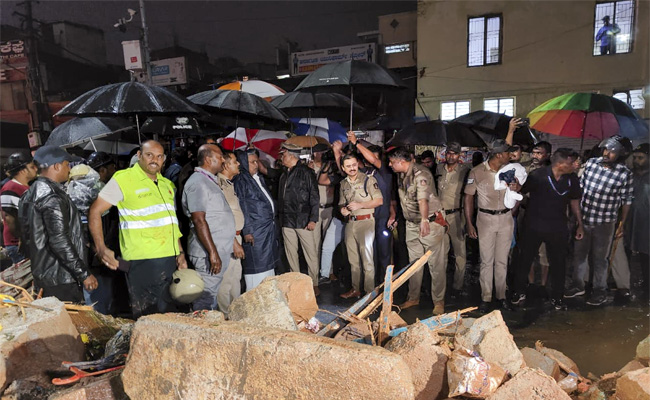
Bengaluru (PTI):The rains in Bengaluru on Wednesday evening wreaked havoc, killing 10 people, authorities said.
Heavy rains coupled with a hailstorm and gusty winds uprooted trees, flooded many key stretches and threw traffic out of gear, they said on Thursday.
Large parts of the city witnessed sudden, intense rainfall for nearly an hour, bringing down trees and electric poles, crushing parked vehicles and inundating low-lying areas, while several roads were rendered impassable, severely disrupting vehicular movement during peak hours.
Seven people, including a six-year-old girl, were killed when a compound wall of the Bowring and Lady Curzon Hospital collapsed amid the downpour.
Among the deceased, two were from Kerala who were on a study tour. They had taken shelter near the wall when it gave way, they said.
ALSO READ: ICSE, ISC results: Girls outperform boys, pass rate over 99%
In another incident, a 35-year-old man, identified as Raghu, died of electrocution on Bannerghatta Road near Vega City Mall.
In a separate case in Yarab Nagar, a student, Syed Sufiyan died after coming into contact with a live electric wire while attempting to park his motorcycle during the rain, police said.
One more fatality was reported from Chamarajapet, where Manjunath died on the spot after a cement block fell and pierced through the roof of a house during the storm.
The sudden spell of rain left a trail of destruction across the city.
“So far, 10 people have died due to rain-related incidents in Bengaluru,” police said, attributing the deaths to wall collapse, electrocution and structural damage triggered by the storm.
Civic authorities said at least 87 trees were uprooted and 131 branches snapped across the city, disrupting daily life.
Of these, 60 trees and 98 branches had been cleared, while restoration work was ongoing.
Several cars and two-wheelers parked along roadsides were crushed under fallen trees.
Key junctions and underpasses were waterlogged, with the KR Circle underpass completely submerged, forcing police to barricade the stretch due to lack of drainage.
Fallen branches and stalled vehicles further worsened traffic congestion, leaving commuters stranded for hours.
Officials said buildings suffered partial damage in several areas, while the sudden and unanticipated nature of the storm caught many residents off guard. Authorities have issued a rain alert for the next three days.