Govt does not need extra funds from RBI to meet fiscal deficit target: Jaitley
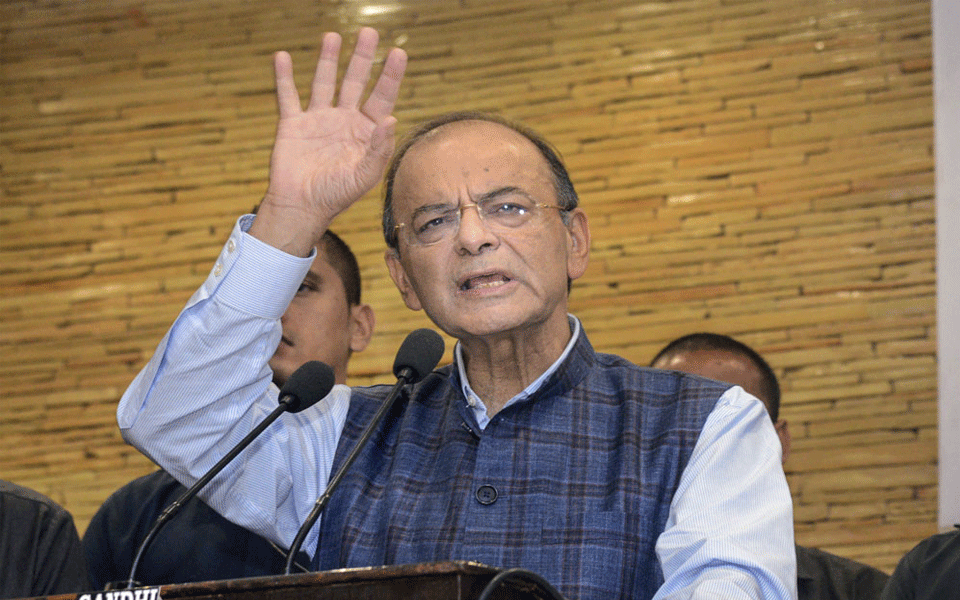
New Delhi, Nov 24: Finance Minister Arun Jaitley has said the government does not need any extra funds from the Reserve Bank or any other institution to meet the fiscal deficit target.
However, he added that extra funds, which may accrue from the new capital framework of the Reserve Bank, can always be used for poverty alleviation programmes over the years by future governments.
"We don't need any extra funds from any other institution to finance our fiscal deficit. Let's be very clear that's not the intention of the government. And we are not saying that in next six months give me some money. I don't need it, the minister said in an interview to TV channel Times Now.
India's fiscal deficit is slated to come down to 3.3 per cent of GDP at the end of the current fiscal.
Responding to criticism that the government was eyeing RBI's reserves, Jaitley said globally central banks have a capital framework which determines the amount of funds that ought to be maintained as reserves.
"All we are saying is there has to be some discussion and some norms under which Reserve Bank will have a capital framework," he said, adding that surplus funds could be used for poverty alleviation programmes by future governments over the next several years.
The RBI board at its meeting earlier in the month decided to set up a high-level committee for examining the Economic Capital Framework (ECF) to determine the appropriate levels of reserve the central bank should hold.
The RBI is reported to be holding a massive Rs 9.59 lakh crore of reserves.
Answering questions with regard to the autonomy of the Reserve Bank, Jaitley said it has to be exercised within the framework of law.
"The government's viewpoint is that we respect and we will always maintain the autonomy within the framework of the laws which have been laid down," he said.
The government, Jaitley added, would continue to flag issues with the Reserve Bank in the larger interest of the economy, and there has to be coordination between the central bank and the government
"If there are sectors of economy which are starved of liquidity or credit, as a sovereign government... we certainly will flag those issues wherever the RBI has the authority to decide certain things," the minister said, adding there is no institutional failure.
He further said that during the Congress-led UPA regime, fiscal deficit went as high as 6 per cent of the GDP.
"We inherited a 4.6 per cent fiscal deficit. This government since 1947 in five-year tenure has the best record of fiscal prudence that any government has. From 4.6 per cent this year we are going to bring it down to 3.3 per cent," he added.
Let the Truth be known. If you read VB and like VB, please be a VB Supporter and Help us deliver the Truth to one and all.
Trump says EU has until July 4 to approve last year's trade deal or it will face higher tariffs
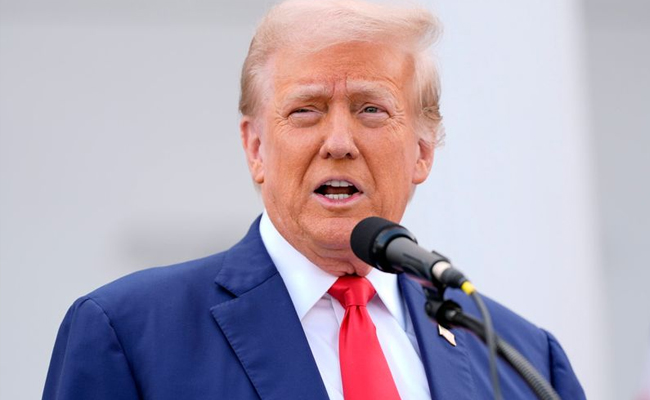
Washington (AP): President Donald Trump has said in a social media post that goods from the European Union would face higher tariff rates if the 27-member bloc fails to approve last year's trade framework by July 4.
The announcement on Thursday appeared to be a deadline extension after the president said last Friday that EU autos would face a higher 25 per cent tariff starting this week. Trump made the updated announcement after what he described as a "great call" with European Commission President Ursula von der Leyen.
Still, the US president was displeased that the European Parliament had yet to finalize the trade arrangement reached last year, which was further complicated in February by the US Supreme Court ruling that Trump lacked the legal authority to declare an economic emergency to impose the initial tariffs used to pressure the EU into talks.
"A promise was made that the EU would deliver their side of the Deal and, as per Agreement, cut their Tariffs to ZERO!" Trump posted. "I agreed to give her until our Country's 250th Birthday or, unfortunately, their Tariffs would immediately jump to much higher levels."
It was unclear from the post whether Trump was implying that the tariff rates would jump on all EU goods or the increase would only apply to autos.
His latest statement indicates he might be backing away from his earlier threat on EU autos by giving the European Parliament several more weeks to approve the agreement.
Under the original terms of the framework, the US would charge a 15 per cent tax on most goods imported from the EU.
But since the Supreme Court ruling, the administration has levied a 10 per cent tariff while investigating trade imbalances and national security issues, aiming to put in new tariffs to make up for lost revenues.