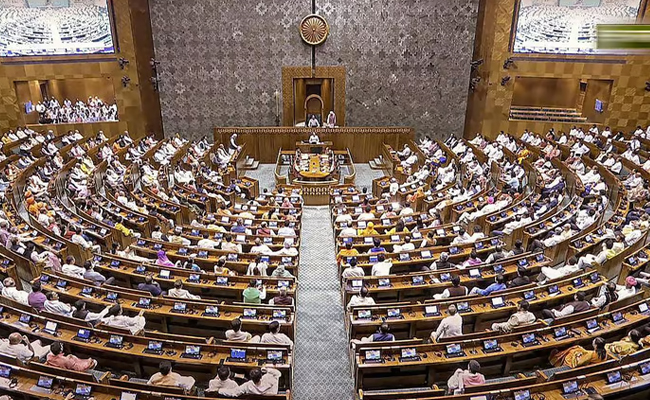
Govt employees mandated to complete competency-linked courses: Centre in Rajya Sabha
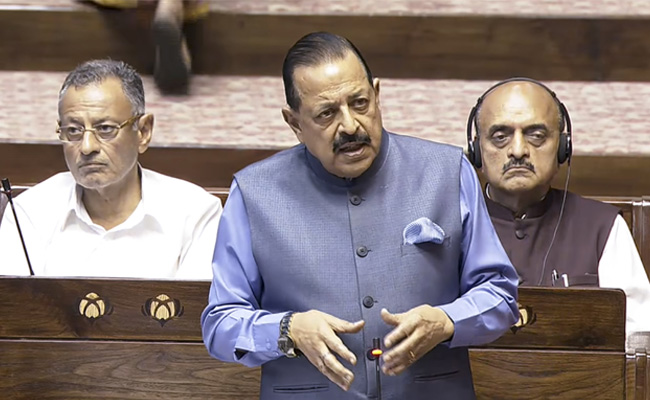
New Delhi (PTI): All central government employees have been mandated to complete competency-linked courses relevant to their role or level on a dedicated online platform annually, which will reflect in their annual performance appraisal reports, the Rajya Sabha was informed on Thursday.
The government has adopted a competency-based capacity building approach, focusing on role-based learning, continuous skill development, and alignment of training with role requirements, Union Minister of State for Personnel Jitendra Singh said in a written reply.
"The Department of Personnel and Training (DoPT) has mandated all central government employees and officers of the all-India services to complete competency-linked courses mapped to their role/level and comprehensive assessments prescribed by their ministries/ departments/organisations (MDOs) or cadre controlling authorities (CCAs) on iGOT (integrated government online training) portal annually, which is to be also reflected in their annual performance appraisal reports (APARs)," he said.
ALSO READ: FIR against Rajasthan MLA Ravindra Singh Bhati for threatening folk singer
The minister was responding to a query about the government's plans to incorporate competency-based scores for promotion and appraisal processes of its employees.
A framework of roles, activities and competencies (FRAC) aims to align all positions in government with clearly defined roles, activities, and required competencies (behavioural, functional, and domain), Singh added.
In a separate reply, the minister said that details of the engagement of consultants are maintained by respective ministries and departments.
The General Financial Rules (GFR), 2017, administered by the Department of Expenditure, Ministry of Finance, provides for the fundamental principles applicable to all ministries or departments concerning the engagement of consultants and external professionals or consultancy firms for specific jobs, he said.
"As informed by the Department of Expenditure, data regarding engagement of consultants is maintained by respective ministries and departments," Singh said.
The minister was asked the year-wise number of consultants engaged by all the central ministries and departments during the last five years.
Let the Truth be known. If you read VB and like VB, please be a VB Supporter and Help us deliver the Truth to one and all.
HC seeks mechanism on disclosure of complaints against judges after SC says no data maintained

New Delhi: The Delhi High Court sought suggestions for a framework to balance transparency and judicial independence on April 1, after the Supreme Court submitted that it does not maintain judge-specific data on complaints alleging corruption or misconduct.
The submission was made by Advocate Rukhmini Bobde. He appeared for the Supreme Court’s Central Public Information Officer, before Justice Purushaindra Kumar Kaurav in a petition filed by journalist and RTI activist Saurav Das. The case concerns an RTI application filed by Das in April 2023 seeking information on whether any complaints had been received against Justice T. Raja, former Acting Chief Justice of the Madras High Court, and if so, the number of such complaints and action taken.
According to a detailed report published by The Wire, the CPIO declined the request and stated that the information was “not maintained in the manner as sought for.” The first appellate authority upheld the decision. Although the Central Information Commission remanded the matter, the CPIO reaffirmed the refusal on similar grounds, which led Das to move the high court through Advocate Prashant Bhushan.
At the hearing, Justice Kaurav observed that the issue had wider institutional implications. It directed both sides to propose a mechanism that would protect the reputation of judges while ensuring public access to information regarding the handling of complaints. The case, Saurav Das v. CPIO, Supreme Court of India has been listed for further hearing on May 7.
During the arguments, Bhushan cited numbers released by the Union Law Ministry in Parliament in February 2026, which said that 8,630 complaints had been filed against sitting judges between 2016 and 2025. The Supreme Court provided data showing that complaints increased from 729 in 2016 to 1,102 in 2025. Bhushan questioned how aggregate data could be calculated without identifying the judges against whom complaints were filed.
Bobde responded that the data shared with Parliament reflected only total complaints against all sitting judges and did not involve judge-wise categorisation. She referred to the RTI request as a "fishing and roving inquiry." She also claimed that the Registry could not be forced to spend resources to collect material that was not stored in the format sought. She referenced the 2019 Constitution Bench decision in Supreme Court of India v. Subhash Chandra Agarwal, which allows for rejection if compliance will disproportionately divert resources, as her justification.
The high court questioned how no judge-specific information was maintained and expressed concern that disclosure of large aggregate figures without clarity on how complaints were handled could affect public perception. Justice Kaurav noted that an applicant could not be denied information solely on technical grounds relating to format.
Bhushan argued that the RTI request did not seek details of complaint contents or collegium deliberations but merely whether complaints were received and what action followed, submitting that transparency in the handling of complaints was essential to maintain public confidence.
The Supreme Court’s in-house procedure for examining complaints, adopted in 1999, provides for scrutiny by the Chief Justice of India and, where warranted, inquiry by a committee of judges. There is no statutory requirement for public reporting of outcomes.