Govt freezes Voda Idea's dues, gives 5-yr payment moratorium; capped AGR dues to be reassessed
_vb_43.jpeg)
New Delhi (PTI): The government on Wednesday approved a major relief package for Vodafone Idea, freezing its outstanding AGR dues, approving a five-year moratorium on payment, and clearing the way for reassessment of the capped statutory charge - giving a critical lifeline to the beleaguered telco.
The relief measures approved by the Union Cabinet aim to protect the interest of the government (which has about 48.9 per cent stake in the telco), enable orderly payment of dues to the Centre by way of spectrum auction charges and AGR dues, ensure competition in the sector and safeguard the interests of 20 crore consumers of Vodafone Idea, according to sources.
The Cabinet, headed by Prime Minister Narendra Modi, agreed to freeze AGR dues of Vodafone Idea at Rs 87,695 crore, which the struggling company now has to start paying from 2031-32 fiscal and clear by 2040-41, sources aware of the decision said.
The frozen dues will be reassessed by the telecom department based on 'deduction verification guidelines' of 2020 and audit reports, sources said, adding that the outcome will be decided by a government-appointed committee and be binding on both parties.
AGR dues refer to payments owed by telecom companies to the government based on Adjusted Gross Revenue (AGR). It is the revenue on which telecom operators must pay license fees and spectrum usage charges.
As per the relief package, AGR dues for FY 2017-18 and FY 2018-19, which were finalised based on the Supreme Court order of September 2020, will now have to be paid over 2025-26 to 2030-31 fiscal without any change, they said.
Sources said this amount works out to roughly Rs 120 crore per annum and between Rs 700-800 crore over the six years.
Responding to a clarification sought by BSE on the issue, Vodafone Idea said in a filing: "We have not received any communication from the government in relation to the above-reported matter. As and when there is any development which requires disclosure, we will do the needful".
Vodafone Idea has been battling a prolonged financial crisis, driven by intense price competition, high debt, and massive AGR liabilities that arose from a change in the definition of AGR. The company has struggled with persistent losses, a shrinking subscriber base, and limited ability to invest in network expansion, even as rivals accelerated 4G and 5G rollouts.
Repeated rounds of government relief and equity conversion of dues have kept the company afloat, but its long-term viability continues to hinge on sustained policy support, fresh capital infusion, and a turnaround in operating performance.
Some had expected that the Cabinet would waive a part, if not all, of the AGR dues immediately. But instead, it decided to give a moratorium on the bulk of the dues, with reassessment in the offing, giving the beleaguered company a shot at stabilising its operations.
Sources pointed out that the telecom is a critical infrastructure sector with strong linkages to economic growth and employment generation.
According to sources, the government remains firmly committed to supporting the sector, ensuring financial stability and preserving healthy sectoral competition for the benefit of customers.
The sector is also highly concentrated, and the government would, in the interest of consumers and competition, like to have multiple players in such critical sectors; therefore, the survival of VIL as a viable player is important.
The move comes in the backdrop of a favourable order VIL got from the Supreme Court, which allowed the government to reconsider and take an appropriate decision with reference to the additional AGR demand raised for the period up to the financial year 2016-2017, and of comprehensively reassessing and reconciling all AGR (adjusted gross revenue) dues, including interest and penalty.
Vodafone Idea incurred a loss of Rs 12,132 crore in the first half of the current fiscal, and its net worth stood at negative Rs 82,460 crore as of September 30.
The total debt of the company stood at Rs 2.02 lakh crore at the end of the reported quarter.
The company, however, has shown improvement in its financial performance by narrowing losses during the reported quarter on a year-on-year basis.
VIL's consolidated net loss year-on-year narrowed to Rs 5,524 crore in the second quarter ended September 2025, mainly on account of savings in finance cost on debt from banks and an increase in average revenue per user supported by tariff hike.
Earlier this month, Vodafone Idea had informed that its subsidiary VITIL has completed a Rs 3,300 crore fundraise by way of issuing non-convertible debentures.
The proceeds, it had said, will be used by VITIL to repay its payment obligation to Vodafone Idea, enabling it to bolster its capex and support business growth.
Let the Truth be known. If you read VB and like VB, please be a VB Supporter and Help us deliver the Truth to one and all.
Two injuries, one DNF, a DQ as India end messy World Relays campaign
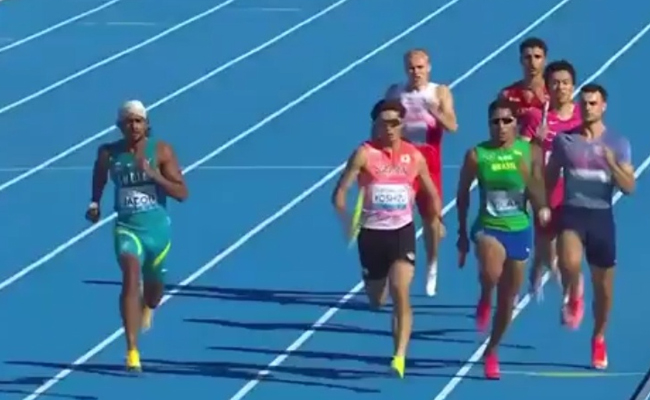
Gaborone (Botswana) (PTI): Amoj Jacob and Ragul Kumar got injured during the men's 4x400m and 4x100 races respectively as India ended their World Athletics Relays campaign in disappointment on the second day of competitions here on Sunday.
The Indian camp had high hopes of making the 2027 World Championships in the men's 4x400m relay but the team did not finish (DNF) the race as Jacob suffered cramps and pulled out of the race after taking the baton from the first leg runner Dharamveer Choudhary. Rajesh Ramesh and Vishal TK were to run in the third and fourth legs.
Those teams which could not qualify for the 2027 Beijing World Championships by reaching the final round of each of the six relay events on Saturday were given another chance in the second qualification round on Sunday.
The top two teams in each of the two heats (in all six relay events) booked the Beijing ticket on Sunday.
India will now have to try and qualify for the World Championships through the Top Lists of the World Athletics, which is a long and tedious process.
In the men's 4x100m race, third leg runner Ragul Kumar fell down the track after failing to hand over the baton inside the exchange zone to fourth leg runner Gurindervir Singh, which clearly showed the lack of coordination among the runners.
Harsh Santosh Raut and Animesh Kujur ran the first two legs.
The Indian quartet was disqualified and Kumar was seen being taken away from the Field of Play with the help of the volunteers.
It was a comedy of errors in the case of the women's 4x100m race, which saw the baton being dropped during an exchange between first leg runner Tamanna and second runner Nithya Gandhe, though the Indians finished the race in 53.09 seconds.
Gandhe started running quite a distance, but after realising that the baton was not in her hand, she turned and ran back to pick it up.
The only silver-lining for the Indian contingent was the national record time in the mixed 4x100m relay race, though the quartet of Ragul Kumar, Nithya Gandhe, Animesh Kujur and Sneha SS finished sixth in heat number two with a time of 41.35 seconds, bettering the previous national mark of 42.30 seconds set in March in Chandigarh.
The mixed 4x400m relay quartet of Theerthesh P Shetty, Kumari Saloni, Nihal William and Rashdeep Kaur ended at fifth in heat number one with a time of 3 minutes and 19.40 seconds.
On Saturday, all the five Indian relay teams had failed to make it to the respective final rounds and thus missed out on the 2027 World Championships berths.