Govt issues clarification on documents needed for citizenship under CAA
New Delhi (PTI): The Centre has expanded the ambit of the rules issued under the citizenship law CAA through which Indian nationality will be given to persecuted minorities coming from Afghanistan, Bangladesh or Pakistan.
The Union home ministry announced that "any document" issued by the central or state governments or quasi-judicial body in India proving that either of the parents, grandparents or great-grandparents is or had been a citizen of one of the three countries will be acceptable.
The clarification of the home ministry came after many applicants seeking Indian nationality under the Citizenship (Amendment) Act, 2019 were reported to be facing difficulties due to a particular clause of the Citizenship (Amendment) Rules, 2024.
"Any document that shows that either of the parents or grandparents or great grandparents of the applicant is or had been a citizen of one of the three countries i.e of Afghanistan or Bangladesh or Pakistan," the earlier clause of the Citizenship (Amendment) Rules, 2024 says.
In its latest clarification, the home ministry said: "It may be clarified that the documents under Sr No. 8 of the Schedule -1A may include any document issued by the central government/state government/ any judicial or quasi judicial body in India such as land record, judicial order etc., identifying or representing that the applicant or the parents or grandparents or great grandparents had been a national of Afghanistan or Bangladesh or Pakistan."
"The above clarification may be taken note of while deciding any citizenship application under Citizenship (Amendment) Act, 2019 (CAA), it said.
The CAA was enacted in December 2019 for granting Indian nationality to persecuted Hindu, Sikh, Jain, Buddhist, Parsi and Christian migrants from Afghanistan, Bangladesh and Pakistan who came to India on or before December 31, 2014.
After the enactment, the CAA got the president's assent but the rules under which Indian citizenship would be granted were issued only on March 11 this year, after over a delay of four years.
Since May, the government has been granting citizenship to those coming from the three countries under the CAA.
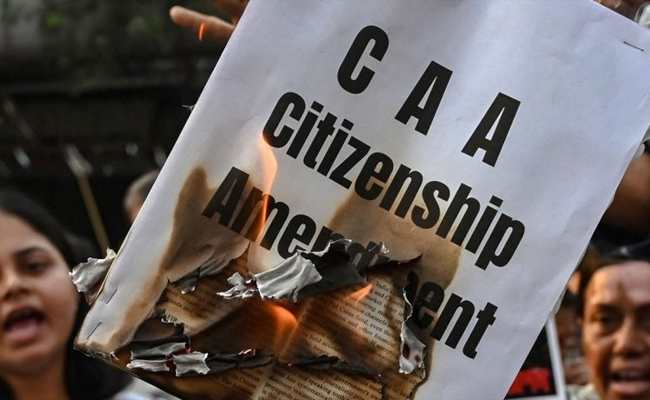
The nod to the CAA in 2019 sparked protests in different parts of the country with agitators terming it "discriminatory".
Over a hundred people lost their lives during the anti-CAA protests or police action in various parts of the country.
Let the Truth be known. If you read VB and like VB, please be a VB Supporter and Help us deliver the Truth to one and all.
For supporters, ''Thalapathy'' Vijay becomes ''Muthalamaichar'' Vijay

Chennai (PTI): As actor-politician Vijay-led TVK appeared inching towards the majority mark of 118 Assembly seats out of the total 234 segments in Tamil Nadu, celebrations by party workers and fans erupted across the state.
Amid chants of 'TVK' and 'Vijay,' party workers gathered outside the party headquarters at Panaiyur near here and distributed sweets and hailed the party founder as "Muthalamaichar (Chief Minister) Vijay, who continues to be popular as "Thalapathy (Commander, his film title)."
Meanwhile, visuals of Vijay's father Chandrashekar and some family members expressing joy and happiness appeared in some television channels. Vijay's party is leading in at least 108 seats out of the total 234 segments.