Govt issues updated clinical guidance for management of COVID-19 patients
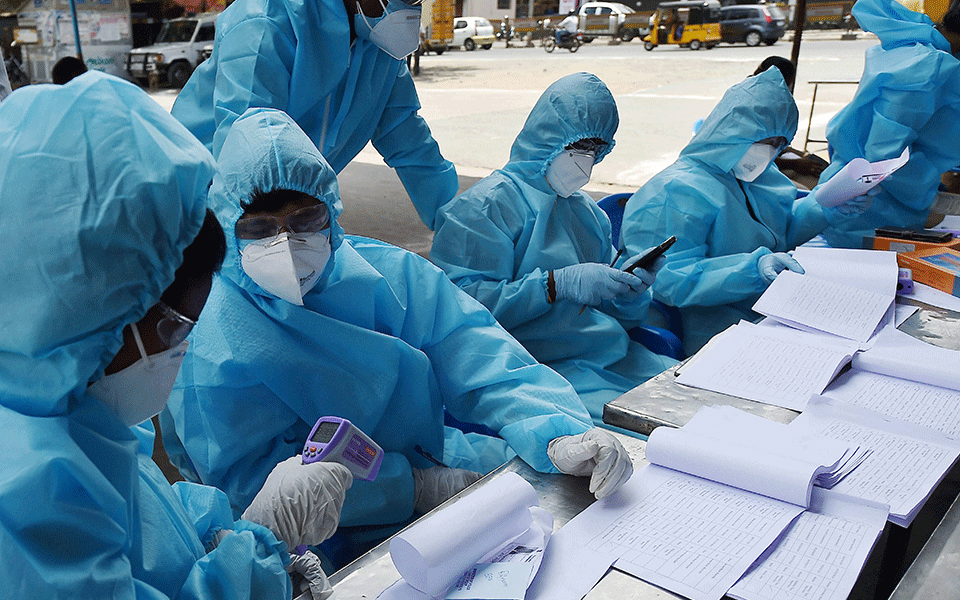
New Delhi: The Union Health Ministry has issued an updated 'Clinical Guidance for Management of Adult COVID-19 Patients' recommending emergency use authorisation of remdesivir for patients with moderate to severe diseases, requiring supplemental oxygen, within 10 days of onset of symptoms.
The guidelines issued by AIIMS, ICMR-COVID-19 National Task Force and the Joint Monitoring Group (DGHS) under the ministry stated that tocilizumab (a drug that modifies the immune system or its functioning) may be considered in patients with significantly raised inflammatory markers and not improving despite use of steroids with there being no active bacterial/fungal/tubercular infection.
They also recommended off-label use of convalescent plasma only in the early moderate disease, preferably within seven days of symptom onset, stating that "no use after seven days" and only on availability of high titre donor plasma.
Under emergency use authorisation (EUA), remdesivir may be considered for only those patients with moderate to severe diseases (requiring supplemental oxygen) within 10 days of onset of symptoms.
It is not recommended for those with severe renal impairment or hepatic dysfunction, the guidelines stated.
"Not to be used in patients who are not on oxygen support or in home settings," the ministry underlined.
The guidance note comes in the wake of increasing demand for tocilizumab, remdesivir and plasma, as the COVID-19 cases continue to surge. The note specifies how and in what stages and doses should the drugs be used.
According to the guidance note, upper respiratory tract symptoms (or fever) without shortness of breath or hypoxia has been categorised as mild disease' and people have been advised home isolation and care.
The guidelines advise physical distancing, indoor mask use, strict hand hygiene. symptomatic management (hydration, anti-pyretics, antitussive, multivitamins), staying in contact with treating physicians, monitoring temperature and oxygen saturation (by applying a SpO2 probe to fingers) for such patients.
They should seek immediate medical attention if they develop difficulty in breathing, high grade fever/severe cough, particularly if lasting for five days.
A low threshold to be kept for those with any of the high-risk features such as 60 years of age, having cardiovascular disease, hypertension, chronic lung/kidney/liver disease or cerebrovascular disease or obesity, the note stated.
Let the Truth be known. If you read VB and like VB, please be a VB Supporter and Help us deliver the Truth to one and all.
BCI urges CJI to take action against Andhra HC judge for sending young lawyer to 24-hour custody
New Delhi (PTI): The Bar Council of India on Wednesday sought the urgent intervention of Chief Justice of India Surya Kant following a "deeply disturbing" incident where a judge of the Andhra Pradesh High Court reportedly sent a young advocate to
24-hour judicial custody over a procedural lapse.
The Bar Council of India (BCI) Chairperson and senior advocate Manan Kumar Mishra, in a formal representation, termed the conduct of Justice Tarlada Rajasekhar Rao "grossly inappropriate" and "damaging to the confidence of the Bar".
“I most respectfully request your Lordship to kindly take immediate institutional cognizance of the matter and call for the video recording of the proceedings, the order passed, and the surrounding circumstances.
“I further request that appropriate administrative action may kindly be considered, including withdrawal of judicial work from the learned Judge pending review, his immediate transfer to some far off High Court, and his nomination for appropriate judicial training/orientation on court management, judicial temperament, Bar-Bench relations, and proportional exercise of contempt/judicial authority,” Mishra wrote.
This representation is made to preserve the “dignity, moral authority and public confidence of the judiciary”, he said, adding, “Judges command the highest respect not by fear, but by fairness, patience, restraint and constitutional humility”.
The communication urged the CJI to intervene at the earliest to ensure that the faith of Bar, particularly young advocates, in the protective and corrective role of the judiciary is restored.
The controversy stems from proceedings on May 5.
According to the BCI, a video circulating online shows Justice Rao rebuking a young advocate who was unable to produce a specific order copy during a hearing.
The letter said that despite the advocate "repeatedly seeking pardon and mercy" and claiming he was in physical pain, the judge remained "unmoved".
The judge allegedly told the lawyer, "now you will learn," and mocked his experience before directing the Registrar and police personnel to take him into custody for 24 hours.
The BCI chairperson said that the judge’s actions lacked proportionality and fairness.
"The dignity of the court is not enhanced when a lawyer is made to beg for grace in open court and is still sent to custody for a procedural lapse," the letter said.
"A young lawyer... is an officer of the Court, still learning, still growing, and entitled to correction without humiliation," it added.
The bar body said that such actions create a "chilling effect" on the legal fraternity, particularly among junior members, and undermine the mutual respect required between the Bench and the Bar.