Govt may allow private air traffic controllers to manage drones in lower airspace
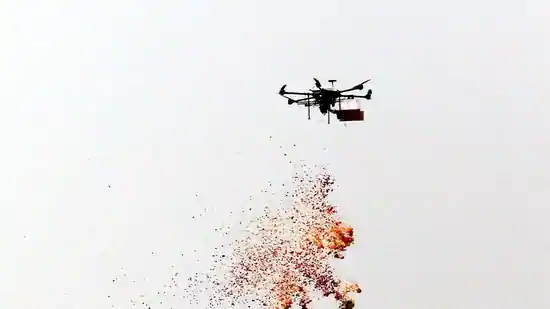
Bengaluru, Feb 3: The government is considering allowing air traffic controllers, operated by private entities, to manage drone operations in the Indian airspace below 1,000 feet, said a senior Civil Aviation Ministry official on Wednesday.
"The drone ATC (air traffic controller) will be called UTM (unmanned traffic management) and it will collaborate with the manned traffic management, which is being handled currently as a sovereign function by the Airports Authority of India (AAI)," said Amber Dubey, Joint Secretary, Ministry of Civil Aviation.
The AAI, which works under the ministry, manages all manned aircraft operations in the Indian airspace. A passenger aircraft generally flies at a height of around 30,000 feet.
"The airspace below 1,000 feet is lower airspace and it would be the main playground of drones. For that, we may have a system of private ATCs, which would be managed by private operators," Dubey said at a session organised by industry body FICCI at Aero India 2021.
"It could be a government agency or a private agency, it is something that would evolve," he added.
The AAI cannot handle drones because they would be flying at 5 feet to take care of crops to about 1,000 feet in the airspace, Dubey mentioned.
Drone technology is moving way faster than the regulations so we have decided that we need to start a parallel activity, he said.
Let the Truth be known. If you read VB and like VB, please be a VB Supporter and Help us deliver the Truth to one and all.
Maharashtra sets up state vaccination task force to strengthen immunisation programme

Mumbai (PTI): The Maharashtra government has set up a State Vaccination Task Force to strengthen the regular immunisation programme and review the progress of related campaigns, a health department official said on Monday.
The State Vaccination Task Force will comprise at least 29 members and will be headed by the administrative head of the health department, he informed.
The government has also constituted separate district-level and municipal vaccination task forces to improve implementation and address challenges at the grassroots level, he said.
Municipal task forces, chaired by respective civic commissioners, have been constituted in view of the vast urban population in Maharashtra and the role of civic bodies in implementing different health programmes.
The district-level task forces will function under the chairmanship of collectors.
"Complete immunisation of children at the appropriate age is an extremely simple, cost-effective and highly effective measure to reduce child mortality and the prevalence of diseases among kids. Immunisation is a powerful tool for reducing illness in children," maintained the official.
To ensure full vaccination of all children, the state government implements various campaigns from time to time as per the central government guidelines, he pointed out.
"Active participation and cooperation of other relevant government departments are essential (in making these campaigns successful)," according to the official.
The state-level body will review the regular immunisation programme, associated campaigns and vaccine-preventable diseases in detail. It will also conduct focused assessments of high-risk districts and municipal corporations, including vacancies at district, municipal and sub-district levels, availability of cold chain equipment, resource gaps and training requirements, he noted.
The state task force will review allocation and utilisation of funds for immunisation and ensure timely action by officers concerned based on reports from district and municipal task forces and state-level monitoring mechanisms, the official said.
It will also ensure active coordination and participation of other government departments in immunisation drives, while district and municipal task forces will carry out similar functions at their respective levels, the official added.