Govt must take resolute diplomatic actions to de-hyphenate India, Pakistan on global stage: Cong
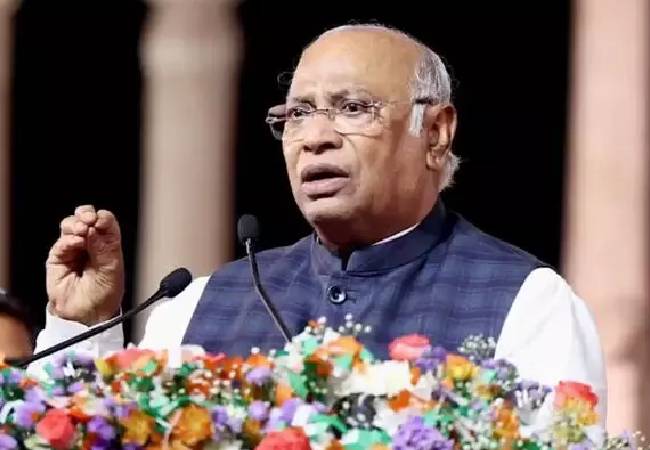
New Delhi (PTI): The Congress on Thursday said Pakistan being named vice chair of the 15-member UN Security Council's counterterrorism committee and chair of another panel of the world body was most unfortunate, ill-informed and unacceptable.
In a statement, Congress president Mallikarjun Kharge urged the government to take resolute diplomatic actions to de-hyphenate India and Pakistan on the global stage, and exhorted the international community to understand and support New Delhi's stand on terrorism emanating from Pakistan.
The party also described the development as the sad story of "our own foreign policy collapse" but questioned how the global community can continue to legitimise Pakistan's sponsorship of terrorism.
Kharge asserted that making Pakistan accountable for its sins is a necessity not just for India but for the interests of the international community.
"The Indian National Congress exhorts the international community to understand and support India's stand on terrorism emanating from Pakistan," he said.
Kharge's remarks came after the development that Pakistan will chair the Taliban Sanctions Committee of the UN Security Council for 2025 and will be vice-chair of the Counter-Terrorism Committee of the UN body.
"Pakistan is the perpetrator of terror. India is a victim of terror. They cannot be equated. They should not be hyphenated," Kharge said in a post on X.
The IMF, the ADB, and the World Bank sanctioning or deciding to sanction loans and bailout packages shall only increase Pakistan's military expenditure, which its rogue Army uses to unleash terror on Indians, he said.
"The naming of Pakistan as the vice-chair of the 15-member United Nations Security Council's Counter Terrorism Committee and chair the Taliban Sanctions Committee for 2025 is most unfortunate, ill-informed and unacceptable," Kharge said.
The international community must see merit in India's case that Pakistan should be included back in the FATF grey list for monitoring of its terror financing, he asserted.
Kharge pointed out that Pakistan was first included in the grey list after India's diplomatic efforts, under then prime minister Manmohan Singh in 2008 and again in 2012.
It has been in the Grey List three times, the last being in 2018, he noted.
"Making Pakistan accountable for its sins is a necessity not just for India, but for the interests of the international community. It is perhaps worth to remind that the most wanted terrorist - Osama Bin Laden, responsible for 9/11, was found and eliminated in Pakistan. Khalid Sheikh Mohammed (KSM), the chief planner of 9/11, was also a Pakistani," Kharge said.
"As a responsible Opposition party, we would urge our government to take appropriate and resolute diplomatic actions to de-hyphenate India and Pakistan on the global stage," he said.
Congress' media and publicity department head Pawan Khera said the IMF gave USD 1 billion to Pakistan on May 9 during Operation Sindoor.
"World Bank decides to give USD 40 billion to Pakistan soon after Operation Sindoor. ADB gave USD 800 million to Pakistan on June 3, soon after Operation Sindoor," he said on X.
And on June 4, Pakistan gets elected as chairman of the UNSC Taliban Sanctions Committee and vice chairman of the UNSC Counter Terrorism Committee, he pointed out.
"Of course, this is the sad story of our own foreign policy collapse, but how can the global community allow this continuous legitimisation of sponsorship of terrorism by Pakistan?" Khera said.
Pakistan will chair the 1988 Taliban Sanctions Committee that imposes an assets freeze, a travel ban and an arms embargo on individuals, groups, undertakings and entities associated with the Taliban in constituting a threat to the peace, stability and security of Afghanistan. Guyana and Russia will be vice-chairs of the Taliban sanctions committee.
Pakistan will also be co-chair of the Informal Working Groups on Documentation and Other Procedural Questions and on the General UNSC Sanctions Issues.
Pakistan is a non-permanent member of the 15-nation Security Council for the 2025-26 term.
The sanctions committees of the Council comprise all 15 members of the Security Council and make their decisions by consensus.
India was chair of the UNSC Counter-terrorism Committee for 2022 during its 2021-22 tenure in the council as a non-permanent member.
India has consistently reminded the international community that Pakistan is host to the world's largest number of UN-proscribed terrorists and entities.
Al Qaeda leader Osama bin Laden was hiding in Pakistan's Abbottabad for years and was killed in an operation by the US Navy Seals in May 2011.
China, France, Russia, the UK and the US are the five permanent members of the UN Security Council, while Algeria, Denmark, Greece, Guyana, Pakistan, Panama, South Korea, Sierra Leone, Slovenia, and Somalia are currently in the council as non-permanent members.
Let the Truth be known. If you read VB and like VB, please be a VB Supporter and Help us deliver the Truth to one and all.
Mangaluru: Man sentenced to 20 years rigorous imprisonment in POCSO case

Mangaluru: A court in Mangaluru has sentenced a 44-year-old man to 20 years of rigorous imprisonment in connection with a case under the Protection of Children from Sexual Offences (POCSO) Act.
According to Deccan Herald, the Additional District and Sessions Judge, FTSC-II (POCSO), Maanu K S, delivered the judgment.
The convict has been identified as Dayanand Moolya (44).
According to Special Public Prosecutor Sahana Devi Boloor, the incident occurred on November 16, 2025, when a seven-year-old girl was studying alone at home and the accused illegally entered the house and raped her. He threatened to kill her and throw her into a well if she revealed it to anyone.
The survivor later informed her mother, following which a complaint was registered at Mulki Police Station on November 22. Police Inspector Manjunath B S investigated the case and submitted the charge sheet to the court.
For the rape, under POCSO Section 6, along with Bharatiya Nyaya Sanhita (BNS) Act 65(2) and POCSO 4(2), the man has been sentenced to 20 years of rigorous imprisonment and a fine of Rs 30,000. For illegal entry into the house, under BNS Section 332(B), the convict has been sentenced to three years of simple imprisonment and a fine of Rs 5,000. For issuing death threats, under BNS Section 351(3), he has been sentenced to two years of simple imprisonment and a fine of Rs 5,000.
The court also directed payment of Rs 4 lakh as compensation to the survivor, including Rs 40,000 from the fine amount, and instructed the District Legal Services Authority to provide the remaining Rs 3.60 lakh.